Jean Cocteau — natal chart
What does Jean Cocteau’s natal chart reveal?
Jean Cocteau, born on 5 July 1889 in Maisons-Laffitte, was a French poet, playwright, novelist and filmmaker, central to the artistic avant-garde of the twentieth century. He published the novel Les Enfants terribles in 1929 and wrote the play La Voix humaine in 1930. As a director he made the celebrated films Le Sang d'un poète (1930), La Belle et la Bête (1946) and Orphée (1950). He collaborated with figures such as Picasso, Stravinsky and Diaghilev, and designed murals, including the chapel at Villefranche-sur-Mer. Elected to the Académie française in 1955, he ranged across nearly every art form. He died on 11 October 1963 at Milly-la-Forêt, where he is buried.
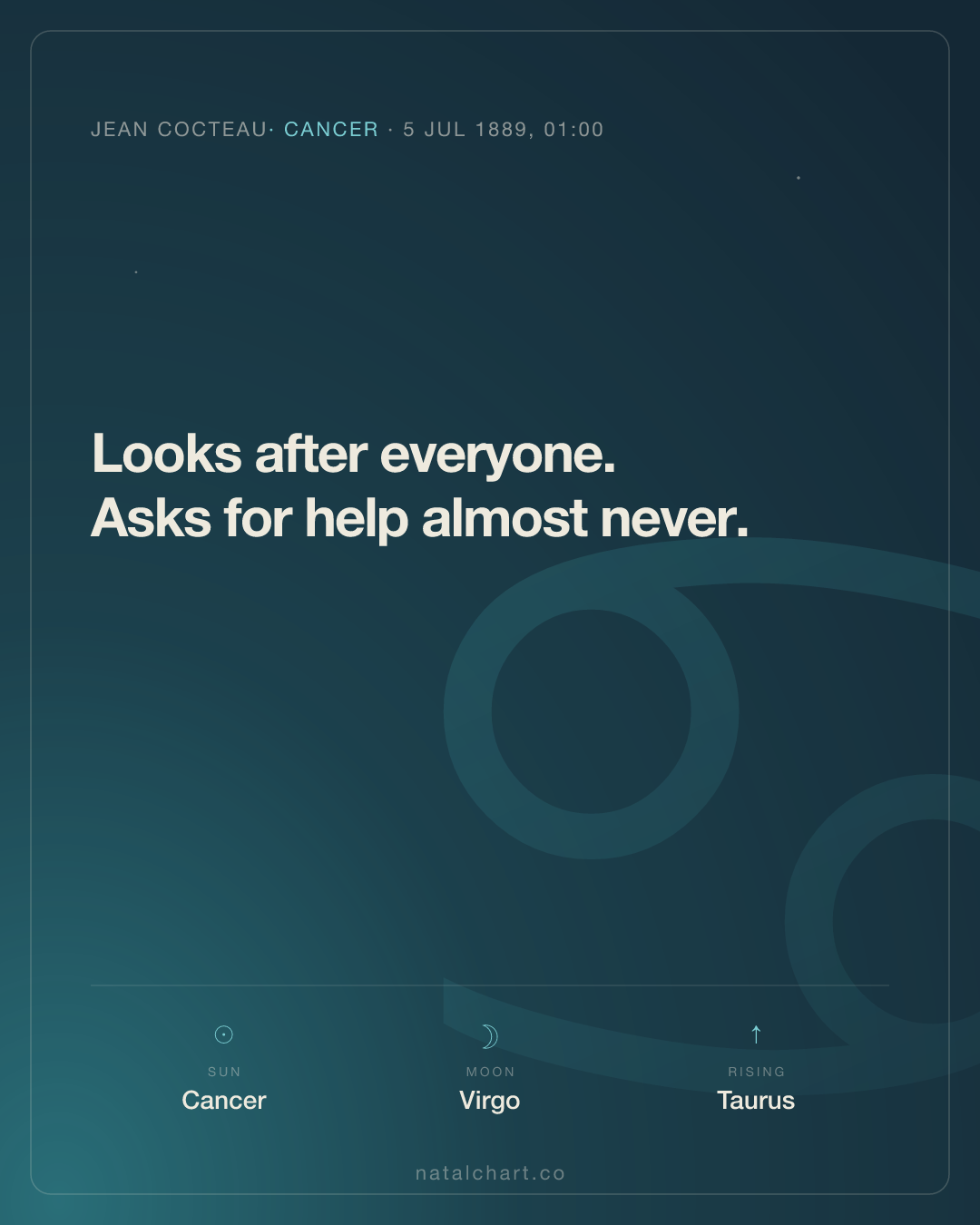 Share
Share
Birth
1889-07-05 · 01:00 · Maisons-Laffitte, France Reliability: A · reliable data
The man who moved through walls
Jean Cocteau once said that a poet must know how to die several times. His chart takes that instinct seriously. Born in the small hours of a July night in 1889, with Taurus rising, his Cancer Sun and Mars placed in the third house — the zone of language, communication, and the movement between ideas — describe a man for whom thinking and feeling were the same motion, and for whom words, images, and forms were not separate disciplines but a single continuous act of making.
The Taurus Ascendant (the face he met the world with) gave Cocteau something his public persona might not suggest: a fundamental sensory groundedness, an eye for materials, textures, and surfaces. Taurus rising is attracted to beauty not as an abstraction but as something you can touch. His mural work at the Villefranche-sur-Mer chapel, his designs for stained glass, his handmade visual poetry — these are the physical residue of a Taurus Ascendant who needed to get his hands into things. Even his films have a sculptural quality: objects matter in Cocteau's world, mirrors behave strangely, hands pass through stone.
What drove the work: Cancer and the third house
Sun and Mars together in Cancer, in the third house, is a combination that makes the act of writing, speaking, and imagining feel like survival. Cancer needs to contain, to protect, to create something that holds the warmth of the familiar against a threatening outside. Mars adds urgency — this is not gentle musing but driven, sometimes compulsive creation. The third house is the house of the immediate environment, of siblings and neighbours and the daily exchange of ideas; Cancer's protective instinct expressed through the third house produces an art that is deeply personal and simultaneously addressed to the close circle, the intimate public.
Les Enfants terribles (1929) is perhaps the most direct expression of this: a novel about the world created between a brother and sister, a universe unto itself, sealed against the adult world outside. The film La Belle et la Bête (1946) works from the same instinct — the enchanted house as a protected interior space, beautiful and dangerous, charged with the feeling of childhood fairy tales recalled by an adult who has not forgotten what it felt like to believe in them.
Mercury and the gift of too many forms
Mercury in Gemini, in the second house — the zone of resources, of what one owns and what one values — at tension with the Virgo Moon: Cocteau's mind moved quickly across surfaces, making connections that others hadn't noticed, picking up languages and idioms and borrowing them. Gemini Mercury is genuinely polyglot, not just across languages but across art forms. He wrote poetry, plays, novels, criticism, and screenplays; he designed costumes, drew, painted, made ceramics. This was not dilettantism. It was the natural expression of a mind that thought in translation — from image to word to sound to texture — and could not be satisfied by a single channel.
The Moon in Virgo in the fifth house (the zone of creative expression, of play, and of the work one makes for its own pleasure) gave this rangy Mercurial mind a quality of craft and discernment. Virgo Moon notices what is slightly wrong, what can be more precise, what is still a little loose. In the fifth house, this quality becomes an aesthetic standard: not perfectionism as anxiety, but the craftsman's eye that knows when the thing is finished and when it only looks finished.
The beautiful Venus and what it built
Venus in Taurus, in the first house, closely aligned with the Moon in Virgo in an easy flow between them: Cocteau had an instinctive, cultivated sense of what was beautiful, and it permeated everything he touched. Venus in Taurus is not adventurous in its aesthetic — it tends toward the classical, the harmonious, the formally resolved. But it is deeply committed. His collaborations with Picasso, Stravinsky, and Diaghilev were not opportunistic name-collecting; they were sustained, emotionally invested partnerships born of genuine aesthetic recognition.
Chiron (the point associated with a wound that becomes a teaching) sits in Taurus in the first house, very close to both Venus and the Ascendant. This says something about how Cocteau's sense of beauty and his sense of self were entangled with something that had been hurt. His early career was built on a kind of social brilliance — he was a celebrated Paris figure before he had done his most serious work — and he was at various points accused of superficiality, of living off charm rather than substance. That Chiron, that wound about surface and depth, about whether the beautiful thing is also the real thing, runs through everything he made.
The Capricorn Midheaven and the long game
The Midheaven — the career and public legacy point — falls in Capricorn. Capricorn is the sign of the long view, of structures that outlast their makers, of authority that accumulates over time. It is also the sign of Jupiter in Cocteau's chart: his Jupiter sits in Capricorn in the ninth house (the zone of broad ideas, of philosophy, of what one believes about the world and how those beliefs shape one's work).
Election to the Académie française in 1955 — the most institutional recognition French culture offers — is the Capricorn Midheaven arriving on schedule. Cocteau had spent his career being celebrated but not quite legitimised, admired but sometimes dismissed as a decorator of surfaces. The Académie said: no, this holds. The chair at the Académie was held by someone who had made films that are still shown, plays that are still performed, novels that are still read. Capricorn Midheaven takes time to confirm, but when it does, it tends to confirm completely.
Neptune, Pluto, and the generation he inhabited
Neptune and Pluto are joined in Gemini in the second house — a generational aspect that describes the era's collective imagination — but in Cocteau's second house, the house of what one possesses and what one values, this conjunction says something more specific. His wealth was not financial; it was the accumulated richness of a mind that had absorbed an extraordinary range of cultural material and could reorganise it into new forms. He possessed language, and myth, and image, and the company of the most remarkable artists of his time.
Neptune closely aligned with the Moon in an easy flow adds a dimension of permeability: the capacity to receive impressions, to let the dreamed thing come through without forcing it into shape prematurely. His films — particularly Orphée (1950), with its mirrors that are doorways and its radio transmissions from the underworld — have the logic of actual dreams, not the approximated logic of films that are trying to look dreamlike.
Saturn, structure, and what discipline gave him
Saturn in Leo in the fourth house — the zone of foundations, of home, of what one builds in private — in easy connection with Uranus in Libra in the sixth house of daily work: Cocteau's creative discipline was real, even if his public persona suggested effortlessness. Uranus in the sixth house introduces unpredictability into the working day, the tendency for the most interesting ideas to arrive sideways, unsummoned. Saturn in Leo in the fourth house gave that unpredictability something to work against — a structure, however idiosyncratic, within which the surprising thing could land and be used.
The North Node in Cancer (the direction a life tends to grow toward) aligns with his Sun and Mars in Cancer in the third house. The growth edge, for Cocteau, was not outward conquest but depth — going further into the interior rooms of the imagination, making the personal genuinely strange, converting the intimate into the universal. His most lasting work has this quality: Les Enfants terribles, Orphée, La Voix humaine. Not the works of a man performing cosmopolitan brilliance, but of one who went very deep into a particular feeling and found that others recognised it.
What remains
Jean Cocteau died in October 1963, hours after hearing of the death of Édith Piaf, in the house at Milly-la-Forêt where he is buried. He decorated the small chapel of Saint-Blaise-des-Simples there himself, with herbs of the field painted in dark ink on white walls — as physical, as sensory, as direct as a Taurus Ascendant right to the end.
His chart does not describe a man who made a single great work and stopped. It describes a man whose nature required constant making — Gemini Mercury, Cancer Mars, Moon in the fifth house — and who found in that constancy a form of loyalty to the world he had been given. The Capricorn Midheaven confirms what time has since proved: the work has lasted.
The chart
How to read it →Frequently asked questions
What is Jean Cocteau's zodiac sign?
Jean Cocteau's Sun sign is Cancer — the Sun was in Cancer at birth (1889).
What is Jean Cocteau's moon sign?
Jean Cocteau has the Moon in Virgo. The Moon sign describes the emotional and instinctive layer of the chart.
What is Jean Cocteau's rising sign?
Jean Cocteau's rising sign (ascendant) is Taurus — the sign on the eastern horizon at the moment of birth.
When and where was Jean Cocteau born?
Jean Cocteau was born in 1889 in Maisons-Laffitte, France.