Jean-Paul Sartre — natal chart
What does Jean-Paul Sartre’s natal chart reveal?
Jean-Paul Sartre (1905-1980) was a French philosopher, playwright and novelist born in Paris, a leading figure of existentialism. His works include 'Being and Nothingness' (1943) and the play 'No Exit'. Awarded the 1964 Nobel Prize in Literature, which he declined, he shaped 20th-century thought.
 Share
Share
Birth
1905-06-21 · 18:45 · Paris, France Reliability: AA · vetted record
A Gemini who refused every cage
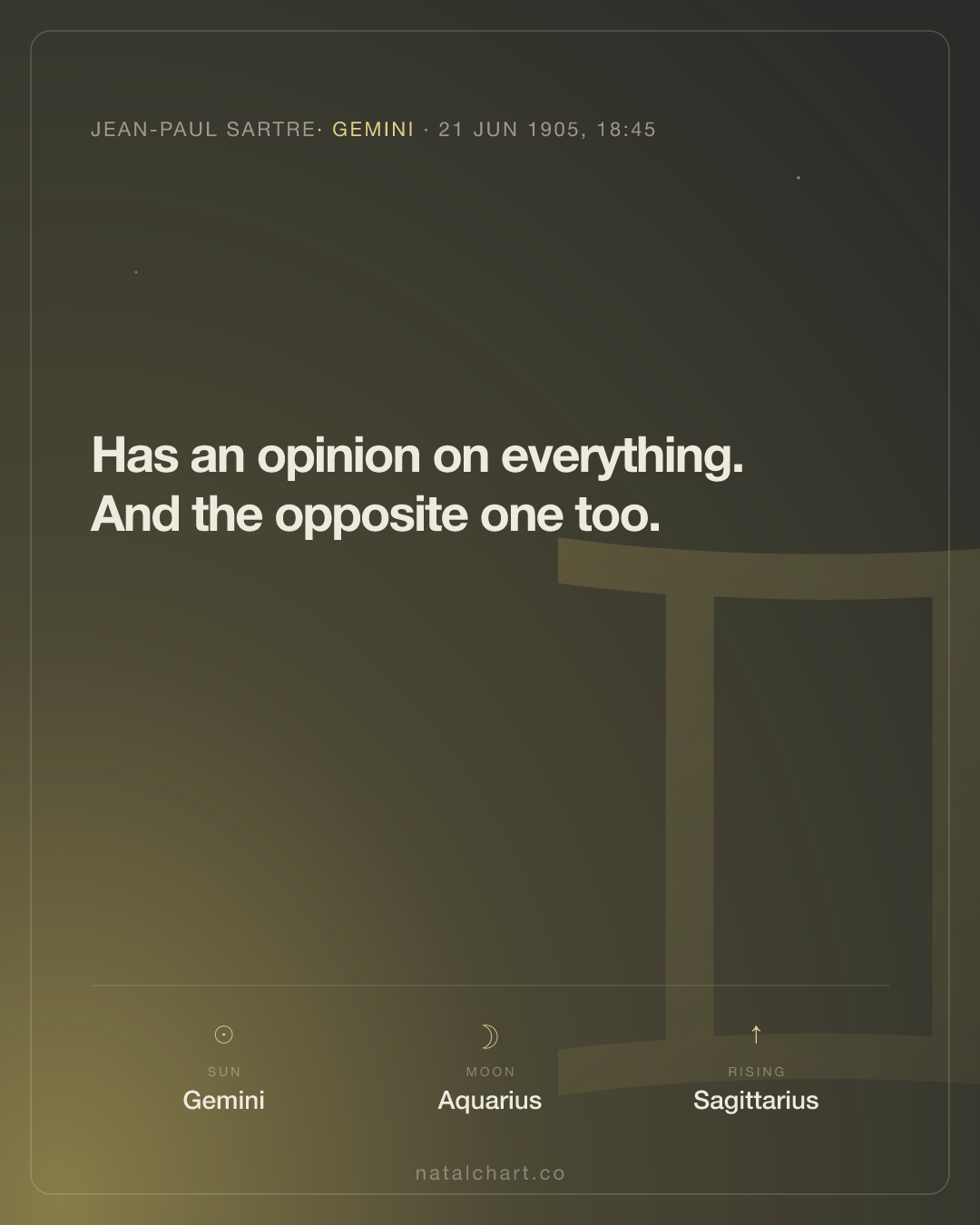
Jean-Paul Sartre was born on 21 June 1905 in Paris at 6:45 pm — right at the cusp of summer, in the last hours of the longest day. The Sun in Gemini sits in the seventh house (the zone of encounters, of the other, of the public relationship), and that placement captures the paradox at the heart of his life: a relentlessly interior thinker who was, above all, a social animal. Sartre needed the friction of the other person to generate thought. His philosophy of existence — the argument in Being and Nothingness that we are fundamentally free, yet constituted through the gaze of others — was not an abstract idea but a description of how he actually lived.
The Ascendant (the face one meets the world with) is Sagittarius, the sign of the archer, of broad horizons, of the refusal to be fenced in. Where Gemini multiplies, Sagittarius reaches. Together they explain the man who wrote existentialist treatises, novels, plays, political manifestos, literary criticism, screenplays, and a biography of Flaubert that ran to four volumes — and still felt he had not said enough. The Sagittarius Ascendant also explains why, when the Nobel Committee awarded him the 1964 Nobel Prize in Literature, he turned it down. No institution, however prestigious, would define him. You cannot put a Sagittarius Ascendant in a frame and hang it on a wall.
The Moon in Aquarius: a thinker who felt through ideas
The Moon describes the emotional interior, the instinctive needs that run beneath rational awareness. Sartre's Moon is in Aquarius, in the third house — the zone of language, of communication, of the immediate neighbourhood of the mind. A Moon in Aquarius does not feel feelings in the ordinary sense; it processes them through concepts, through abstraction, through the need to understand rather than simply experience. This was Sartre to the bone. He was famously resistant to sentimentality, famously uncomfortable with what he called 'bad faith' — the pretence that one is not fully free and responsible.
Yet the Moon in Aquarius also has a fierce attachment to humanity in the collective, if not always in the individual. Sartre's political commitments — to anti-colonialism, to the Algerian independence movement, to his long and complicated relationship with Marxism — were emotionally driven even when they were philosophically argued. The Moon in the third house placed all this feeling in the domain of words: he needed to write to feel, and to feel in order to write.
The Moon forms an easy flow with Mercury (0.7° — exceptionally tight), and also flows easily with the Sun (4.0°). These connections mean that emotion, thought, and identity in Sartre were not three separate systems; they were one. When he thought clearly, he also felt rightly. When the thought was confused, he was also emotionally off-balance.
Mercury in Gemini joined with the Sun: the mind that is the self
Mercury and the Sun stand only 3.3° apart in Gemini, in the seventh house. For most people, the mind serves the self. In Sartre's chart — and in his life — the mind was the self. He could not disentangle intellectual activity from personal identity. This is why the defeat of an argument felt to him like a personal loss, and why he could sustain intellectual friendships (with Simone de Beauvoir, with Merleau-Ponty, later painfully with Camus) only as long as philosophical agreement remained.
The seventh-house placement means these mental processes were activated above all in dialogue. Being and Nothingness was not written in a monastery; it was written in the Café de Flore and the Café des Deux Magots during the Nazi Occupation of Paris, surrounded by people, noise, and the pressing question of what it meant to be free under constraint. The dialogues of No Exit — three people locked in a room who are simultaneously each other's tormentors and mirrors — are a perfect seventh-house image.
Venus in Taurus and Mars in Scorpio: the weight of desire
Venus in Taurus, in the sixth house (the zone of daily life, practice, and the body), describes a person who took pleasure seriously — seriously enough to theorise it. Sartre's relationship with Simone de Beauvoir lasted fifty years, but was organised as a 'necessary love' alongside what they called 'contingent loves.' Venus in Taurus does not easily relinquish what it values; it also prefers to name and structure desire rather than let it remain formless.
Mars, the planet of drive and directed action, sits in Scorpio in the twelfth house — the most hidden zone of the chart, the place of things that are not fully seen or acknowledged. Mars in Scorpio in the twelfth is a formidable placement for a writer: the energy is intense, deep, sometimes obsessive, and largely invisible to the outside world. Sartre's writing discipline was prodigious and relentless — reportedly two thousand words a day, every day — and it was driven by something that had nothing cheerful or exhibitionistic about it. It came from the interior, from the twelfth house, where Mars in Scorpio burned quietly and continuously.
Mars in Scorpio forms an easy flow with Neptune (0.9°): the directed energy of Mars finds its natural channel in the vast, nebulous, idealistic world of Neptune. This explains the ambivalence in Sartre's political writing — his attraction to communist ideals (Neptune) and his continued insistence on individual freedom (Mars in Scorpio). He tried his whole life to reconcile the two, and he never fully succeeded, which is perhaps why the political writing is less durable than the philosophy.
Jupiter and Saturn: the architecture of conviction
Jupiter in Taurus in the sixth house stands close to Venus, amplifying the already serious Taurean commitment to what is real, material, and tangible. Sartre distrusted mysticism. He wanted ideas you could test against lived experience. His philosophy was, at its core, a defence of this world — not a transcendent one — as the only arena in which human freedom operates.
Saturn in Pisces in the fourth house (the home, the psychological foundations) in a delicate easy contact with Uranus (0.5° — the tightest aspect in the chart) produces something striking: a tension, carefully managed, between structure (Saturn) and rupture (Uranus). Saturn in Pisces gives a somewhat fluid, even uncertain sense of personal foundation — and indeed, Sartre's father died before he was two years old, leaving a wound in the bedrock of self that he explored with extraordinary candour in his autobiography Words (1964). Yet the stabilizing contact with Uranus means this instability was channelled into relentless innovation. He could not rely on inherited frameworks, so he built new ones.
The Midheaven in Libra: a vocation for justice
The Midheaven (the public/career point, the highest point of the chart) is in Libra — the sign of justice, balance, and the weighing of competing claims. This is the vocation written into Sartre's chart in plain letters. His public life was one long effort to weigh and judge: colonial violence against European self-interest, individual freedom against collective responsibility, art against politics, the writer's voice against the intellectual's duty to take sides.
Libra as the Midheaven does not always find comfortable answers. It finds the question clearly and sits with the tension. Sartre's great late work, the Critique of Dialectical Reason (1960), is an attempt to understand how individual freedom and historical necessity can coexist — a quintessentially Libra problem, held for decades without resolution. The Libra Midheaven also speaks to his reputation: he was, above all, the public intellectual par excellence, the thinker whose ideas mattered to people who had never read a philosophy book in their lives.
Chiron in Aquarius and the North Node in Virgo
Chiron (an old wound that becomes a gift) sits in Aquarius in the third house — the same house as the Moon. The wound is in the domain of communication, of how one's ideas land in the collective. Sartre was famously blind, almost entirely so, by the end of his life — unable to read or write, dependent on dictation. The man whose entire being was organised around language found his primary tool taken from him. But the gift in this wound had already been given: the decades of writing, thinking, and speaking had permanently altered the intellectual landscape of the twentieth century.
The North Node in Virgo (the sign of discernment, of careful analysis, of separating the essential from the incidental) points toward a direction of growth away from the dreamy, boundaryless tendencies of Pisces (where Saturn and the South Node axis pull) toward precision, service, and concrete usefulness. Sartre's turn from pure phenomenology toward political engagement in the 1940s and 50s, and his late obsession with the specific and material in the Critique, are both movements in this direction — toward Virgo, toward the particular and the practical.
A mind that never rested
Sartre died in April 1980 at the age of seventy-four. Fifty thousand people followed his coffin through the streets of Paris — not organised, not summoned, simply there. It was a spontaneous tribute to someone who had spent his whole life insisting that spontaneity was the only honest response to existence.
His chart is not that of a comfortable man. Sun square with Uranus (2.7°), the Moon in tension with Jupiter (1.4°), Mercury locked in opposition with Uranus — these are not configurations built for ease. They are built for perpetual motion, perpetual questioning, the refusal of premature closure. He would have found the idea of a definitive reading of his chart absurd. He believed we are always more than what we have been, always in the process of becoming something other than what we appear to be. The chart, read honestly, agrees.
The chart
How to read it →Frequently asked questions
What is Jean-Paul Sartre's zodiac sign?
Jean-Paul Sartre's Sun sign is Gemini — the Sun was in Gemini at birth (1905).
What is Jean-Paul Sartre's moon sign?
Jean-Paul Sartre has the Moon in Aquarius. The Moon sign describes the emotional and instinctive layer of the chart.
What is Jean-Paul Sartre's rising sign?
Jean-Paul Sartre's rising sign (ascendant) is Sagittarius — the sign on the eastern horizon at the moment of birth.
When and where was Jean-Paul Sartre born?
Jean-Paul Sartre was born in 1905 in Paris, France.