Marie Curie — natal chart
What does Marie Curie’s natal chart reveal?
Marie Curie, born Maria Skłodowska on 7 November 1867 in Warsaw, was a Polish-French physicist and chemist who pioneered research on radioactivity, a term she coined. Working in Paris with her husband Pierre Curie, she discovered the elements polonium and radium in 1898. She won the Nobel Prize in Physics in 1903, shared with Pierre and Henri Becquerel, and the Nobel Prize in Chemistry in 1911, becoming the first person to win Nobel Prizes in two scientific fields. The first woman to teach at the Sorbonne, she founded the Radium Institute and developed mobile radiography units during the First World War. She died on 4 July 1934 from prolonged radiation exposure, and in 1995 was interred in the Panthéon.
 Share
Share
Birth
1867-11-07 · 12:00 · Warsaw, Poland Reliability: DD · conflicting Birth time of noon is approximate and not reliably documented; sources disagree (one cites 'soon after sunrise').
A mind that looked straight through things
Marie Curie's chart is built around a single, commanding pattern: four planets — Sun, Venus, Mars, and Saturn — gathered in Scorpio in the eleventh house, the zone of collective endeavour, of working toward something larger than oneself. Scorpio is the sign that investigates what others accept at face value, that refuses surface explanations and presses until it reaches the hidden structure underneath. Applied to science, this is not a personality quirk. It is a method. The discovery of radioactivity, polonium, and radium — phenomena invisible to the naked eye, embedded in matter itself — required exactly this quality: the refusal to stop looking until the concealed thing was named.
Her Ascendant in Capricorn (the face she met the world with) added a layer of reserve and methodical discipline to this Scorpionic drive. The woman colleagues described — serious, economical with words, tireless in the laboratory — is recognisably Capricorn rising: someone who earns trust through work rather than charm, whose authority accumulates over years of demonstrated competence. The first woman to teach at the Sorbonne did not arrive there through brilliance alone. She arrived through the kind of sustained, unhurried determination that Capricorn rising builds.
The interior life: feeling as instrument
Her Moon in Pisces, in the third house — the zone of thought, communication, and daily intellectual exchange — describes an emotional intelligence that operated through intuition and pattern-recognition as much as through logic. Moon in Pisces does not separate feeling from thinking: it uses the quality of a feeling (the sense that something is significant, that a result is worth pursuing, that an anomaly matters) as data. This is not unscientific. It is the mode of a scientist who knows when to trust her instincts about where the interesting thing is hiding.
The Moon forms an easy connection to Pluto and a supportive link to the Sun, weaving her emotional life into her intellectual and public one rather than keeping them separate. There was no division, in Marie Curie, between the woman who grieved deeply after Pierre's death in 1906 and the scientist who continued working with radioactive materials until her own death in 1934. Both were expressions of the same Moon: a feeling nature that goes all the way in.
The Midheaven and what she was known for
Her Midheaven — the career and public legacy point — falls in Scorpio, the same sign as her Sun, Venus, Mars, and Saturn. This is unusual and telling: her public identity and her deepest private nature were the same thing. She did not perform a professional persona that diverged from who she was. The work was the woman. Radioactivity research — the investigation of invisible, transformative forces at the heart of matter — is as Scorpio a vocation as can be imagined.
The North Node in Virgo (associated with the direction a life tends to grow toward) reinforces this: precision, service, methodical accumulation of evidence, the willingness to return again and again to the same experiment. The Radium Institute she founded was built on exactly this principle — rigorous, replicable, unglamorous work, done over and over, because that is how knowledge actually advances.
Love, partnership, and the price of commitment
Venus and Saturn are joined at almost exactly the same degree in Scorpio — within a third of a degree, the tightest personal aspect in her chart. Venus describes how one loves and what one values; Saturn brings discipline, seriousness, and cost. Together in Scorpio in the eleventh house, this describes a love that is inseparable from shared purpose, from working toward the same goal as one's partner, from a bond that is tested and deepened by shared difficulty.
The scientific partnership with Pierre Curie, whom she married in 1895, is the most vivid expression of this configuration. They worked in the same laboratory, published together, shared the 1903 Nobel Prize. When Pierre was killed in a street accident in 1906, she continued his professorship at the Sorbonne — a decision that was simultaneously an act of mourning, loyalty, and stubborn continuation. Venus-Saturn in Scorpio does not let go easily, even of what has been lost.
The mind: hidden work, broad reach
Mercury in Sagittarius, in the twelfth house — the zone of withdrawal, of work done out of public view — describes a thinker whose best thinking happens in private, in the quiet of the laboratory, away from the performance of intellect. Sagittarius gives Mercury a pull toward the large question, the theoretical frame, the meaning that lies beneath the data. This is not inconsistent with experimental precision: it is what makes the experimentalist keep going past the point where others would be satisfied, because the underlying question has not yet been answered.
That Mercury is in the twelfth house explains something about her reticence in public settings. She was not a performer of science. She was a practitioner of it. The Nobel lectures she gave — in 1903 and 1911, in two different fields — were notable for their precision and their restraint, not for oratory. The thinking was done elsewhere, in conditions she controlled.
Ambition and its cost: the cardinal cross of the chart
Mars in Scorpio pulls against Jupiter in Aquarius across the chart — a tension between the focused, personal ambition of Mars in Scorpio and the more universalist, collective aspiration of Jupiter in Aquarius. In a more comfortable configuration these two might simply alternate. In Marie Curie's life they produced a genuine friction: the woman who fiercely protected her laboratory and her data, who kept her most sensitive research results from publication until she was ready, and the woman who founded an institution, trained other scientists, drove mobile radiography units to the front lines of the First World War because the need was immediate and she had the means to meet it.
Sun in Scorpio in tension with Pluto in Taurus — a polarity across the chart — describes a life organised around transformation: the transformation of matter (literally, in her research), the transformation of what was known (radioactivity rewrote the physics of the atom), and a personal identity that was shaped by what it cost to do that work. She did not arrive at her two Nobel Prizes without sustained opposition, dismissal, and eventual illness from the materials she refused to protect herself against.
Chiron and the wound that became the work
Chiron (the point associated with an old wound that slowly becomes a gift one can offer others) sits in Aries, in the fourth house — the zone of foundations, family, and what one carries from one's origins. Born in Warsaw in 1867, at a time when Poland was under Russian partition and higher education for women was either forbidden or severely restricted, Marie Curie's early formation was shaped by the knowledge that the things she most needed — formal schooling, scientific access, institutional recognition — were not meant for her. That wound (Aries: the right to begin, to be recognised as someone who can act) fed directly into the life she built.
She attended the Flying University in Warsaw — an illegal clandestine network of educators — before eventually reaching Paris. Chiron in the fourth house suggests that what was withheld at the root became the very thing she spent her life proving could not be permanently denied. The first woman to hold a Sorbonne professorship. The first person to win Nobel Prizes in two scientific fields. These are not incidental biographical details: they are Chiron resolving.
Uranus, Neptune, and the era they carried
Uranus in Cancer in the seventh house, almost exactly at right angles to Neptune in Aries in the fourth house — this is a generational aspect, but its house placement tells something specific about her life. Uranus in the seventh house (the zone of partnership, of the other) brought an unusual partnership: with Pierre, but also with science itself as a collaborator, as something that surprised and exceeded expectation. The discoveries she and Pierre made were, in the strictest sense, unexpected — polonium and radium were not predicted. They were found by someone who was paying attention to anomalies.
The connection between Sun and Uranus (an easy flow between them) suggests she was not threatened by the unexpected result. She moved toward it. That quality — the willingness to follow data into territory that upended current understanding — is, arguably, the defining quality of her scientific method.
What endures
Marie Curie's chart is not a comfortable one. It is a chart of sustained effort against resistance, of a nature so concentrated on its object that ordinary personal protections (including, literally, protection from radiation) were secondary to the work. The conjunction of Venus and Saturn in Scorpio says: this is what devotion costs, and the cost is accepted. The twelfth-house Mercury says: the most important thinking happens in private, away from an audience. The Capricorn Ascendant says: the authority is earned slowly, and it holds.
What the chart does not say — what her life refuses to confirm — is that this kind of intensity is tragic. Her death in 1934 from aplastic anaemia caused by decades of radiation exposure is objectively a consequence of insufficient safety precautions. But the Scorpionic pattern of her chart, the Venus-Saturn that accepts the price of commitment, suggests she knew, somewhere, what the work required. In 1995, her remains were transferred to the Panthéon — the only woman to be interred there for her own achievements. The chart, read as a whole, does not produce surprise at that ending.
The chart
How to read it →Frequently asked questions
What is Marie Curie's zodiac sign?
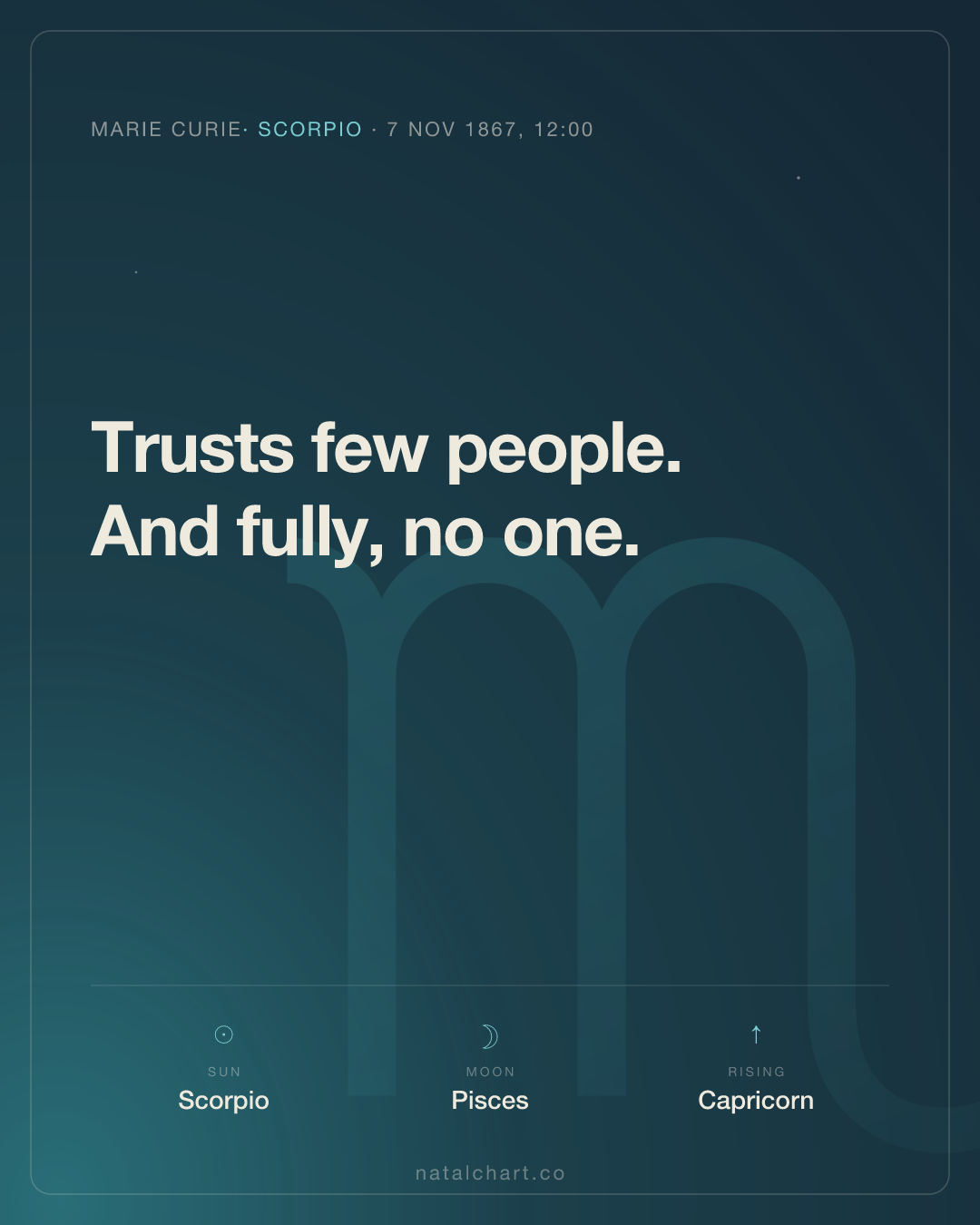
Marie Curie's Sun sign is Scorpio — the Sun was in Scorpio at birth (1867).
What is Marie Curie's moon sign?
Marie Curie has the Moon in Pisces. The Moon sign describes the emotional and instinctive layer of the chart.
What is Marie Curie's rising sign?
Marie Curie's rising sign (ascendant) is Capricorn — the sign on the eastern horizon at the moment of birth.
When and where was Marie Curie born?
Marie Curie was born in 1867 in Warsaw, Poland.