Paolo Sorrentino — natal chart
What does Paolo Sorrentino’s natal chart reveal?
Paolo Sorrentino, born in Naples on 31 May 1970, is an Italian film director and screenwriter. He made his name with "One Man Up" (2001) and "The Consequences of Love" (2004), developing a baroque, ironic visual style. With "Il Divo" (2008), a portrait of Giulio Andreotti, he won the Jury Prize at Cannes. In 2014 "The Great Beauty" earned him the Academy Award for Best Foreign Language Film. He has directed "Youth" (2015), the series "The Young Pope" (2016) and the autobiographical film "The Hand of God" (2021). He lives and works between Rome and Naples.
 Share
Share
Birth
1970-05-31 · Naples, Campania, Italy Reliability: X · no time No verified birth time: ascendant and houses are omitted.
The core: beauty as a way of thinking
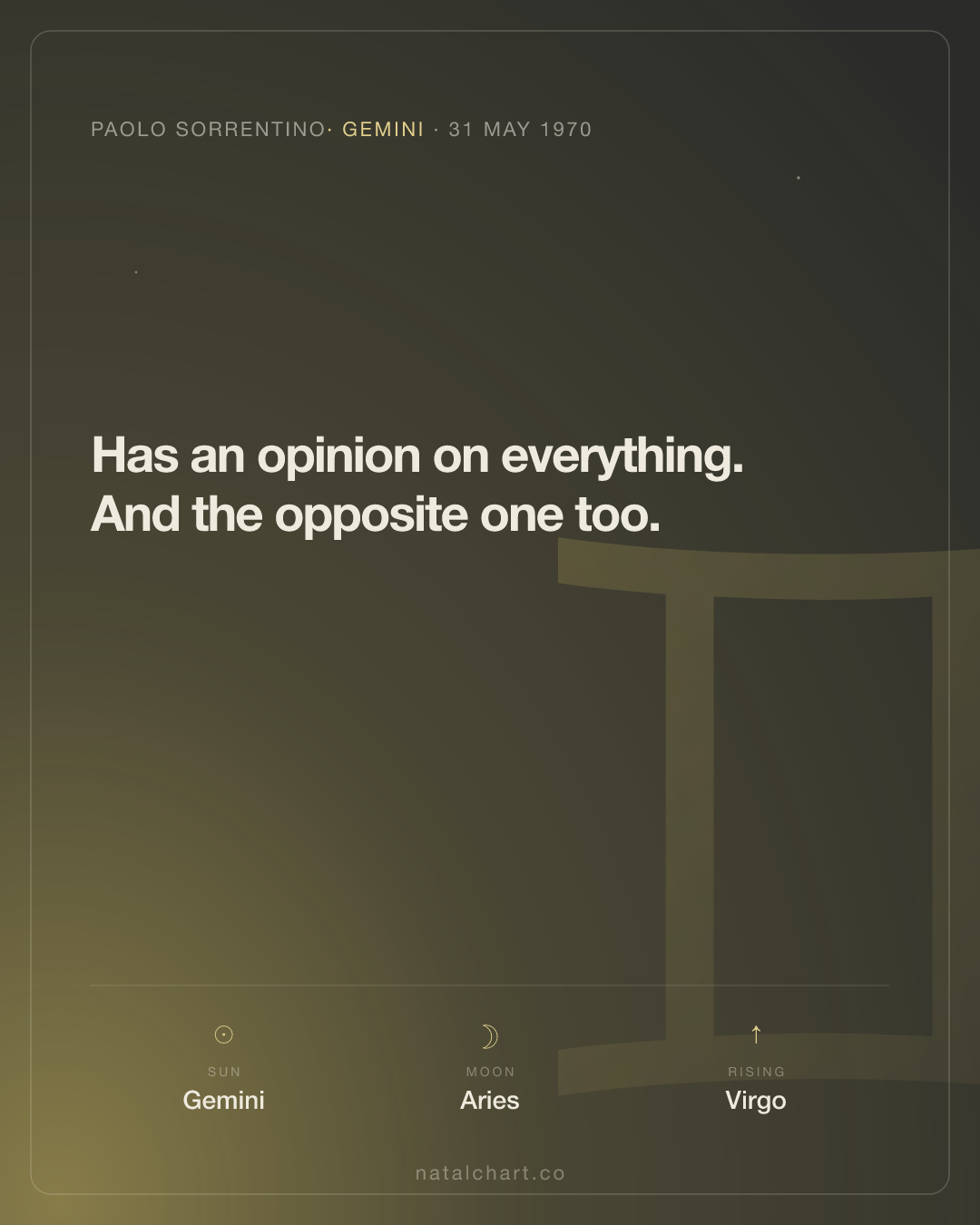
Paolo Sorrentino thinks in images before he thinks in words. The Sun in Gemini gives him a restless, plural intelligence — one that circles a subject from multiple angles, that holds contradictions without needing to resolve them, that finds the joke and the grief in the same frame. But the Sun is not working alone here: Mars is also in Gemini, quickening the creative energy and giving his instincts a competitive, improvisational edge. The Gemini quality in Sorrentino's work is unmistakable — the wit, the digression, the refusal of the single correct interpretation, the pleasure in surfaces alongside an obsessive curiosity about what lies beneath them.
The Moon in Aries sharpens all of this into something more urgent. Emotionally, Sorrentino moves fast — reactions are immediate, enthusiasms are fierce, and the impulse to create does not wait for the conditions to be perfect. The Moon in opposition to Jupiter (in Libra) creates a productive tension between this impulsive emotional core and a genuine appetite for grandeur, for scale, for the beautiful and the excessive. His films are not modest. "The Great Beauty" is three hours long and contains everything — aging, longing, the ruins of a civilization, a woman who has been fasting for decades, a giraffe. The tension between the raw Aries impulse and the Libra Jupiter's hunger for aesthetic amplitude is the engine of his style.
Mercury and Saturn: the architecture beneath the baroque
The tightest aspect in Sorrentino's chart is Mercury joined with Saturn in Taurus, a gap of just 0.6 degrees. This is the structural skeleton beneath all the ornamentation. Saturn in Taurus grounds ideas in the material world — in specific textures, specific places, specific faces. Mercury here does not deal in abstractions; it thinks concretely, carefully, with patience. A Saturn-Mercury conjunction creates a writer and thinker who works slowly and precisely, who does not release something until it is right, who has a strong sense of formal architecture.
This is the key to understanding how Sorrentino reconciles his Gemini restlessness with the monumental seriousness of his output. The wit and the speed are real — but underneath them is a craftsman who rewrites, who plans, who does not trust the first version. "The Consequences of Love" (2004), his breakthrough film, is one of the most formally disciplined Italian films of its decade: spare, precise, controlled to the point of rigour. That rigour is Saturn in Taurus speaking through every frame.
Venus in Cancer: where the work comes from
Venus in Cancer is not the planet of abstract aesthetic preference — it is the planet of emotional memory, of home as the source of feeling, of tenderness toward the vulnerable and the lost. In Sorrentino's work, Naples is not a backdrop; it is a protagonist. The smells, the light, the noise, the particular quality of grief and comedy that belongs to that city — these are not local colour but the emotional core of his imagination.
"The Hand of God" (2021) makes this explicit: it is a directly autobiographical film about his adolescence in Naples, about the death of his parents in a gas accident when he was sixteen, about how a boy survives devastating loss. The Venus in Cancer, when it is in tension with Uranus (in Libra) — as it is here, in a square — produces a specific quality: the love is real and total, but it is also marked by sudden rupture, by loss that arrives without warning and rewrites everything. That rupture is not only the biographical fact of his parents' death; it is the emotional logic of his cinema, where beauty and grief arrive together.
Mars and the tension with Pluto
Mars in Gemini, in easy flow with Jupiter, makes Sorrentino a storyteller with genuine ambition — someone who reaches for large canvases without fear. But Mars is also in tension with Pluto (in Virgo), a square that runs through the whole chart. Pluto governs power, transformation, and the forces that do not yield to charm or intelligence alone. A Mars-Pluto square produces a drive that is sometimes frustrated by structures larger than the individual will, and a tendency to push against those structures — sometimes subtly, sometimes not.
This shows up most clearly in "Il Divo" (2008), Sorrentino's portrait of Giulio Andreotti, the Italian politician who survived fifty years of the republic's darkest dealings. The film does not explain Andreotti; it circles him, unsettled by a power that cannot be named directly. The Mars-Pluto tension in Sorrentino's chart is what makes him drawn to figures like this — to the immovable, to power that cannot be simply defeated or understood. He does not resolve the tension in his films. He stages it.
Neptune in Scorpio: the layer beneath the surface
Neptune in Scorpio sits at the generational frequency of the late 1960s, but in Sorrentino it connects to something personal: a lifelong interest in what is hidden, in the secret interior of public figures, in the gap between what is performed and what is felt. Scorpio does not accept the visible as the whole story. Neptune there dissolves the visible further — turns it soft, ambiguous, half-dreamed.
The series "The Young Pope" (2016) is the clearest expression of this Neptune. Pius XIII — Jude Law's character, a fictional American pope — is a figure of complete ambiguity: is he a man of genuine faith or a brilliant manipulator? Sorrentino does not answer. He is, like Andreotti, a figure who cannot be seen through, and the refusal to see through is the point. Neptune in Scorpio is drawn to this kind of irreducible opacity.
Chiron in Aries and the wound at the beginning
Chiron (the symbol of the old wound that gradually becomes a gift) is in Aries — the sign of beginnings, of the raw self, of the first impulse. A wound in Aries territory often has to do with the right to exist fully, to be the protagonist of one's own story, to begin without apology. In Sorrentino's case, the biographical weight of losing both parents at sixteen is not a small detail: it disrupts the beginning. The young man who should have been forming his identity in the ordinary way — through adolescence, through parental relationship, through the slow development of a self — had that ground removed.
"The Hand of God" is the direct reckoning with this Chiron. The film is not therapeutic in a tidy sense — it does not conclude with healing. But the act of making it, of returning to the Naples of his adolescence and rendering it precisely and tenderly, is precisely what Chiron in Aries asks for: to go back to the wound at the beginning and make something from it.
The North Node in Pisces: toward the universal
The North Node (the direction the life is moving toward, the quality that needs developing) is in Pisces. Sorrentino has been, for most of his career, a supremely controlled ironist — distance is one of his great tools. The baroque ornamentation, the wit, the circling camera, the refusal of simple emotion: these are Gemini and Scorpio and Virgo working together, keeping the feeling at arm's length.
The North Node in Pisces is the pull toward surrender — toward the direct emotional statement, toward work that dissolves the ironic armour and lands in pure feeling. "The Hand of God" is the closest Sorrentino has come to that. It is, for him, unusually undefended. The distance falls away. A boy grieves for his parents. The Node in Pisces is not a criticism of his earlier style — it is the next room, the one he has been slowly moving toward.
The through-line
There is a Naples-shaped hole at the center of everything Sorrentino makes. The Sun in Gemini gives him the wit and the plurality; Mercury-Saturn gives him the structure; the Moon in Aries gives him the speed and the rawness; Venus in Cancer ties it all back to the specific place and the specific loss. The excess and the beauty and the irony are not decorations — they are what a person builds when they have had to carry something enormous from a very young age and still need to make art from it. The Aries Moon does not wait. The Gemini Sun finds another angle. And the work keeps coming, each film a different way of saying the same thing: that Naples is beautiful and funny and unbearable, and that the parents he lost there were real people whose absence has shaped everything.
The chart
How to read it →Frequently asked questions
What is Paolo Sorrentino's zodiac sign?
Paolo Sorrentino's Sun sign is Gemini — the Sun was in Gemini at birth (1970).
What is Paolo Sorrentino's moon sign?
Paolo Sorrentino has the Moon in Aries. The Moon sign describes the emotional and instinctive layer of the chart.
When and where was Paolo Sorrentino born?
Paolo Sorrentino was born in 1970 in Naples, Campania, Italy.