Paul Cezanne — natal chart
What does Paul Cezanne’s natal chart reveal?
Paul Cezanne (1839-1906) was a French Post-Impressionist painter born in Aix-en-Provence whose work bridged Impressionism and Cubism. Known for landscapes of Mont Sainte-Victoire and still lifes, his structural approach to form profoundly influenced Picasso, Matisse and modern art.
 Share
Share
Birth
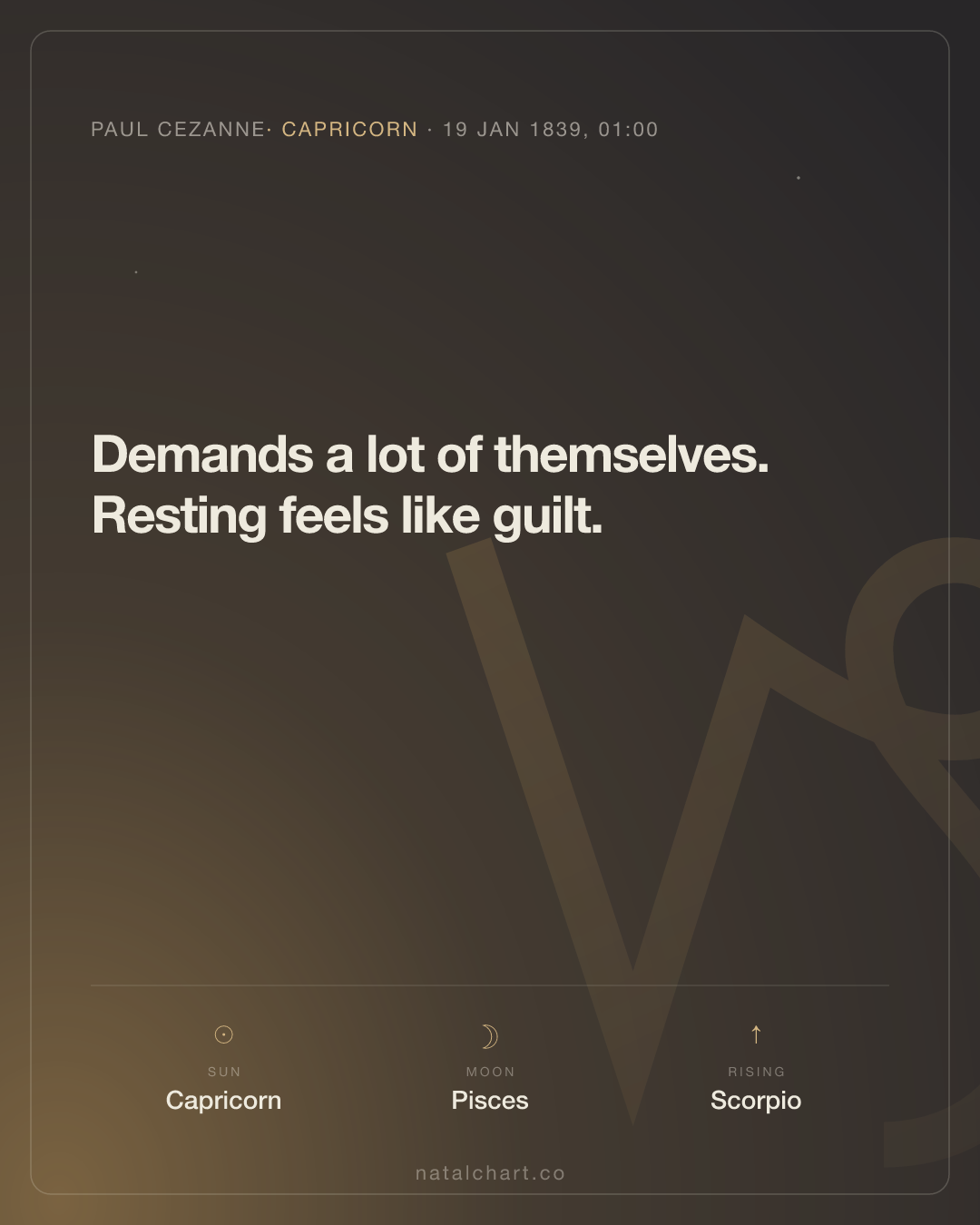
1839-01-19 · 01:00 · Aix-en-Provence, France Reliability: AA · vetted record
The Core
Paul Cézanne arrived with his Sun in Capricorn in the third house — the house of the working mind, of correspondence, of the daily labour of thought. Capricorn is the sign that builds slowly, that distrusts shortcuts, that respects form. The third house is the workspace of ideas, the studio of the intellect. Together they produced a man who worked the same motif — Mont Sainte-Victoire, the card players, the kitchen table with its tilted fruit bowl — again and again and again, not because he failed to get it right but because getting it right was a permanent discipline rather than a destination.
Scorpio rises as his Ascendant, the face he met the world with. Scorpio rising is penetrating, private, watchful and difficult to read at first meeting. Cézanne was famously prickly — he abandoned friendships rather than endure what he perceived as condescension, he refused for years to show in Paris, he would leave a canvas mid-session rather than let a visitor see it half-finished. That wasn't eccentricity for its own sake; it was the Scorpio rising guard protecting the extraordinary interior work happening behind it.
The Emotional Interior
The Moon in Pisces in the fifth house — the house of creative expression — joined closely with Uranus in Pisces tells a particular story: an emotional life that was porous to feeling and to the unpredictable, but one that found its safest and truest outlet in making. When Cézanne said he wanted to «do Poussin over again from nature,» he meant that the emotional impulse — fluid, visionary, Piscean — had to be made structurally accountable to the Capricorn Sun's insistence on form. That tension was not a contradiction in him; it was the engine.
The Moon joined to Uranus in the fifth house also means sudden emotional shifts, an instinctive readiness to break with convention when convention no longer served the felt truth. He broke with Impressionism before Impressionism was even finished becoming itself. He didn't break it out of contrarianism; he broke it because something deeper was still undone, and he could feel it.
The Working Method
The Sun in easy flow with Mars in Virgo in the eleventh house is the tightest aspect in the chart, with just 0.9 degrees of separation. Mars in Virgo is systematic, methodical, precise in execution, oriented toward craft as service. The eleventh house is the house of future-oriented purpose, of the collective to come. That his disciplined effort flowed easily toward a larger artistic community he would never quite see recognise him speaks to something almost structural: he worked for the painters who would come after him, not for the Salon jury in front of him. Picasso and Matisse called him «the father of us all.» He died in 1906 having sold almost nothing in his lifetime.
The Aesthetic Vision
Venus in Aquarius in the fourth house, joined very closely with Neptune in Aquarius, describes a private aesthetic life saturated with idealism. The fourth house is the innermost sanctum — the studio in Aix, the view of Sainte-Victoire from the hill behind Les Lauves. Venus joined to Neptune in Aquarius makes beauty into a project of liberation: the idea that painting could be freed from the obligation to represent the surface of things and could instead render the underlying structure, the logic of planes, the bones beneath the skin of the visible world.
Venus also forms an easy flow with Saturn in Sagittarius, one of the cleaner aspects in the chart. Saturn in Sagittarius in the second house points toward patient, earned material value — the hundred-plus paintings of Mont Sainte-Victoire were not dash, they were devotion, and they accrued value slowly. The Venus-Saturn connection means that the aesthetic vision and the structural discipline were not in conflict; they fed each other.
Structure and Vision in Tension
Saturn in tension with Uranus, with 2.6 degrees between them, is the central geometry of the chart and arguably the central tension of his life: tradition against revolution, what is inherited against what must be broken. His famous line about wanting to «redo Poussin from nature» is a perfect Saturn-square-Uranus statement: honour the classical masters while rupturing their method through direct perceptual experience. He spent forty years in that tension, never resolving it, because the tension was the work itself.
Saturn also forms an easy sextile with Neptune, which is the softer face of the same coin: the ability to discipline a vision, to make the intangible material. Cézanne's planar method — building a surface through systematic small marks of colour so that the whole acquires a structural logic that transcends the visible scene — is that Saturn-Neptune collaboration made into paint.
The Public Vocation
The Midheaven — the point in the chart that marks public vocation and lasting reputation — is in Leo. Leo is warmth, mastery, the quality of a work that radiates outward and makes others feel the authority of its presence. Cézanne's reputation — posthumous for the most part, since he died a year before the retrospective that changed everything — is exactly Leo at the Midheaven: a crown conferred not through ambition but through the undeniable presence of the work itself. His paintings now hang in every major museum on earth. The Leo Midheaven sometimes receives its recognition on its own schedule.
Jupiter in Libra in the twelfth house, pulling against Pluto in Aries in the sixth house, describes a hidden expansiveness brought to bear on daily craft labour. The twelfth house keeps its gifts private and unrewarded during the life; the sixth house is where one actually works, day by day, in the studio. Pluto there makes the work transformative in ways that aren't immediately legible — not obviously so to the Salon jury, but unmistakably so in retrospect.
Chiron: The Wound That Teaches
Chiron — a point in the chart that marks an old wound that, over time, becomes a hard-won source of understanding — falls in Gemini in the eighth house. The eighth house governs deep transformations, legacy, what persists after we are gone. Chiron in Gemini is a wound around being understood, around language and communication and being heard clearly. Cézanne was systematically rejected by the Paris Salon. Zola, his oldest friend, wrote a novel — «L'Oeuvre,» in 1886 — whose failed, broken painter protagonist was widely read as a portrait of Cézanne. Zola thought he was depicting a tragedy; Cézanne never spoke to him again.
Being misread by the people who should most have understood him was a wound that ran deep. But Chiron in the eighth house points toward transformation and legacy: what is not understood in the life can be profoundly understood afterward. Cézanne's method was not legible to his contemporaries partly because it was ahead of them. It became the grammar of twentieth-century painting.
The North Node and Direction
The North Node in Pisces — the chart's indicator of the direction toward growth — points toward dissolution of boundaries, toward allowing the felt and the visionary to guide the hand. Every time Cézanne abandoned the rigid outline, every time he let the edge of an apple blur into the tablecloth or allowed the mountain to become suggestion as much as fact, he was following that Piscean direction: trusting the sensation beneath the surface rather than the convention on top of it.
Lilith in Libra in the twelfth house adds a private, undomesticated sense of beauty that never quite made peace with the aesthetic conventions of his time. The Salon wanted one kind of beauty; his paintings proposed another, and that proposal was made quietly, from a studio in the south of France, without seeking permission.
The Portrait
What makes Cézanne's chart remarkable is how accurately it maps the contradiction that was his life: the Capricorn Sun and Virgo Mars that made him methodical, disciplined, almost monastic in his working habits, set against the Pisces Moon and Uranus that made him porous, visionary and structurally distrustful of every answer he arrived at. He spent forty years not finishing — or rather, finishing over and over in search of the thing that kept receding.
The Scorpio Ascendant protected that interior struggle from premature exposure. The Venus-Neptune conjunction in the fourth house kept feeding him the idealism to continue. The Saturn-Uranus tension kept the work honest: he couldn't rest in tradition, and he couldn't rest in rupture either. He had to keep finding the place where they met, canvas by canvas, session by session.
He died at sixty-seven from pneumonia contracted while painting outdoors in the rain. He had gone out that morning to work, as he had every morning. The discipline was constitutional. The Leo Midheaven had its own timing. What he built is still being learned from.
The chart
How to read it →Frequently asked questions
What is Paul Cezanne's zodiac sign?
Paul Cezanne's Sun sign is Capricorn — the Sun was in Capricorn at birth (1839).
What is Paul Cezanne's moon sign?
Paul Cezanne has the Moon in Pisces. The Moon sign describes the emotional and instinctive layer of the chart.
What is Paul Cezanne's rising sign?
Paul Cezanne's rising sign (ascendant) is Scorpio — the sign on the eastern horizon at the moment of birth.
When and where was Paul Cezanne born?
Paul Cezanne was born in 1839 in Aix-en-Provence, France.