Rita Levi-Montalcini — natal chart
What does Rita Levi-Montalcini’s natal chart reveal?
Rita Levi-Montalcini (1909-2012) was an Italian neurologist who, with Stanley Cohen, discovered nerve growth factor, earning the 1986 Nobel Prize in Physiology or Medicine. A senator for life in Italy, she continued scientific and public work into her hundreds, becoming a renowned figure in science.
 Share
Share
Birth
1909-04-22 · 23:00 · Turin, Italy Reliability: AA · vetted record
The Core: A Mind Built to Endure
Some scientists collect data. Rita Levi-Montalcini built a cathedral of it, one patient observation at a time, in a bedroom laboratory, under a fascist occupation that had stripped her of her university position and her legal right to practice science. The chart of a person who does this is not a chart of lucky circumstance — it is the chart of someone whose identity and their work are the same object.
The Sun in Taurus sits in the sixth house, the domain of daily craft, rigorous method, and health. In Taurus, the Sun is stubborn in the most productive sense: it commits. It does not pivot toward the fashionable or the easier path. Combined with Mercury and Venus also gathered here in tight conjunction, the sixth house becomes a kind of inner laboratory — a space where beauty, logic, and relentless daily effort live together. Sun joined to Mercury (the thinking mind) by just over a degree means Levi-Montalcini's sense of self and her intellectual process were indistinguishable. She was not someone who had a scientific career; she was someone for whom thinking carefully about the natural world was the same as existing.
The Ascendant in Sagittarius — the face she met the world with — added range and philosophical ambition to that Taurean core. The person others saw first was expansive, wide-seeing, someone whose goals crossed borders. And they did: her work crossed the Atlantic, her public roles crossed into politics, and her life crossed a century.
The Moon: Curiosity Faster Than Patience
The Moon in Gemini in the seventh house sits in almost exact flow with Mars in Aquarius — a gap of just 0.1 degrees, the tightest aspect in the whole chart. The Moon is the emotional interior, the instinctive register; Gemini makes it quick, multi-directional, insatiably curious. The seventh house governs partnerships and what one draws in from others; a Gemini Moon here suggests someone who needed the friction and stimulation of intellectual peers to do their best thinking.
That extremely tight Moon-Mars connection, in easy flow, means the impulse to act and the emotional need to understand were essentially one reflex. When Levi-Montalcini encountered a problem she wanted to solve, there was no long deliberation about whether to try: the curiosity and the drive arrived simultaneously. This may help explain how she began her nerve fiber research on chick embryos in her Turin apartment in the early 1940s — no university, no grant, no formal infrastructure, just a mind that moved directly from question to action.
Mercury, Venus, Sun: The Triple Conjunction
Sun joined to Mercury by just over a degree, Mercury joined to Venus at about two and a half degrees, and Sun joined to Venus at one and a half — all three in Taurus, all in the sixth house. A cluster this tight involving the thinking mind, the values, and the identity is unusual. It means these three things operated as one system: what Levi-Montalcini cared about (Venus), how she thought (Mercury), and who she was (Sun) pointed in exactly the same direction.
In practice, this likely explains her lifelong refusal to separate the scientific from the ethical. She didn't treat the discovery of nerve growth factor (NGF) as a technical achievement to be celebrated and then left alone; she spent the subsequent decades arguing for science education, founding the European Brain Research Institute, and sitting in the Italian Senate championing public investment in knowledge. The values and the intellect and the identity were the same engine.
Mercury also forms an easy flow with Jupiter in Virgo in the tenth house — the career and public reputation point. Jupiter in Virgo is precise, not merely large; it expands through detail, through getting things right. That Mercury-Jupiter connection in easy flow means her thinking communicated well publicly — her ideas were comprehensible, well-organized, exact. The Nobel committee, when they awarded her the 1986 Prize in Physiology or Medicine with Stanley Cohen, described the discovery of NGF as one of the most important in modern neuroscience. Exact and comprehensible turned out to be Nobel-level qualities.
The Career Point: Jupiter in Virgo at the Top
Jupiter in Virgo in the tenth house — the Midheaven, the public and career point — is the signature of a reputation built on precision, service, and accumulation of knowledge that genuinely helps people. Virgo does not seek the spotlight for its own sake; it earns standing through the quality of the work. Jupiter here expands that principle into public life: the more carefully right the work, the broader the reach.
Lilith also sits in Virgo in the tenth house. Lilith in a chart marks a place where power or presence was suppressed and then reasserted on its own terms. In the house of public reputation, in the sign of meticulous service, this speaks to Levi-Montalcini's experience of being dismissed from her academic position in 1938 under the Italian racial laws — literally expelled from the structure she had earned her place in. That wound did not suppress the work. She rebuilt the laboratory in her bedroom, continued during the war, and eventually received recognition at the highest level the scientific world offers. The suppression became, over decades, the credential.
Mars in Aquarius: The Unconventional Drive
Mars in Aquarius in the third house — the house of ideas, communication, and local environment — describes someone whose drive expresses itself through thinking differently, working outside established channels, finding the unconventional approach. Aquarius-flavored Mars does not want to use the tools everyone else uses; it wants to invent new ones or repurpose old ones in strange ways.
The years Levi-Montalcini spent experimenting with chick embryo nerve tissue in improvised conditions, without institutional support, are the lived expression of this placement. The method she and her collaborator Viktor Hamburger eventually developed — studying nerve fiber growth by transplanting extra limb buds onto embryos — was unorthodox. The Aquarian streak ran all the way through.
Chiron — a point in the chart that marks an old wound that slowly becomes a source of skill — sits in Aquarius as well, in the third house. The wound territory here is ideas and belonging to a community of thinkers. Being excluded from the official scientific community in her most productive early years left a mark. But that exclusion forced her into independent experimental thinking that academic structures, with their hierarchies and received methods, might have slowed. The wound and the gift were the same object.
Saturn and the North Node: The Shape of a Long Life
Saturn in Aries in the fifth house — the house of creative expression and individual output — can make the relationship to one's own creative power feel effortful or delayed. In Aries, Saturn carries a slightly impatient quality that sits uneasily with the natural Taurean steadiness elsewhere in the chart. The tension this generates is productive: it means the creative drive is never entirely comfortable, never fully satisfied, always looking for the next thing to resolve.
Saturn forms a tense angle with Neptune in Cancer — a degree apart. Neptune governs imagination, illusion, and what one hopes for; Saturn in tension with Neptune often marks someone who has to work to keep their idealism grounded in the actual. For a scientist, this is not a deficiency: it is a useful friction. The hope of what one might discover has to be tested against what the data actually shows. That ongoing negotiation between aspiration and evidence was Levi-Montalcini's daily working condition for over sixty years of research.
The North Node in Gemini — the point that indicates the direction of greatest personal growth — points toward communication, intellectual breadth, and making connections across domains. Levi-Montalcini's later years bear this out directly: after the Nobel, she did not retreat to the laboratory alone. She wrote books, gave speeches, sat in the Senate, founded institutions. The arc of the life bent toward the collective sharing of knowledge, not its private accumulation.
Neptune in the Eighth House: The Long Arc
Neptune in Cancer in the eighth house — the house of deep resources, transformation, and what outlives the individual — describes a legacy that outlasts the person who made it. Cancer's Neptune attaches meaning to care, to the tissue of family and community, to what protects the vulnerable. Placed in the house of inheritance and long-term consequence, this suggests that Levi-Montalcini's contribution was understood, eventually, not merely as a discovery but as a gift — the discovery of NGF has since underpinned research into Alzheimer's disease, Parkinson's disease, and various cancers. The work protected people she would never meet.
She lived to 103. She was still publishing scientific papers in her nineties, still giving public speeches in her late nineties, still serving in the Italian Senate in her hundreds. Taurus endures; the sixth house is the house of daily practice; Sagittarius reaches; Neptune holds the legacy open. The chart does not explain a life of that length or that quality — but it maps the architecture of a person capable of it: steady, precise, wide, and built to last.
The Close: What Holds
The tightest aspects in this chart are not dramatic — no raw ruptures, no violent crises written in the sky. The Moon in almost exact flow with Mars is a clean, direct line between feeling and doing. The Sun joined to Mercury is identity fused with intelligence. The Mercury-Jupiter easy flow is thinking that reaches people. These are the aspects of someone who worked, consistently, with great care, for a very long time, and in doing so changed what the world knows about how living tissue grows.
Rita Levi-Montalcini was excluded, persecuted, ignored, and then eventually recognized at the highest level. The chart does not promise any of those outcomes — it only describes the equipment she brought to each of them: a mind that moved from question to action without hesitation, values and intellect and identity braided into one purpose, and the kind of stubborn daily commitment that turns a bedroom laboratory into a Nobel Prize.
The chart
How to read it →Frequently asked questions
What is Rita Levi-Montalcini's zodiac sign?
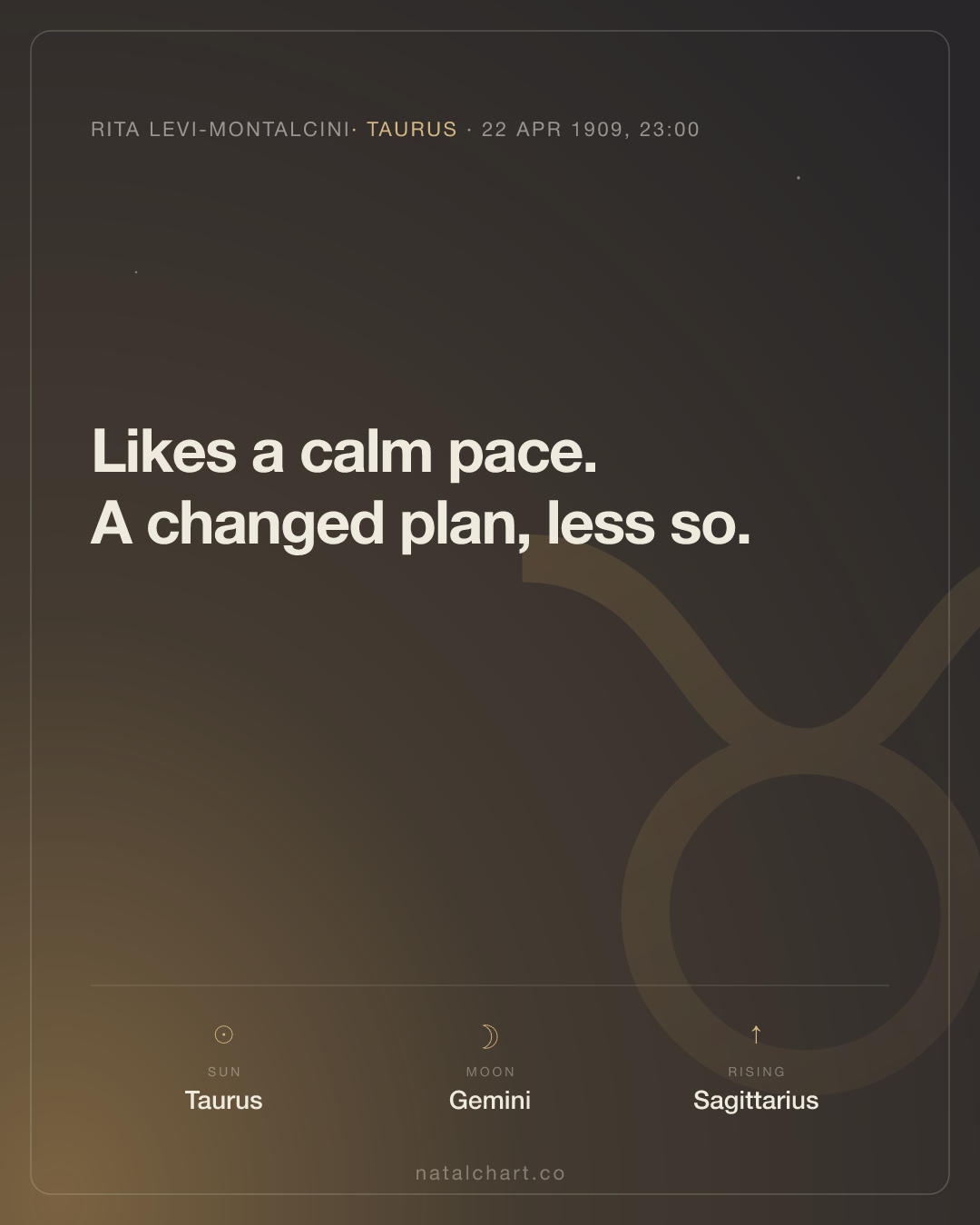
Rita Levi-Montalcini's Sun sign is Taurus — the Sun was in Taurus at birth (1909).
What is Rita Levi-Montalcini's moon sign?
Rita Levi-Montalcini has the Moon in Gemini. The Moon sign describes the emotional and instinctive layer of the chart.
What is Rita Levi-Montalcini's rising sign?
Rita Levi-Montalcini's rising sign (ascendant) is Sagittarius — the sign on the eastern horizon at the moment of birth.
When and where was Rita Levi-Montalcini born?
Rita Levi-Montalcini was born in 1909 in Turin, Italy.