Roberto Benigni — natal chart
What does Roberto Benigni’s natal chart reveal?
Roberto Benigni (born 1952) is an Italian actor, comedian and director. He wrote, directed and starred in the 1997 Holocaust tragicomedy 'Life Is Beautiful', which won three Academy Awards including Best Actor for Benigni and Best Foreign Language Film, making him an internationally beloved figure of Italian cinema.
 Share
Share
Birth
1952-10-27 · 13:00 · Castiglion Fiorentino, Italy Reliability: AA · vetted record
The weight behind the lightness
Roberto Benigni spent decades making people laugh — in the streets of Rome, on Italian television, on international stages — but the work that defined him globally was not a comedy. Life Is Beautiful, the 1997 tragicomedy in which he wrote, directed, and played a father who constructs a game of make-believe inside a Nazi concentration camp to shield his young son from the horror around him, won three Academy Awards including Best Actor and Best Foreign Language Film. The chart of a man who can hold that much grief and still make it inhabitable belongs to someone constitutionally unable to separate laughter from truth.
Benigni has the Sun in Scorpio in the eleventh house, alongside Mercury in the same sign and house. Scorpio is the sign that does not look away. It investigates, it endures, it finds the thing that is hidden underneath the acceptable surface. Sun and Mercury here describe a mind that goes toward what is difficult — not despite its discomfort, but because the truth underneath is worth more than the comfort of not looking.
The Capricorn Ascendant and the discipline of form
The Ascendant — the way a person meets the world, the first impression they make — is Capricorn. Capricorn rising creates a certain tension with everything else in this chart: the Sun in Scorpio burns with intensity, but the face it shows first is measured, structured, composed. Benigni built his public persona around apparent wildness — the dancing on cinema seats at the Oscars, the torrential verbal flights, the physical comedy — but the form underneath has always been rigorous. The clowning is not chaos; it is a very precise craft.
Chiron (a point that marks where an old difficulty becomes a capacity) is also in Capricorn, in the first house, right alongside this Ascendant. Chiron here suggests that the very structure of how Benigni presents himself to the world was shaped by something he had to work through — a relationship with discipline, with structure, with the demands of form — and that this difficulty eventually became the foundation of his ability to contain enormous weight within precise artistic structures.
Mars in Capricorn: the engine underneath the clowning
Mars — the planet that governs how someone takes action, where their drive lives — is also in Capricorn, in the first house. Mars in Capricorn is not spectacular in the way Aries Mars is spectacular. It is patient, strategic, and capable of enormous sustained effort. It builds. It does not flame out.
This is the Mars of someone who understands that a career is not a single performance but a body of work assembled over decades. Benigni began in Italian cabaret and television in the 1970s, worked with directors like Bertolucci and Jarmusch, spent years developing Life Is Beautiful before its release, and continued writing and directing into his seventies. The wildness that reads on the surface — the exuberance, the apparent improvisation — is sustained by a very Capricornian endurance.
The Moon in Aquarius: emotional life lived in the collective
The Moon — what someone needs to feel emotionally grounded, the texture of their inner life — is in Aquarius in the second house. Aquarius Moon does not process feeling in private, intimate ways. It thinks about feeling. It converts the personal into something shareable, into something that speaks to more than one person's experience. The warmth is real, but it moves through ideas and through the collective — through stories that belong to everyone rather than through confessional self-exposure.
This Moon forms an extremely close agreement with both Neptune and Saturn (a trine to each, within 0.4° and 1.6° respectively). The Moon-Neptune trine means that imaginative, dreamlike material — the territory of fable, of symbolic story, of what things mean beyond what they literally are — comes naturally to the emotional register. The Moon-Saturn trine adds structure to that dreaminess: the imagination is real and wide, but it is also disciplined, capable of being shaped into something that holds.
This combination is the astrological description of Life Is Beautiful: a fable built with meticulous craft, an imaginative act of protection performed with structural rigor.
Mercury and the square to Pluto: comedy as excavation
Mercury in Scorpio in the eleventh house forms a very tight tension with Pluto in Leo in the eighth house — only 0.6° of separation, making this one of the sharpest configurations in the entire chart. Mercury is how someone thinks and speaks; Pluto is the planet of what is buried, of the forces underneath ordinary experience.
Mercury in tension with Pluto describes language that digs. Not surface chatter — something that reaches toward what is concealed. In performance terms, this is comedy that has weight to it; jokes that land because they've touched something real and slightly frightening. Benigni's verbal comedy has always operated this way: the torrential speed and associative leaping (Mercury) serve a purpose that goes deeper than entertainment (Pluto). He is not simply amusing — he is excavating.
Venus in Sagittarius and the question of boundaries
Venus — values, attachments, the way someone loves and what they love — is in Sagittarius in the twelfth house. Sagittarius Venus loves broadly and generously, and it is not naturally cautious about where its enthusiasm leads. The twelfth house is the domain of what is invisible, of what operates below the threshold of ordinary awareness.
This Venus is part of a broader cluster of meaning: there is a deep pull toward the boundless — in love, in creative work, in the kind of Italian comic tradition that goes all the way back to commedia dell'arte and forward through Benigni's explicitly Pirandellian moments, where the frame of fiction and the frame of reality dissolve into each other. The Sagittarius quality here is philosophical and generous rather than precise and measured; it reaches for something beyond the local and the immediate.
Saturn and Neptune in Libra: the public voice
Saturn and Neptune are both in Libra in the tenth house — the house of vocation, of public standing, of how one's work is recognized in the world. Saturn in the tenth is the most straightforwardly vocational placement in astrology: it indicates a person who takes seriously what they do publicly, who builds a body of work with the understanding that it will be judged, and who, when things go wrong, returns to the work as the site of reconstruction.
Neptune alongside Saturn in the tenth softens that solidity with a quality of dream, of artistic dissolution of ordinary reality. The tenth house placement of Neptune is what allows Benigni's public work to have the quality of fable — not reportage, not documentary, but something that operates at the level of myth while remaining rooted in historical reality. Life Is Beautiful is, in this sense, a perfect tenth-house Saturn-Neptune expression: a work with the moral seriousness of Saturn and the dream-logic of Neptune, aimed at a public audience and built to last.
Saturn in Libra forms a tense relationship with Uranus in Cancer in the seventh house (1.4° separation). Uranus is the planet that disrupts, that refuses the established pattern. In the seventh house — the house of partnerships, of significant others, of how one relates — this creates a particular dynamic: a pull toward the unconventional in close relationships, a refusal of ordinary domestic arrangements, alongside the Saturnian need for form and commitment. The tension between these two does not resolve neatly; it persists as a productive restlessness.
The North Node in Aquarius: toward the universal
The North Node (the direction of growth in a chart, the tendency that develops over time) is in Aquarius. Aquarius points toward the universal: toward the story that belongs to everyone, toward the idea that what is most personal is most collective, toward the comedian who speaks for a whole society's unspoken experience.
Benigni began with intensely local Italian material — the Tuscany of his childhood, the Italian political comedy of the 1970s, the vernacular humor that did not easily translate. The arc of his career moved steadily toward work that crossed every border: Life Is Beautiful was seen by audiences from Tokyo to São Paulo to New York who brought nothing to the viewing beyond their common humanity. That movement is the North Node in Aquarius at work — the deepening of what began as local into something universal without losing the root.
A portrait held together
The chart of Roberto Benigni is the chart of a man who understood, at some level, that comedy and grief are not opposites. They are the same act performed at different frequencies. The Sun and Mercury in Scorpio do not flinch from what is dark; the Moon-Neptune trine converts that darkness into fable; the Saturn-Neptune conjunction in the tenth house builds the fable into a durable public form; and the Capricorn Ascendant with Mars holds the entire structure together with a discipline the exuberance carefully conceals.
The moment that defined him in public memory — sprinting across cinema seats at the 1999 Oscars, shouting his love for cinema to a bewildered but delighted audience — looked like pure spontaneous joy. It was also a man who had just received the world's most public confirmation that the most difficult thing he had ever attempted had worked. The chart had prepared him to carry both things at once.
The chart
How to read it →Frequently asked questions
What is Roberto Benigni's zodiac sign?
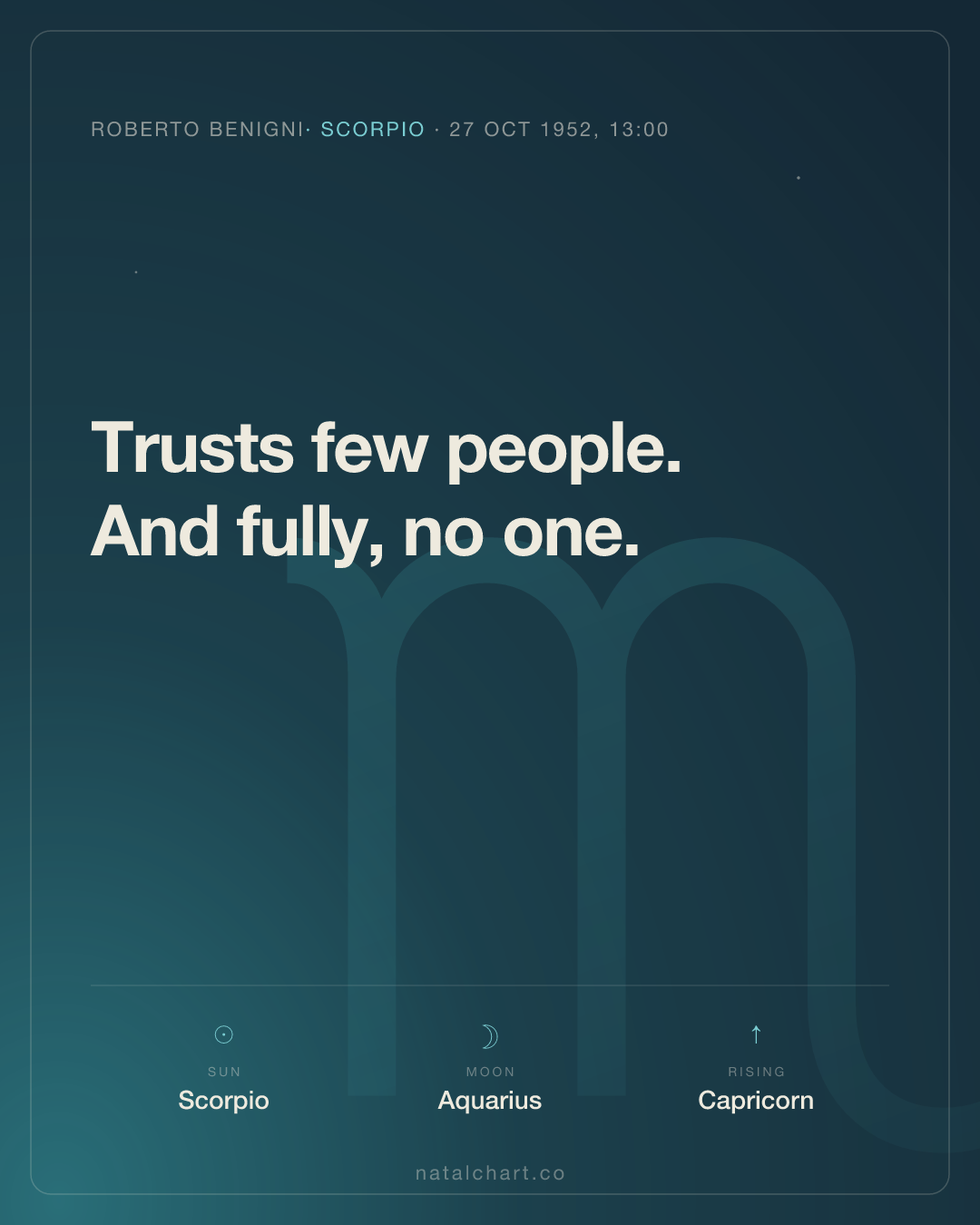
Roberto Benigni's Sun sign is Scorpio — the Sun was in Scorpio at birth (1952).
What is Roberto Benigni's moon sign?
Roberto Benigni has the Moon in Aquarius. The Moon sign describes the emotional and instinctive layer of the chart.
What is Roberto Benigni's rising sign?
Roberto Benigni's rising sign (ascendant) is Capricorn — the sign on the eastern horizon at the moment of birth.
When and where was Roberto Benigni born?
Roberto Benigni was born in 1952 in Castiglion Fiorentino, Italy.