Roberto Rossellini — natal chart
What does Roberto Rossellini’s natal chart reveal?
Roberto Rossellini was an Italian film director, born on 8 May 1906 in Rome. He became a founding figure of the neorealist movement that reshaped cinema after the Second World War. His war trilogy — Rome, Open City (1945), Paisà (1946) and Germany, Year Zero (1948) — used non-professional actors and real locations to depict ordinary lives under occupation and in ruin. He later directed a celebrated cycle of films with Ingrid Bergman, including Stromboli (1950) and Journey to Italy (1954). In his final decades he turned to long historical works for television, such as The Taking of Power by Louis XIV (1966). He died in 1977. His pared-down approach influenced the French New Wave and generations of directors worldwide.
 Share
Share
Birth
1906-05-08 · 12:50 · Rome, Italy Reliability: C · uncertain The noon birth time circulates on astrology sites only and is unsourced; treat it as unverified.
The core: a craftsman who trusted reality more than invention
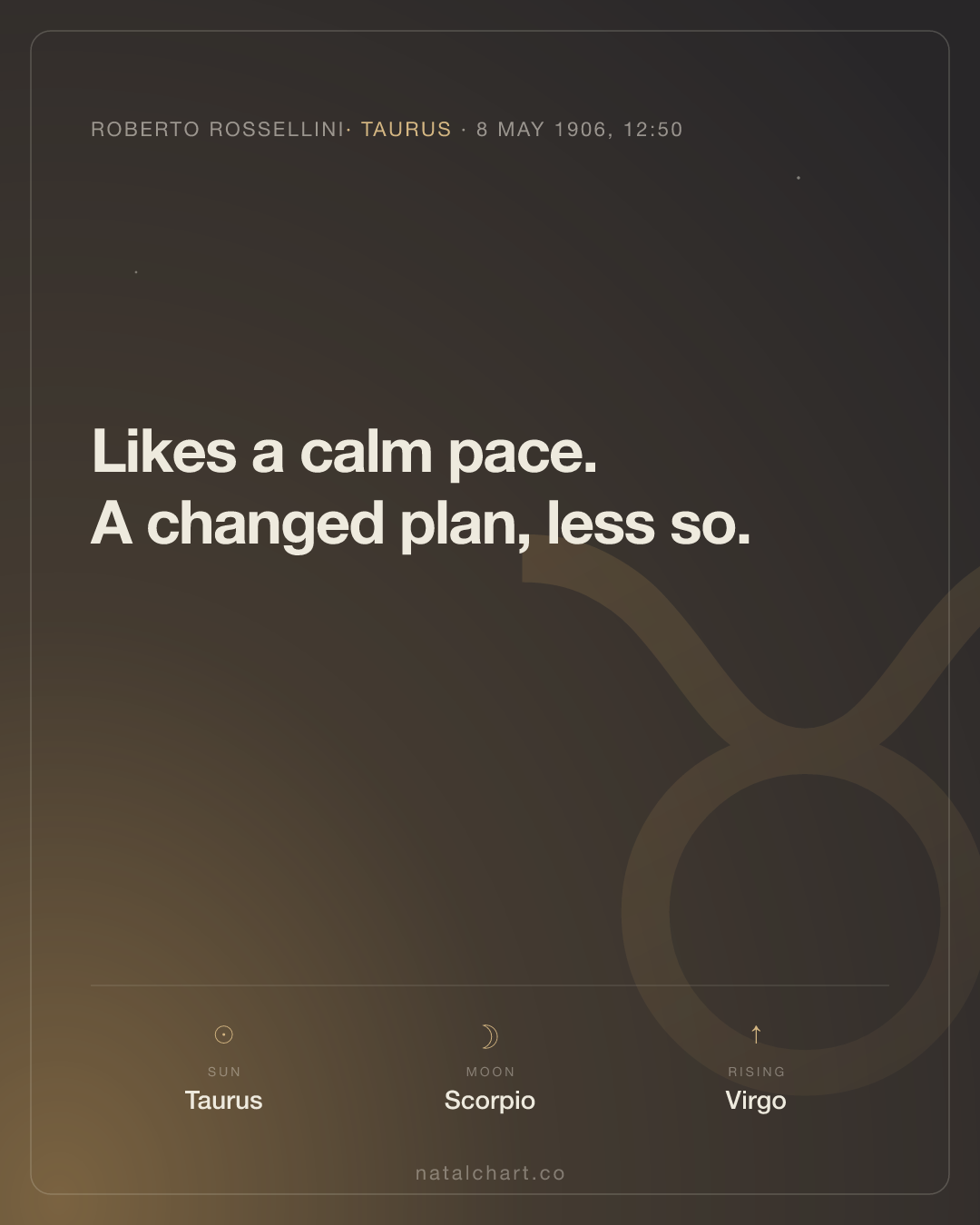
Roberto Rossellini arrived at his vocation through a paradox: the more carefully he arranged the world on screen, the less convinced he became that arrangement was the right method. The Sun in Taurus in the ninth house is the foundation — a deep, patient attentiveness to what is concretely real, to the material texture of places and bodies and faces, grounded by a philosophical curiosity that drove him toward the largest possible questions. The ninth house governs that kind of horizon: the search for meaning that goes beyond the immediate, toward history, toward ideas, toward what a life signifies. A Taurus Sun there does not dream abstractly; it builds understanding from what can be seen and touched.
The Ascendant is Virgo — the face he met the world with was precise, analytical, detail-oriented. The Virgo Ascendant is not comfortable with the loosely approximate; it wants the specific fact, the right word, the accurate image. In Rossellini this manifested as an almost clinical approach to location and casting: he used real bombed streets for "Rome, Open City" (1945), cast non-professional actors alongside professionals, accepted the visible damage of post-war Rome as the only honest visual vocabulary available. The Virgo precision was paradoxically the tool that made his work feel uncontrolled — because it was precise about reality, not about convention.
The opposition at the center: Sun against Moon
The Sun in Taurus sits in direct opposition to the Moon in Scorpio — a gap of just 1.4 degrees, making this the defining tension of the whole chart. Sun in Taurus seeks stability, accumulation, the firm and the lasting. Moon in Scorpio goes exactly the opposite direction: into the volatile, the transformative, the hidden, the aspect of experience that cannot be made stable. This opposition in the lives of people who carry it rarely finds a resting point; it oscillates between the desire for solid ground and the pull toward depth that destabilizes solid ground.
In Rossellini's work, this tension is structural. The neorealist project was nominally about showing things as they are — the Taurus Sun's attachment to the real. But the films are haunted by the Scorpio Moon: by grief that does not resolve, by desire that is destructive, by the war's psychological aftermath that cannot be filmed directly and can only be shown through the distorted faces of survivors. "Germany, Year Zero" (1948) — in which a twelve-year-old boy kills his father and then himself, without the film providing emotional explanation — is a pure expression of this opposition. The surface is documentary-plain. The interior is Scorpio depths.
The Midheaven and the stellium in Gemini: public vocation
The Midheaven (the career and public point of the chart) is in Taurus — aligned with the Sun — and what stands in the tenth house, the house of public work and achievement, is one of the most striking stelliums in the chart: Venus, Mars, Jupiter, and Pluto are all in Gemini. Four planets in the house of career, all in the sign of communication, of multiplicity, of restless movement between forms and ideas.
This Gemini stellium is the key to understanding why Rossellini never stayed still. He was a neorealist. Then he wasn't. He made films with Ingrid Bergman that seemed to abandon everything neorealism stood for — intimate, psychological, European art-cinema in a register no Italian director had used before. Then he abandoned fiction altogether for television. He spent his final two decades making historical pedagogical films for RAI, reconstructing the lives of Louis XIV, Socrates, Augustine of Hippo, Pascal — convinced that television could be the medium through which history was made accessible to everyone. Each of these turns bewildered critics and contemporaries. The Gemini stellium in the tenth house explains it: the public work required constant reinvention, constant movement between forms, a curiosity that could not settle into a single identity.
Venus and Mars joined: desire and action as one
Venus and Mars are within one degree of each other in Gemini — joined so tightly that the aesthetic impulse and the creative drive operate as a single force. Venus in Gemini values the witty, the light, the pleasurably complex; Mars in Gemini acts through language, through the quick shift of direction, through the cut. Together they produce a filmmaker for whom the pleasure of making and the discipline of making are not experienced as separate things.
The cycle of films with Ingrid Bergman — from "Stromboli" (1950) to "Journey to Italy" (1954) — is the most direct expression of this conjunction. Those films emerged from a romantic and creative partnership simultaneously; the Venus and the Mars were not separable. "Journey to Italy" in particular is a film about a marriage in crisis that doubles as a film about Rossellini and Bergman renegotiating their creative collaboration: it is not clear where the professional ends and the personal begins, because in that Venus-Mars conjunction, they never fully did.
Mercury in Aries: the mind that moves first
Mercury in Aries in the eighth house thinks quickly, decides before it has fully analysed, and then builds the justification after the instinct has already committed. The eighth house is the house of depth, of what is shared and hidden, of transformation — the same territory as the Scorpio Moon. Mercury there is a mind drawn to exactly the questions that cannot be answered on the surface: what happens to ordinary people when history destroys their world? What does occupation do to the moral interior of a person? Why does a child kill?
These are not Taurus questions — practical, solid, patient. They are Aries-Mercury questions in the eighth house: urgent, direct, willing to ask what is uncomfortable, unwilling to wait for the safe formulation. The neorealist films are full of this urgency. They do not explain; they ask. The camera holds on a face and refuses to supply the answer.
Jupiter, Saturn, and the tension between expansion and form
Jupiter in Gemini in the tenth house forms a tense square with Saturn in Pisces in the seventh house — a gap of just 1.9 degrees. Jupiter wants to expand, to reach further, to try the larger form. Saturn in Pisces pulls toward dissolution of the conventional structure, toward the fluid, the uncertain, the spiritually and philosophically open. The square between them creates a lifelong creative struggle between ambition and doubt, between the desire to build something monumental and the recognition that monuments are not always honest.
Rossellini's turn to television in the 1960s and 1970s was partly a resolution of this square — not through the studio film, with its imposed structure and commercial expectation, but through a form that could be as long as the material required and as pedagogically serious as he wanted to be. "The Taking of Power by Louis XIV" (1966) is a two-hour film made for television that feels like nothing else: it is about power and performance, about how a king constructs his authority through ceremony, and it is shot with a calm, unhurried attention that the commercial cinema would never have permitted. Saturn in Pisces — the patience of the formless — won.
Chiron in Aquarius and the North Node in Leo
Chiron (the old wound that becomes a gift) is in Aquarius in the sixth house — the house of daily work, of method, of the discipline of craft. A Chiron in Aquarius in the sixth house suggests a wound around the social recognition of one's work — the sense that the method is misunderstood, that the contribution is not legible to contemporaries in the way one would wish. Rossellini was misunderstood repeatedly and seriously: the Bergman films were commercial failures and were received as a betrayal of his earlier work; his television project was largely ignored by critics.
The North Node in Leo — the direction the life was moving toward — calls for creative self-expression, for the courage to be central, to be the author, to not efface the self entirely in the name of reality. Rossellini's late television work, with its remarkable directness and pedagogical confidence, is the most Leo thing he ever did: a filmmaker standing in front of history and saying, here is what I understand, here is what I think you should know.
The lasting quality
Roberto Rossellini did not invent documentary filmmaking — but he showed what fiction could borrow from it, and the directors who learned from him (Godard, Truffaut, Pasolini, Cassavetes) changed cinema's idea of what was possible. The Taurus Sun kept returning to the same fundamental question: what does it mean to live in history, to have a body that history can damage or destroy? The Scorpio Moon could not let that question go soft, could not resolve it into something comfortable. Between them — between the patient and the unresolvable — he made work that is still unsettling, still accurate, still alive.
The chart
How to read it →Frequently asked questions
What is Roberto Rossellini's zodiac sign?
Roberto Rossellini's Sun sign is Taurus — the Sun was in Taurus at birth (1906).
What is Roberto Rossellini's moon sign?
Roberto Rossellini has the Moon in Scorpio. The Moon sign describes the emotional and instinctive layer of the chart.
What is Roberto Rossellini's rising sign?
Roberto Rossellini's rising sign (ascendant) is Virgo — the sign on the eastern horizon at the moment of birth.
When and where was Roberto Rossellini born?
Roberto Rossellini was born in 1906 in Rome, Italy.