Romário — natal chart
What does Romário’s natal chart reveal?
Romário de Souza Faria, known simply as Romário, is a Brazilian former professional footballer and politician born on 29 January 1966 in Rio de Janeiro. A prolific striker, he rose to prominence at Vasco da Gama before moving to PSV Eindhoven in 1988, where he was a leading scorer in the Dutch league. In 1993 he joined FC Barcelona, winning La Liga in 1994 alongside Hristo Stoichkov and Ronald Koeman. He was the central figure of Brazil's 1994 FIFA World Cup victory in the United States, scoring five goals and receiving the Golden Ball as the tournament's best player; that same year he was named FIFA World Player of the Year. He later played for Flamengo, Fluminense and again Vasco da Gama, claiming to have surpassed 1,000 career goals in 2007. After retiring, he entered politics, serving as a federal deputy from 2011 and being elected senator for Rio de Janeiro state in 2014.
 Share
Share
Birth
1966-01-29 · 23:55 · Rio de Janeiro, Brazil Reliability: A · reliable data
The Core
Romário was not a man who ran past defenders — he waited, perfectly still, and then wasn't there anymore. The space he occupied on a football pitch was psychological as much as physical. A cluster of four personal planets in Aquarius in the fourth house explains much of this: Sun, Mercury, Venus and Mars all gather in the same sign, in the house that governs private roots, the base one builds everything from. Aquarius is the sign of the outsider who operates by a completely different set of rules than everyone else. Romário, born in the Jacarezinho favela in Rio de Janeiro, never pretended to belong to the world of institutional football. He belonged to himself.
The Scorpio Ascendant — the face he showed the world, the immediate impression — made him magnetic and opaque in equal measure. You could watch him for ninety minutes and still not be sure what he was going to do next. Neptune in Scorpio sits right at this Ascendant, adding a quality of elusiveness, of dissolving into the game in ways that were genuinely difficult to read. Defenders at PSV Eindhoven, FC Barcelona, and the 1994 World Cup all reported the same thing: they knew where he was and still couldn't stop him.
Inside
The Moon in Taurus in the seventh house describes an emotional life anchored in loyalty and the concrete. The seventh house governs one-on-one relationships, and a Taurus Moon here suggests someone whose deepest emotional investment goes into a tight circle of people. Romário was famously devoted to his family — his son Romarinho followed him into football, and his advocacy work after becoming a politician has been substantially driven by his daughter Ivy, who was born with Down syndrome. The stubborn constancy of Taurus is not glamorous, but it endures.
The Moon sits in tension with the Aquarius Sun (just over three degrees apart, pulling against each other). Sun and Moon pulling in opposite directions describes someone whose public personality and private emotional needs feel, at times, like two different people. The Romário who dazzled the world at the 1994 World Cup — scoring five goals, receiving the Golden Ball as best player, helping Brazil lift the trophy after a twenty-four-year absence — and the Romário who frequently clashed with coaches, missed training sessions, and played by his own schedule are not contradictions. They are the same person seen from different angles.
Mercury and Venus: Mind and Values
Mercury and Venus occupy the same degree of Aquarius in the fourth house, joined so closely they function almost as one voice. Mercury in Aquarius thinks laterally, intuitively, ahead of the available information — and Romário's football intelligence was precisely this: not athletic but spatial, anticipatory. He was not particularly quick over distance; he had an extraordinary sense of where the ball was going to arrive before it arrived.
Venus in Aquarius next to Mercury describes values built around freedom and originality rather than convention. In the way Romário played and in the way he conducted himself — refusing to be constrained by coaches' systems, claiming over a thousand career goals as a personal project, speaking in political life with a directness that made colleagues uncomfortable — there is a consistent thread. He was not interested in being liked by institutions. He was interested in being true to his own measure.
Mars and the Drive
Mars in Aquarius in the fourth house completes the stellium. Four personal planets in Aquarius in the private, foundational fourth house is a remarkable concentration: the source of all that drive, all that conviction, all that refusal to be managed, is interior and private, not public performance. Romário did not play to impress. He played to score, which is a very different thing.
The Mars in Aquarius is original in its methods — unconventional, technically precise, emotionally detached from the crowd reaction in a way that allowed him to keep functioning under high pressure. At the 1994 World Cup final, played on penalties against Italy, Romário converted his spot kick without visible tension. That composure has the fingerprint of an Aquarian Mars: cool, detached, certain.
Jupiter, Saturn and the Structure Beneath
Jupiter in Gemini in the eighth house brings a talent for accumulation and multiplication — particularly in hidden or behind-the-scenes domains. The eighth house governs resources, power, deep transformations. Romário's claim to have scored over a thousand career goals (a number disputed by statisticians but maintained by him) reflects a Jupiterian counting instinct: the need to quantify, to mark, to make the achievement concrete. His move into politics — first as a federal deputy in 2011, then senator for Rio de Janeiro from 2014 — extended this same drive into public resource and power.
Jupiter sits in tension with Uranus and Pluto in Virgo in the eleventh house (squares of roughly three and four degrees respectively). The structures of collective life — institutions, leagues, federations, governments — are not neutral for Romário. They are either a field on which to compete, or an obstacle. Usually both.
Saturn in Pisces in the fifth house is the most counterintuitive placement in this chart. The fifth house governs play, creativity, pleasure, children. Saturn in Pisces here describes a complex relationship with the domain of pure enjoyment: there is something about creativity and pleasure that carries weight, difficulty, blurring of boundaries. Romário's relationship to the game was never simply fun — it was identity, obsession, the primary matter of his life.
The Generational Signature
Uranus and Pluto are joined together in Virgo in the eleventh house (one degree apart), and this is the tightest aspect in the chart. This is the signature of an entire generation born in the mid-1960s — a cohort that brought radical transformation to collective structures. In Romário's life this manifested in the world of football: the game itself changed around him. The Brazilian squads he played in, from Vasco da Gama to the 1994 national team, were not the football of the previous generation.
Saturn in Pisces sits in opposition to Pluto in Virgo (about three degrees). This aspect — two planets pulling in opposite directions — describes an underlying tension between structure and dissolution, discipline and chaos. The story of Romário's career is partly the story of this tension: extraordinary talent held in permanent friction with the difficulty of operating within any structure that didn't serve the talent.
Neptune in Scorpio at the Ascendant, flowing easily with Uranus (three degrees), adds the quality of reading collective undercurrents intuitively. Romário in his political career has aligned himself with causes — disability rights, social housing, criticism of FIFA and World Cup spending — that carry this same capacity to see what is actually happening beneath the official version.
The Midheaven and Public Vocation
The Midheaven — the career and public legacy point — is in Cancer. Cancer governs home, family, the people one is rooted to, the community of origin. Romário's public career, both in football and in politics, has been inseparable from his identity as a carioca, as someone from the favela, as a father. His most visible political cause — the rights of people with Down syndrome, prompted by Ivy's birth — is not a detached policy position. It is personal to the core.
The Cancer Midheaven also suggests that the lasting legacy is emotional rather than institutional: what people remember about Romário is not a trophy cabinet or a voting record, but something warmer and more specific — the feeling of watching someone do something that seemed impossible, done with complete conviction.
Chiron and the North Node
Chiron in Pisces in the fifth house — Chiron marks an old wound that, over time, becomes a source of understanding — sits in the house of play, creativity and children. The wound here is in the domain of joy, of free expression, of the child's relationship to the game. Romário grew up in the Jacarezinho favela; the path from there to the world's most prestigious football stages was not a given, and the psychological distance between where you came from and where you arrived is part of the texture of this placement.
The North Node in Gemini — the direction of growth across a lifetime — points toward communication, articulation, bringing together different strands of experience into a coherent public voice. Romário's second career as a politician — genuinely vocal, consistently provocative, unwilling to trade in platitudes — is this growth edge made visible.
A Particular Kind of Greatness
There are footballers who are celebrated for what the game gave them, and there are footballers who seem to have given the game its direction, at least for a period. Romário belongs to the second category. The 1994 World Cup is remembered differently because of how he played. His chart describes someone whose inner life is both the engine and the limit: an Aquarian concentration of intelligence and will, rooted in private conviction rather than public ambition, powered by a Scorpio capacity for psychological precision, and ultimately oriented — through the Cancer Midheaven — toward the people and the place he came from. That is a coherent portrait. And it is, in the end, exactly what the record shows.
The chart
How to read it →Frequently asked questions
What is Romário's zodiac sign?
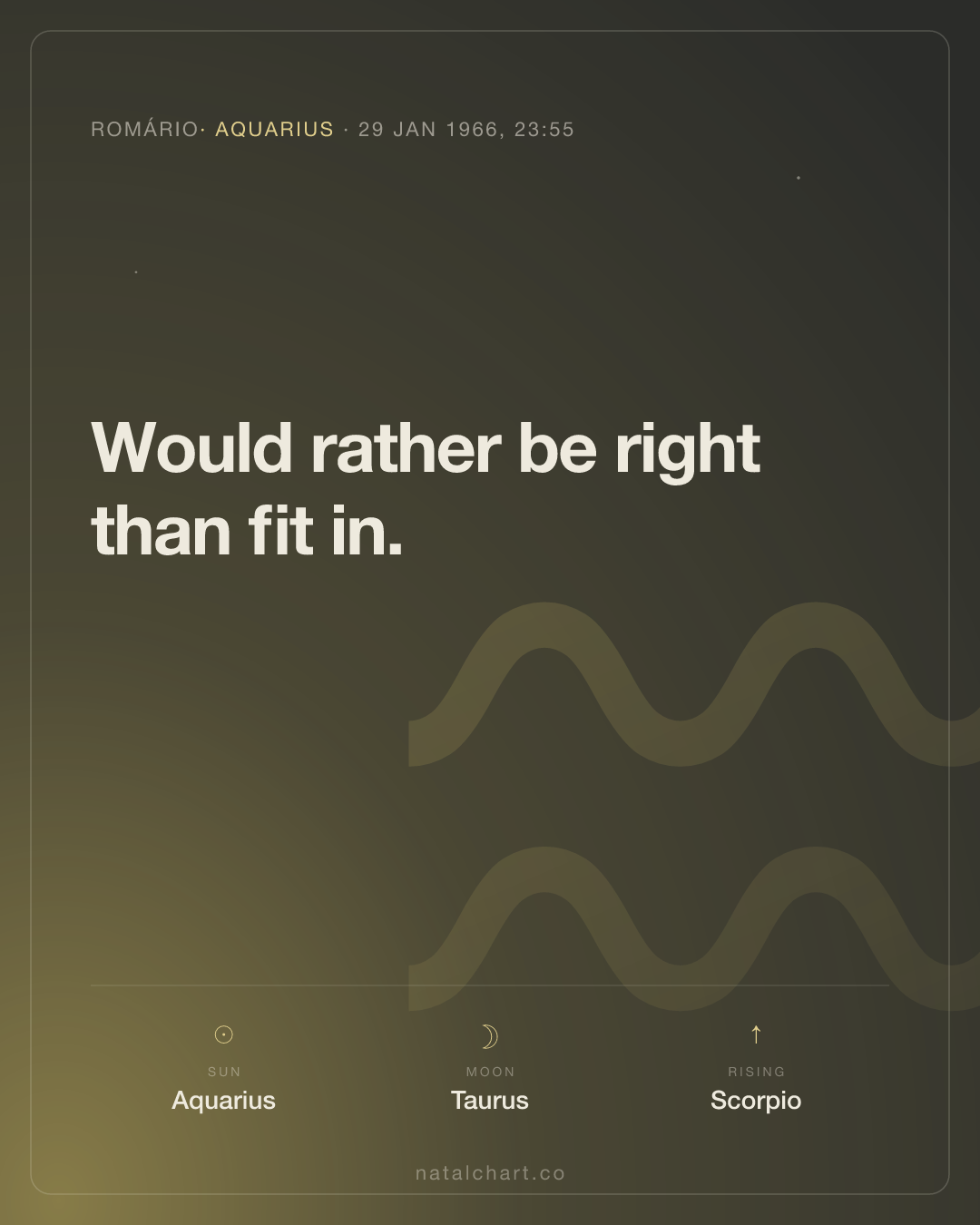
Romário's Sun sign is Aquarius — the Sun was in Aquarius at birth (1966).
What is Romário's moon sign?
Romário has the Moon in Taurus. The Moon sign describes the emotional and instinctive layer of the chart.
What is Romário's rising sign?
Romário's rising sign (ascendant) is Scorpio — the sign on the eastern horizon at the moment of birth.
When and where was Romário born?
Romário was born in 1966 in Rio de Janeiro, Brazil.