Simone de Beauvoir — natal chart
What does Simone de Beauvoir’s natal chart reveal?
Simone de Beauvoir (1908-1986) was a French philosopher and writer born in Paris, a foundational figure of modern feminism. Her 1949 work 'The Second Sex' became a landmark feminist text. She also wrote novels including 'The Mandarins', winner of the 1954 Prix Goncourt.
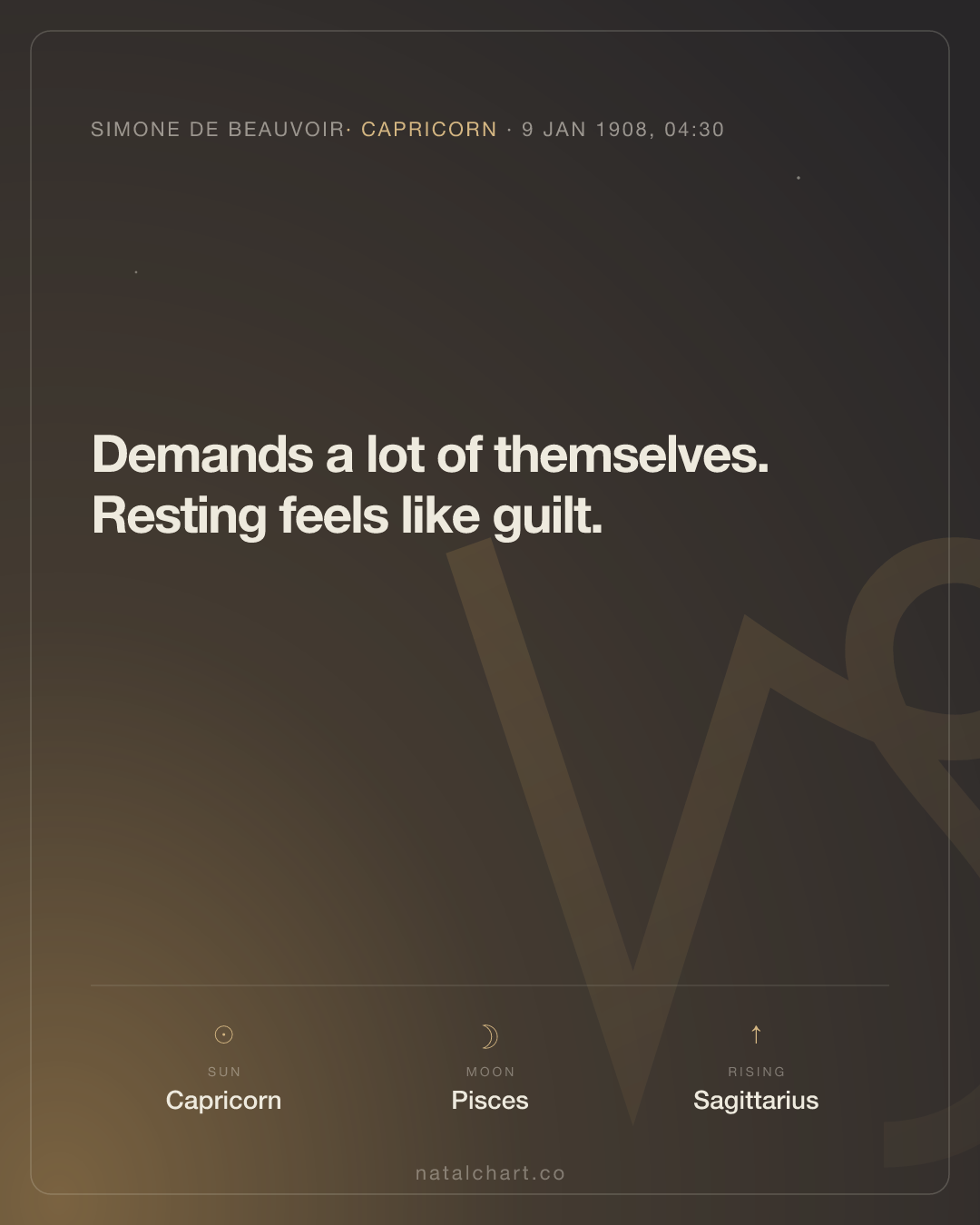 Share
Share
Birth
1908-01-09 · 04:30 · Paris, France Reliability: AA · vetted record
The Architecture of a Mind
Simone de Beauvoir was born on January 9, 1908, in Paris, into a bourgeois family whose financial decline she witnessed through childhood. She grew up knowing that independent thought was not a luxury but a necessity — that no one was going to provide her the life she imagined for herself. This early reckoning shaped everything. In her natal chart, the Sun, Mercury, and Uranus cluster together in Capricorn in the second house (the house of material resources and personal values), and the whole cluster pulls in direct tension against Neptune in Cancer across the chart. This is the signature of a mind that could not stop questioning what it had been given — not rebelliously, but structurally, as if the architecture of received ideas simply did not hold under examination.
The Ascendant (the face one shows the world) is Sagittarius — philosophical, direct, reaching for the larger frame, disinclined to stay comfortable in small answers. She wrote from the age of seven; by nineteen she had decided, quite plainly, that she would be a writer. Sagittarius rising does not hesitate about direction — it sets it early and heads there.
The Weight of Thought
Sun in Capricorn in the second house is not a placement that produces easy declarations. Capricorn builds carefully, earns before claiming, speaks from evidence rather than feeling. The second house reinforces this: it is the domain of what one actually possesses — not title or appearance, but substance. For de Beauvoir, ideas were possessions, carefully acquired and rigorously defended. The Second Sex, published in 1949, is a Capricorn Sun book in the best sense: exhaustively researched, structurally ambitious, grounded in philosophy and history and lived observation before it reaches its arguments.
Mercury joins the Sun in Capricorn in the second house, and also joins Uranus there (the gap between them is barely one degree). Mercury joined with Uranus — both in tension against Neptune — describes a thinker who cannot receive ideas passively. The conjunction of Mercury and Uranus produces the kind of mind that makes a sudden conceptual leap and cannot quite explain how it got there, except that the leap turned out to be right. For de Beauvoir, that leap was the question she put at the center of The Second Sex: what does it mean that a woman becomes a woman — that femininity is not natural but constructed? In 1949, that was not a refinement of existing thought. It was a rupture.
What the Pisces House Holds
The Moon, Mars, and Saturn all sit in Pisces in the fourth house — the house of home, of private life, of what one carries from origin. This is an unusually dense emotional interior: feeling and drive and discipline all fused in the same mutable water sign. Pisces does not separate easily — it absorbs. De Beauvoir absorbed her era: the Occupation, the Resistance, the postwar reconstruction of French intellectual life, the Algerian War, the feminist uprisings of the 1960s and 70s. Her Memoirs of a Dutiful Daughter (1958) and the subsequent autobiographical volumes are exactly this — a Pisces Moon fourth house in literary form, where private life and historical time become inseparable.
The Moon in close company with Mars (barely one and a half degrees apart) gives this emotional interior an active, sometimes urgent quality. De Beauvoir did not merely feel — she acted from feeling, and she wrote from it. The collaboration and lifelong bond with Jean-Paul Sartre, which she documented across her memoirs without ever fully reducing it to a simple category, carries the mark of this Moon-Mars conjunction: an emotional life that was also an intellectual combat, a private life that was also a public project.
Saturn in the same house as the Moon adds weight and longevity to this interior. She returned to her own life as a subject repeatedly across four volumes of memoir: the younger self was always available for examination, always worth understanding more precisely.
What She Wanted and Why
Venus in Aquarius in the third house (the house of ideas, writing, communication) describes a woman whose deepest attractions were intellectual. Love as a meeting of minds; desire as mutual recognition of equals; the relationship as a space where thought could happen. This fits what is known of her relationship with Sartre — unconventional, non-exclusive, built on a pact of transparency, enduring for nearly fifty years until his death in 1980. Venus in Aquarius does not want to be possessed, and it does not want to possess. It wants the principle of connection to be honest and freely chosen.
The third house placement for Venus also signals that writing and ideas were not separate from her emotional life — they were its primary arena. The Prix Goncourt for The Mandarins in 1954 recognized a novel about the French intellectual left in the postwar years — a book in which the political, the erotic, and the philosophical were woven together as they were in her own life.
Jupiter and the Public Platform
Jupiter in Leo in the ninth house — the house of philosophy, of publishing, of reaching a broad audience — is a placement of considerable public scale. Jupiter in Leo does not wish to address only a seminar room; it wants the argument to reach as far as possible, to be felt as well as understood. The ninth house is the natural home of published ideas, of the lecture, of the work that crosses borders. De Beauvoir's influence was not merely French: The Second Sex was translated into dozens of languages and became foundational reading for feminist movements in the United States, Latin America, and across Europe.
Lilith (the unclaimed feminine, the force that refuses containment) also occupies Leo in the ninth house. The parallel with de Beauvoir's project is almost too neat: a woman who refused the categories available to women, who named that refusal publicly, and whose refusal became a philosophical argument that reshaped how the West understood gender.
The Tightest Tensions
Uranus pulling in opposition to Neptune (barely three-tenths of a degree apart) is the sharpest line in the whole chart. This is a generational aspect — those born around 1908 share it — but in de Beauvoir's chart, it runs through the second house to the eighth (the house of depth, of what is hidden, of transformation). Mercury joined with Uranus at barely one degree makes this opposition personal, not merely historical: her mind was literally structured around the tension between the sharp conceptual cut (Mercury-Uranus in Capricorn) and the dissolving, oceanic, hard-to-name (Neptune in Cancer). That tension — between radical clarity and the acknowledgment that some things resist clear articulation — runs through all her work. She was simultaneously a systematic thinker and a writer who knew that experience outran philosophy.
Saturn in a tight square to Pluto (less than one degree of orb) adds the recognition that certain structures — social, intellectual, gendered — are not merely inconvenient but actively suppressive. The philosopher who can name that force with precision is not being dramatic. She is being accurate.
Chiron and the North Node
Chiron (the place of an old wound that gradually becomes a source of skill) sits in Aquarius in the third house — the same house as Venus. A wound around ideas, around communication, around belonging to a community of thinkers. De Beauvoir studied philosophy at the Sorbonne, passed the agrégation in 1929 — finishing second, behind Sartre — and spent decades navigating an intellectual world that was structurally male. The wound of being taken less seriously than her male peers, of having her own ideas returned to her as derivative or secondary, was real and documented. What Chiron in Aquarius in the third house eventually produces is exactly what she produced: a philosophical language precise enough to name the structure that caused the wound, and to show others how to name it too.
The North Node (the direction the chart points toward) is in Cancer — the sign of care, of nourishment, of what is felt rather than constructed. For a woman whose chart is heavily weighted toward Capricorn intellectual architecture, the Cancer node asks for the integration of the felt life, the body, the experience that does not fit the argument. Her late work — including A Very Easy Death (1964), an account of her mother's dying — is exactly this integration: the philosopher encountering what cannot be philosophized away, and finding a way to write it anyway.
A Life of Chosen Structure
Simone de Beauvoir died in Paris in 1986, seventy-eight years old, and was buried next to Sartre at Montparnasse cemetery. The life she built — the writing, the decades of intellectual partnership, the refusal to accept a category of womanhood she had not chosen — was itself an argument. The chart that opened this life placed the sharpest conceptual tools (Mercury, Uranus, Capricorn) in direct tension with the most dissolving and encompassing of forces (Neptune, Pisces, the fourth house) and asked her to build something real from that friction. She did. What endures is not merely the argument but the precision with which she made space for others to see what she saw — that becoming oneself is never simply given, and that the freedom to construct that self is worth whatever it costs.
The chart
How to read it →Frequently asked questions
What is Simone de Beauvoir's zodiac sign?
Simone de Beauvoir's Sun sign is Capricorn — the Sun was in Capricorn at birth (1908).
What is Simone de Beauvoir's moon sign?
Simone de Beauvoir has the Moon in Pisces. The Moon sign describes the emotional and instinctive layer of the chart.
What is Simone de Beauvoir's rising sign?
Simone de Beauvoir's rising sign (ascendant) is Sagittarius — the sign on the eastern horizon at the moment of birth.
When and where was Simone de Beauvoir born?
Simone de Beauvoir was born in 1908 in Paris, France.