Totò (Antonio de Curtis) — natal chart
What does Totò (Antonio de Curtis)’s natal chart reveal?
Antonio de Curtis, known as Totò, born in Naples on 15 February 1898, was a comic actor, screenwriter, poet and composer, regarded as the prince of Italian laughter. Raised in the Sanità district, he started in variety theatre before conquering cinema with a uniquely surreal, physical comedy. He made over a hundred films, including "Totò Looks for an Apartment" (1949), "Cops and Robbers" (1951), "Poverty and Nobility" (1954) and Pasolini's "The Hawks and the Sparrows" (1966). He also wrote the famous poem "'A livella" and the song "Malafemmena." He died in Rome in 1967.
 Share
Share
Birth
1898-02-15 · 07:00 · Naples, Campania, Italy Reliability: A · reliable data Birth time (07:00) drawn from the birth record cited in Ennio Bìspuri's "Vita di Totò"; some sources give 07:30.
The Prince of Laughter
Five planets gathered in Aquarius — the Sun, Mercury, Venus, Mars, and the Ascendant itself — made Totò one of the most concentrated and unusual personalities in the history of Italian culture. Aquarius does not follow convention. It observes the rules of ordinary life from a slight distance, finds the absurdity in what everyone else takes for granted, and turns that observation into a form of communication. In Totò's case, that communication was physical comedy of a kind that had never existed before and has not been replicated since: limbs that seemed to move independently of his body, a face that could change register in a fraction of a second, a timing so precise it operated like a mechanical instrument.
The Ascendant — the face someone presents to the world — was also in Aquarius, which meant there was very little gap between the performer and the person. The eccentricity was not a mask. It was the man.
The Interior Life
Beneath the surface of that comedic machinery, the Moon tells a different story. Totò's Moon was in Sagittarius, in exact opposition to Pluto — a hair's breadth of separation between them, almost exact to the minute. When two planets stand directly across from each other in the chart, there is a pull between two forces that do not easily reconcile. The Moon governs the emotional interior: what one needs to feel safe, how one experiences loss, what one carries privately. Pluto governs transformation through pressure — intensity, things that cannot be left unexamined.
Totò grew up in the Sanità district of Naples, illegitimate, raised in poverty, the son of a marquis who did not formally recognise him until he was an adult. He spent decades attempting to obtain legal recognition of his noble title — the Prince de Curtis, Duca di Andria. That pursuit, which many found eccentric, makes perfect sense under a Moon-Pluto opposition: a deep emotional need to legitimise an identity that was taken from him at birth, something that could not simply be processed and left alone, but had to be faced and fought.
The Moon was also joined with Saturn in Sagittarius — another exact aspect, less than two degrees of separation. Saturn alongside the Moon adds a note of gravity to the emotional life, a quality of endurance, of carrying weight without making a show of it. It is the hallmark of someone who understood suffering from the inside and could therefore portray it without sentimentality.
The Comedic Mind
Mercury and Mars were both in Aquarius, less than three degrees apart and working in close agreement. Mercury governs the mind and the way one speaks; Mars governs the impulse to act, to strike, to initiate. Together in Aquarius, they produced a mind that moved sideways — not through logical progression but through unexpected leaps, non-sequiturs, the sudden rupture of one register by another. Totò's comedy did not build towards a punchline in the conventional sense. It dismantled the premise.
Mercury also worked in easy coordination with Uranus — the planet associated with disruption, originality, and the refusal to behave predictably. Uranus was in Sagittarius, in the same cluster as the Moon and Saturn. The comic machinery and the emotional weight occupied the same part of the sky. This is, in retrospect, exactly what made films like Uccellacci e uccellini (1966) — his collaboration with Pier Paolo Pasolini — so strange and so indelible. Pasolini saw what others had missed: that the comedy was inseparable from the grief.
The Stage and the Screen
Neptune and Pluto were both in Gemini, in the fifth house — the sector associated with performance, creative expression, and the kind of joy that comes from making something. Gemini multiplies and transforms: it is the sign of the double, the mirror, the role that contains another role. Totò's first decade as a performer was in variety theatre, in the Neapolitan tradition of the macchietta — a character sketch, a type, a compressed portrait of a social condition. That training, which he absorbed before cinema, gave him a physical vocabulary that the camera would later capture with a precision no stage could match.
Chiron — an old wound that over time becomes a point of skill — was in Gemini, in the same fifth house. The wound connected to expression, to the voice, to the act of making people laugh. Totò lost his sight almost entirely in the final years of his life. He continued to make films, guided by memory, by the physical instincts he had built over forty years. The wound had always been there, underneath the performance. It did not stop him.
Jupiter and the Philosophy
Jupiter was in Libra, in the ninth house — the area of the chart associated with broad ideas, with philosophy, with the attempt to understand the shape of things. Libra is concerned with balance, with what is fair, with the weight of opposing claims. Jupiter in easy coordination with Saturn — just under two degrees — suggests someone who built a genuine, if private, worldview: not optimism for its own sake, but a considered equilibrium between what can and cannot be changed.
Totò wrote poetry. His poem 'A livella — about a Neapolitan gravedigger who is lectured by the ghost of a nobleman and responds that death is the great leveller — is one of the most widely known dialect poems in Italian literature. It is also, unmistakably, a philosophical argument. Jupiter in the ninth, in dialogue with Saturn: the aristocrat and the gravedigger, the hierarchy and its dissolution, rendered in the voice of a man who had lived both sides of that divide.
The North Node and Direction
The North Node — the point in the chart that suggests the direction in which a life finds its fullest expression — was in Capricorn. Capricorn values craft, endurance, the slow building of something that lasts. Totò made over a hundred films. He worked with directors across the entire spectrum of Italian cinema: from commercial entertainment to Pasolini's political allegory. The quantity was not accidental, and neither was the range. He was building something — a body of work, a record of what Neapolitan popular culture could do when taken seriously — with the quiet persistence of a Capricorn north star.
The Chart as a Whole
Totò's chart is, at its centre, a portrait of someone who inhabited contradiction without needing to resolve it. Five planets in Aquarius gave him the detachment to observe the human condition from outside; the Moon in exact tension with Pluto gave him the depth to feel it from within. Saturn beside the Moon meant he carried the weight of both without burdening the audience. The result was a comedian who made people laugh at poverty, at bureaucracy, at death — not to dismiss those things, but because laughter was the most honest response available to someone who knew them well.
He died in Rome on 15 April 1967, having lost most of his sight but none of his precision. The films remained. The poem remained. 'A livella remained: the nobleman and the gravedigger, equal at last, under the same earth. A chart shaped by Aquarius and marked by Pluto had, in the end, made exactly that argument — not in philosophical language, but in the only language Totò ever trusted completely: the body, the voice, the perfectly timed pause.
The chart
How to read it →Frequently asked questions
What is Totò (Antonio de Curtis)'s zodiac sign?
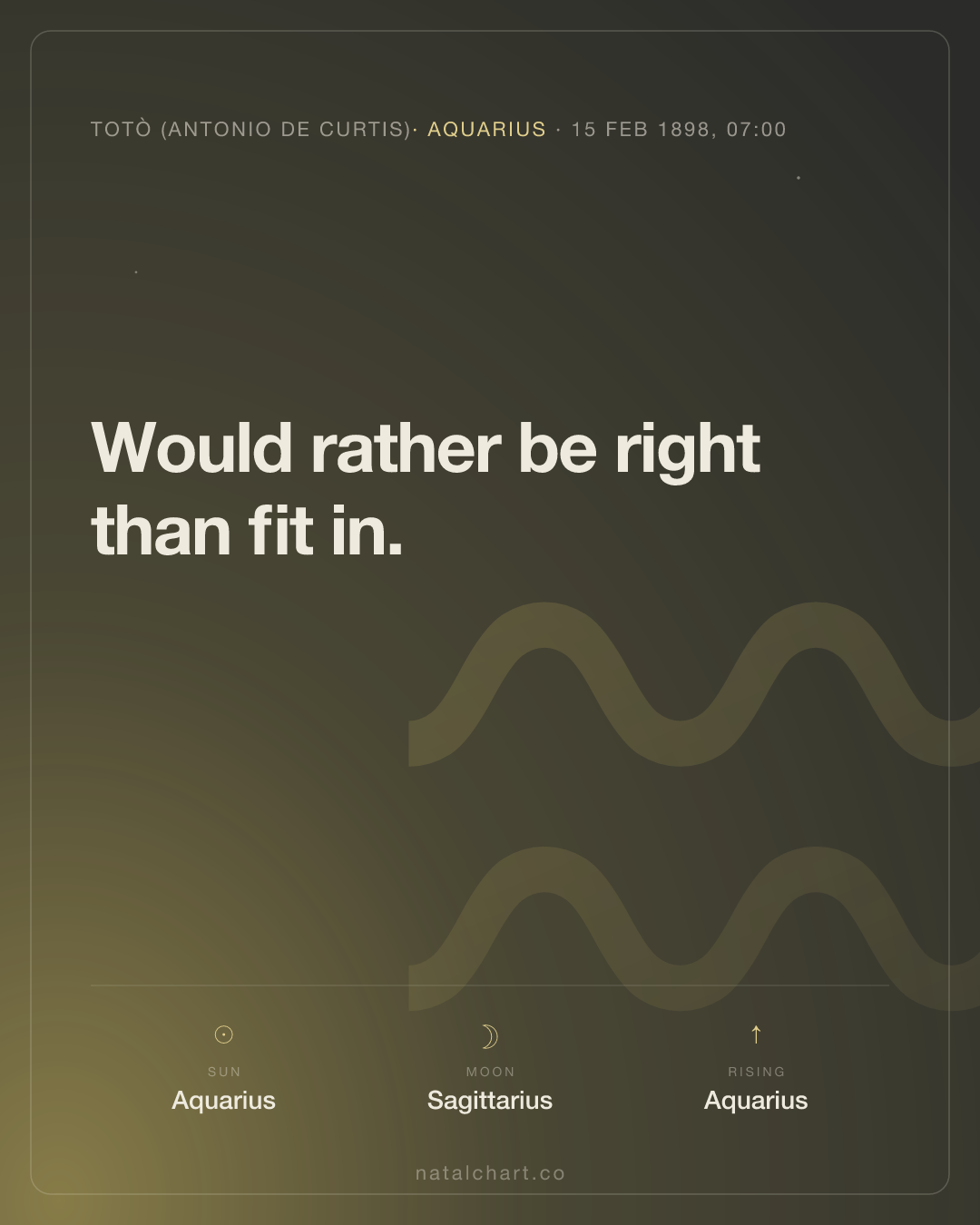
Totò (Antonio de Curtis)'s Sun sign is Aquarius — the Sun was in Aquarius at birth (1898).
What is Totò (Antonio de Curtis)'s moon sign?
Totò (Antonio de Curtis) has the Moon in Sagittarius. The Moon sign describes the emotional and instinctive layer of the chart.
What is Totò (Antonio de Curtis)'s rising sign?
Totò (Antonio de Curtis)'s rising sign (ascendant) is Aquarius — the sign on the eastern horizon at the moment of birth.
When and where was Totò (Antonio de Curtis) born?
Totò (Antonio de Curtis) was born in 1898 in Naples, Campania, Italy.