Camilo José Cela — natal chart
What does Camilo José Cela’s natal chart reveal?
Spanish writer born in 1916 in Iria Flavia. He published 'The Family of Pascual Duarte' (1942) and 'The Hive' (1951), key works of tremendismo. Nobel Prize in Literature 1989 and Cervantes Prize 1995.
 Share
Share
Birth
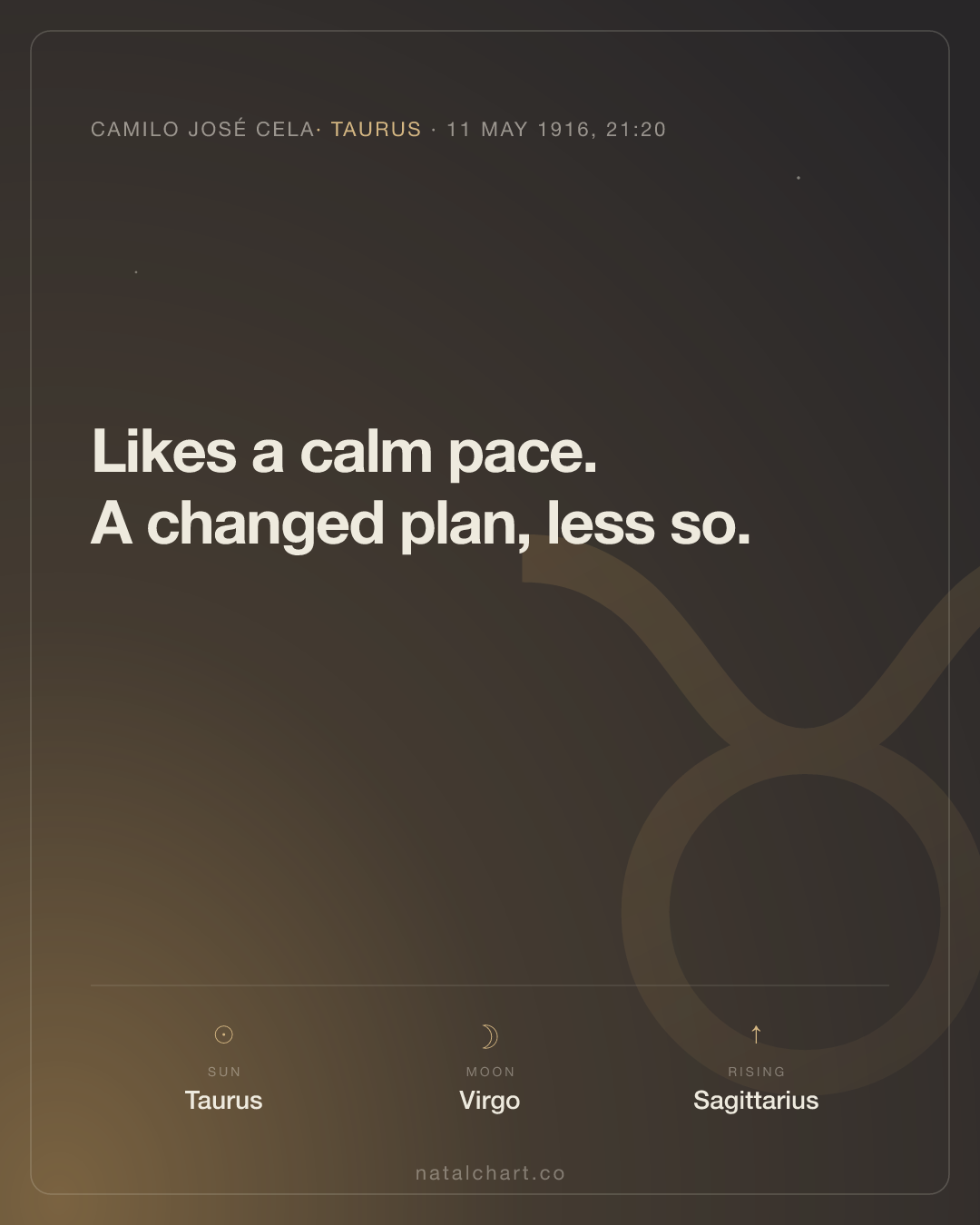
1916-05-11 · 21:20 · Padrón, Spain Reliability: AA · vetted record
The core: a Sagittarius who worked like a Taurus
Camilo José Cela arrived in the world with a Sagittarius Ascendant — the face he met the world with: broad, restless, tilted toward the horizon, drawn to the uncomfortable edge of things. And yet his Sun sat in Taurus in the sixth house, the house of daily work, habit, craft. The contradiction is the key. Sagittarius wanted range, provocation, the moral and geographical frontier; Taurus insisted on sitting down and doing the work, page after page, decade after decade, until the craft was undeniable. The Family of Pascual Duarte (1942) and The Hive (1951) are not books that announce themselves with flair and disappear; they are built with the Taurean stubbornness that only stops when the thing is finished and solid.
The public reputation: Virgo Moon at the career point
The Moon — the emotional interior, the instinctive register — sits in Virgo in the tenth house, the house of public reputation and vocation. Virgo is the sign of precision, analysis, and the refusal to let sloppiness pass. At the career point, that Virgo Moon meant that Cela's public identity was built on exactness: the exact word, the exact observation, the cataloguing of human degradation that defined tremendismo — the literary movement he helped create, which found beauty in the brutal and precise rendering of suffering and misery in postwar Spain. The Nobel committee in 1989 cited his rich and intensive prose; this is a Virgo Moon commendation.
The Moon in tension with Mercury in Gemini (the two pulling against each other across the chart) adds complexity: Virgo wants to examine everything carefully; Gemini wants to move quickly and say everything at once. For a prose writer, this tension produced both relentless observation and an almost baroque urge to accumulate: The Hive alone contains over three hundred named characters.
The mind: Mercury in Gemini, in the house of partnerships
Mercury — the planet governing the mind, language, and how thought translates into expression — sits in Gemini in the seventh house, which governs one-to-one encounters, dialogue, and public-facing relationships. Gemini is Mercury's own territory; the mind here is quick, multidirectional, interested in divergence and in following a thought wherever it leads, regardless of propriety. In the seventh house, this mental quickness was always performing for an audience of interlocutors — Cela was a famously combative public intellectual, a columnist, an editor, a man who started arguments as readily as he ended them.
Mercury's tension with the Virgo Moon across the chart also explains the stylistic range in Cela's work: Pascual Duarte is taut, brutal, first-person; The Hive is sprawling, polyphonic, deliberately fragmented. The same writer, pulled in two directions by the same internal configuration.
Love and depth: Venus, Saturn, and Pluto in Cancer
Venus, Saturn, and Pluto all cluster in Cancer in the eighth house — the house of what is hidden, of transformation, of the psychological depths that ordinary social life keeps covered. Cancer is the sign of the familial, the domestic, the wound carried from the early home. To have Venus (the affective register, what draws and what is valued aesthetically), Saturn (the structuring principle, the weight of time and authority), and Pluto (radical depth, the compulsion to strip things to their essence) all concentrated here is a portrait of someone whose emotional life and creative wellspring were never light. The private ache of Cancer, held under the pressure of both Saturn and Pluto, becomes the source material.
Venus joined with Pluto (the two within about three degrees) is an especially distinctive marker: it produces an aesthetic sensibility drawn toward what is extreme, exposed, and psychologically raw — the exact aesthetic of tremendismo. Beauty, for this chart, was never ornament. It was what survived when everything comfortable had been stripped away.
Mars and vision: Leo in the ninth house
Mars and Neptune both sit in Leo in the ninth house — the house of philosophy, travel, foreign cultures, and the broader meaning of things. Mars in Leo is flamboyant directional force: the kind of energy that insists on presence, that refuses to be marginal, that performs even when performing makes enemies. Cela's public biography is full of this: the provocateur who wrote a foreword defending his own controversial work, the figure who accepted the Nobel Prize with the composure of someone who had always known it was coming.
Mars works in easy harmony with Jupiter in Aries (the two flow well together), which sits in the fifth house of creative play. Jupiter in Aries is unguarded creative confidence — the willingness to begin a project that has no guaranteed success, to plant a flag before the territory is secured. For a writer who published Pascual Duarte in 1942, at a time when the Franco regime made the reception of any honest literature about Spanish suffering deeply uncertain, that Aries confidence was not a small thing.
Jupiter, Uranus, and the unconventional current
Jupiter (creative confidence, in Aries in the fifth house) sits in an easy, flowing relationship with Uranus in Aquarius in the third house — Uranus being the planet associated with disruption, the refusal of convention, and structural breaks. The third house governs writing, ideas, and the immediate intellectual environment. Uranus here, in the sign of the collective and the forward-facing, placed Cela's thinking in a continuous productive tension with the mainstream: he was always writing toward where the culture wasn't, exploring modes (the picaresque, the fragmented, the deliberately anti-lyrical) that were considered inappropriate or excessive by the literary establishment he was simultaneously joining and challenging.
Uranus is also in tension with the Taurus Sun (Sun square Uranus within 1.2 degrees — one of the tightest aspects in the chart). This is the lived friction of someone who fundamentally wants stability, craft, and the steady accumulation of work, but who is constitutionally unable to stay inside conventional lines. The most original things in Cela's bibliography — Mrs. Caldwell Speaks to Her Son (1953), San Camilo, 1936 (1969) — are the ones where Uranus won the argument.
The vocation: Libra Midheaven, the literary judge
The Midheaven — the career and public standing point — falls in Libra, the sign of balance, aesthetic judgment, and the mediation between competing claims. For a literary figure, a Libra Midheaven is fitting: the career built on weighing language carefully, on adjudicating between the possible and the necessary in a sentence, on editing others (Cela founded and edited the influential literary journal Papeles de Son Armadans from 1956 to 1979). Libra also contains the shadow of the official: the figure who is asked to arbitrate, to represent, to receive prizes. Cela was elected to the Real Academia Española in 1957; he became a Senator by royal appointment in 1977. The Midheaven in Libra holds both the literary craftsman and the literary institution.
Chiron and the wound carried from home
Chiron — an asteroid associated with a wound that does not fully close, but which, when integrated, becomes the specific gift one offers the world — sits in Pisces in the fourth house, the house of home, roots, and inherited psychological ground. Pisces is the sign most associated with dissolution, with what cannot be held to sharp edges, with the blurring of boundaries between the self and something larger and more diffuse. In the fourth house, this Chiron speaks of a wound in the foundation — something in the early domestic world that was porous, unclear, or hard to name, and that left a residue the adult kept returning to in the work.
Cela was born in Iria Flavia, in what was then a culturally complex Galicia straddling Spain and Portugal; his mother was British. The fourth-house Chiron in Pisces might speak to that early sense of being neither fully one thing nor another — and the Pascual Duarte who kills, the characters of The Hive who survive in the wreckage of a society, carry that foundational ambiguity in their bones.
The North Node in Aquarius: the collective over the personal
The North Node — the point in the chart that marks the direction of growth, the quality developed and offered over a life — sits in Aquarius, the sign of the collective, the impersonal, the structural view from a distance. For someone with as much personal intensity as the Cancer eighth-house cluster suggests, the Aquarius North Node is a chart asking for a move from the private wound to the public document: the specific suffering of specific people in specific places that becomes evidence about the human condition in general. That is the leap The Hive makes — three hundred individuals, each carrying their own particular bruise, assembled into a portrait of a social organism in crisis. The personal, delivered at enough scale, becomes the universal.
The portrait: the honest witness
Camilo José Cela's chart describes someone whose gift was the willingness to look directly at what other writers looked away from. The Taurus foundation did not let him quit; the Sagittarius face pointed him toward the frontier; the Cancer depths gave him the material; and the Virgo Moon demanded that it be rendered with exactness rather than sentiment. The Nobel Prize at seventy-three was the formal recognition of what the chart had always suggested: that the honest witness, who stays at the page long enough and precisely enough, eventually earns the right to be heard across all borders.
The chart
How to read it →Frequently asked questions
What is Camilo José Cela's zodiac sign?
Camilo José Cela's Sun sign is Taurus — the Sun was in Taurus at birth (1916).
What is Camilo José Cela's moon sign?
Camilo José Cela has the Moon in Virgo. The Moon sign describes the emotional and instinctive layer of the chart.
What is Camilo José Cela's rising sign?
Camilo José Cela's rising sign (ascendant) is Sagittarius — the sign on the eastern horizon at the moment of birth.
When and where was Camilo José Cela born?
Camilo José Cela was born in 1916 in Padrón, Spain.