Jacques Derrida — natal chart
What does Jacques Derrida’s natal chart reveal?
Jacques Derrida (1930-2004) was a French philosopher born in El Biar, French Algeria, founder of deconstruction. His works, including 'Of Grammatology' (1967), profoundly influenced philosophy, literary theory and the humanities, making him one of the most cited thinkers of the late 20th century.
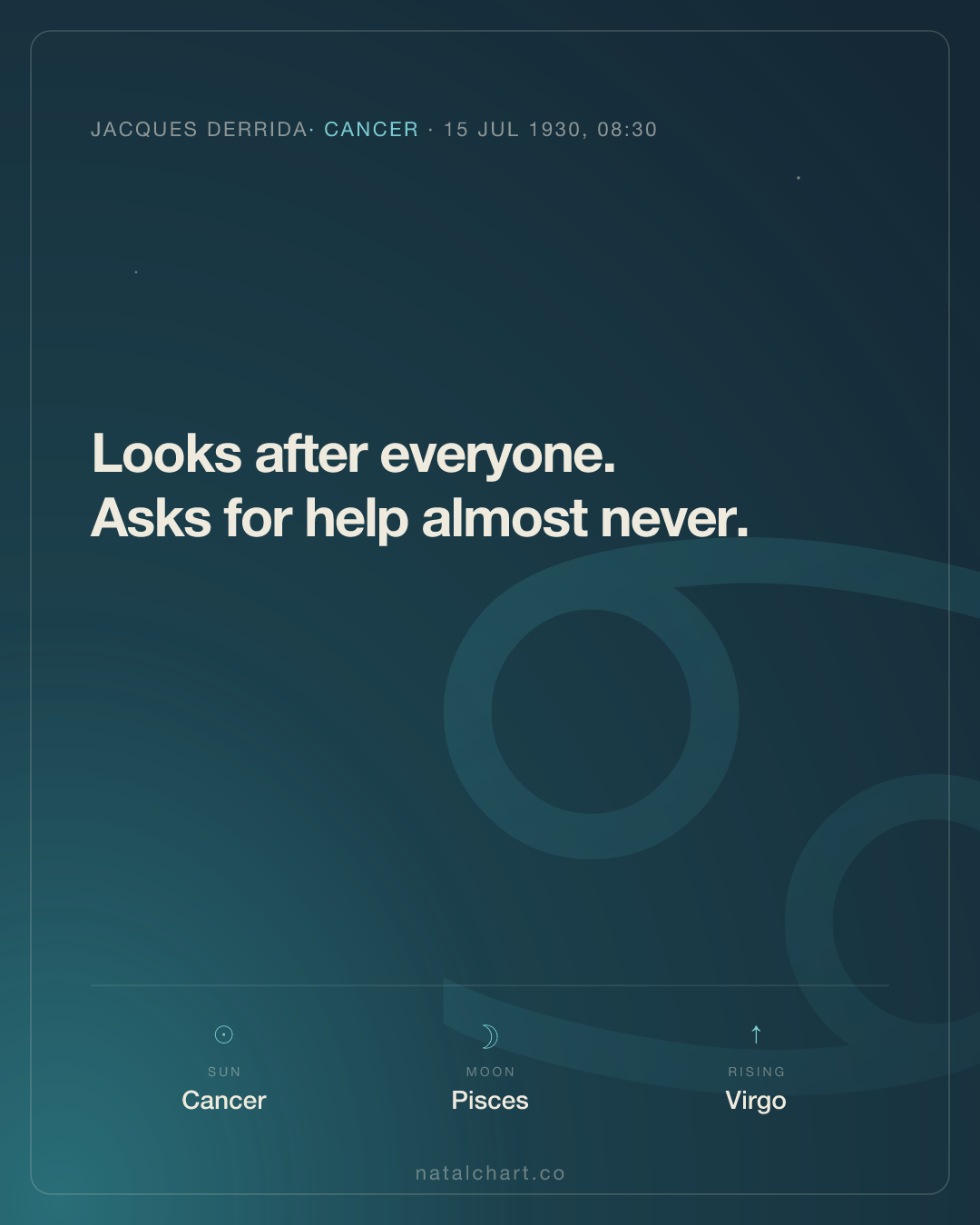 Share
Share
Birth
1930-07-15 · 08:30 · El Biar, Algeria Reliability: AA · vetted record
The Core: A Mind That Dissolves What It Touches
Derrida was a thinker whose natural instrument was suspicion — not cynical suspicion, but the precise, patient kind that asks what a word is doing and notices that it is always doing more than one thing at once. The Sun in Cancer joined to Mercury (the two planets are less than a tenth of a degree apart, which is extraordinarily close) in the eleventh house reveals a mind that thinks through bonds of feeling and collective affiliation, never in cold isolation. Cancer gives the intellect a quality of intimate attentiveness — it registers nuance, inflection, what is said by omission. Mercury here is the mind as caretaker of meaning, sensing where language shelters and where it hides.
The Ascendant in Virgo (the sign that rises over the horizon at birth, describing the face one meets the world with) sets the register for how all of that intelligence is expressed: precisely, carefully, with a commitment to the detail rather than the grand gesture. Those who attended Derrida's seminars describe a lecturer who moved with great deliberateness through a text, pausing over a single word for twenty minutes, turning it over until the audience saw it had become strange. That is Virgo: the love of the small thing that turns out to be immense.
Emotional Life: The Fluid Interior
The Moon in Pisces in the seventh house speaks of an emotional life that moves by resonance and permeation rather than clear lines. Pisces dissolves boundaries; in the seventh house, this played out in Derrida's relationships — both intellectual and personal — as an unusual capacity for identification, for taking on the position of the other not as a rhetorical maneuver but as a genuine act of inhabitation. His method of reading — staying inside a text until the reader is no longer certain where the author ends and the reading begins — is almost a literal chart description.
Pisces also carries vulnerability to dissolution, to losing the thread of oneself in the other's current. Derrida's lifelong engagement with questions of identity, of the self that is always already haunted by what it is not, has the texture of someone who lived this question rather than merely theorized it. He was born in French Algeria to a Jewish family, and grew up caught between worlds that did not fully claim him — neither fully French nor fully Algerian, neither quite at home. That lived displacement is Moon in Pisces in the seventh: belonging through relation, never through fixed ground.
The Tightest Thread: Mercury-Sun and the Mind That Is the Person
The conjunction of Sun and Mercury so close — 0.1 degrees, essentially the same point in the sky — means Derrida's identity and his intellect were the same instrument. He was not a person who also happened to think; thinking was the form his selfhood took. For Derrida, there was no part of himself that stepped back from language to observe it neutrally; he was inside it, always, which is precisely why he could see that everyone else was too.
The cluster in Cancer in the eleventh house — Sun, Mercury, Jupiter, and Pluto all grouped there — is not merely a generational signature but a profoundly personal one for Derrida: several of his most personal planets align in the house of intellectual community, collective dialogue, and the ideas that move through a generation. Of Grammatology was published in 1967 and within a decade had changed the way literature and philosophy were taught across the world. That is the eleventh house at its most precise: the individual mind that becomes, almost against its own intention, a collective current.
Venus and Neptune: Precision as Aesthetic
Venus in Virgo on the Ascendant, joined to Neptune (just over one degree apart), gives Derrida an aesthetic standard of startling precision. Venus in Virgo at its most characteristic cares about form, about the exact word, about the difference between almost right and exactly right. Neptune alongside it adds something more diffuse — a sensitivity to what floats beneath the surface of a text, to connotation, to the unsaid. Together they describe a writer for whom the sentence was never merely informational: it had to enact its own meaning, perform what it said. His prose style, notoriously difficult and dense, was not accidental difficulty — it was the difficulty of precision about things that resist precision.
Mars: The Combative Edge at the Midheaven
Mars in Gemini in the tenth house — the tenth house is the public point of the chart, called the Midheaven, describing career and public image — places the combative, quicksilver energy of Gemini's Mars right in the arena of professional life. Derrida was a tireless debater, a fighter in the philosophical ring who relished the encounter. His 1971 confrontation with John Searle over speech-act theory, collected in Limited Inc, is one of the most entertainingly combative exchanges in modern philosophy — Mars in Gemini enjoying every word. At the same time, Mars in tension with both Venus and Neptune (tight squares of 0.2 and 1.3 degrees respectively) shows how this combativeness could strain the relationships Venus rules and the collaborative generosity Neptune seeks.
The Midheaven in Gemini itself describes a public vocation built around the pair and the multiple — not single truths but the play of difference, the conversation that never resolves. Deconstruction, as a method, is the Midheaven in Gemini made into philosophical system.
Jupiter-Saturn Opposition: Expansion Against Boundary
Jupiter in Cancer in the eleventh house sits opposite Saturn in Capricorn in the fifth. These two slow planets pulling against each other is the tension between the impulse to affirm and expand (Jupiter) and the demand for limit, form, and critique (Saturn). For Derrida, this was not merely a psychological tension but the intellectual nerve of his work: every text both affirms a meaning and immediately opens the gap through which that meaning leaks. The generous, affiliative Jupiter in Cancer builds communities of readers; the rigorous Saturn in Capricorn in the house of creative expression asks whether any community of readers has not also closed something off.
He described this tension himself in interviews, noting that deconstruction was not nihilistic destruction but something closer to a faithful, patient reading that takes the text seriously enough to follow it to its own internal contradictions. That is Jupiter and Saturn locked in productive opposition.
Chiron and the Deep Wound of Belonging
Chiron in Taurus in the ninth house — Chiron marks the point of an old wound that, when worked through, becomes a particular gift — places this in the territory of belief systems, of the great cultural and philosophical frameworks that tell us who we are and where we come from. The wound for Derrida was one of cultural homelessness: the French-Algerian Jew who was expelled from his school during the Vichy years (he was ten years old), who arrived in Paris to discover he was not quite French, who spent his life inhabiting the margins of every identity he was assigned. That wound — Chiron in the ninth, in Taurus, the sign of ground and rootedness — became the exact mechanism through which he produced work that showed all cultural identities to be constructed, provisional, and haunted by what they exclude.
The North Node in Aries (the Node describes the direction a life is called toward) points toward action, initiative, and a willingness to move first without waiting for permission. Derrida's trajectory — from a boy told he did not fully belong anywhere to the philosopher who made belonging itself the central philosophical question — is one of the more precise cases of a North Node actually being lived.
Uranus in the Eighth House: The Shock That Breaks the Frame
Uranus in Aries in the eighth house — the eighth house governs what lies beneath the surface, what is hidden, what is shared in depth — gives the chart a capacity for sudden, destabilizing insight. Uranus brings the rupture, the moment when the frame fails. In the eighth house, this plays out in encounters with what cannot be fully assimilated: death, the unconscious, the other that is truly other. Derrida spent the last years of his life writing extensively on mourning — the essays collected in The Work of Mourning — with a quality of directness about loss that those who knew him found both philosophically rigorous and deeply personal. Uranus in the eighth: the philosophical shock of mortality, channeled into thought.
The Portrait as a Whole
What holds the chart together is the meeting of an extraordinarily sensitive, permeable emotional instrument (Moon in Pisces, Venus-Neptune, the Cancer cluster) with a commitment to precision and critical rigor that never allowed feeling to become careless (Virgo Ascendant, Saturn in Capricorn, Midheaven in Gemini). Derrida did not choose between warmth and precision; he built a philosophical practice out of refusing to choose. His work is hard to read not because it is cold but because it is trying to be precise about warmth itself — about the way language loves what it cannot quite hold.
The tightest aspect in the chart, Sun conjunct Mercury at a tenth of a degree, says simply: this person and this mind were one thing. Philosophy, for Derrida, was not what he did — it was what he was. Everything else follows from that.
The chart
How to read it →Frequently asked questions
What is Jacques Derrida's zodiac sign?
Jacques Derrida's Sun sign is Cancer — the Sun was in Cancer at birth (1930).
What is Jacques Derrida's moon sign?
Jacques Derrida has the Moon in Pisces. The Moon sign describes the emotional and instinctive layer of the chart.
What is Jacques Derrida's rising sign?
Jacques Derrida's rising sign (ascendant) is Virgo — the sign on the eastern horizon at the moment of birth.
When and where was Jacques Derrida born?
Jacques Derrida was born in 1930 in El Biar, Algeria.