Juan Rulfo — natal chart
What does Juan Rulfo’s natal chart reveal?
Juan Rulfo, born Juan Nepomuceno Carlos Pérez Rulfo Vizcaíno on May 16, 1917, in Sayula, Mexico, was a writer and photographer whose small body of work exerted an outsized influence on Latin American and world literature. His short story collection El Llano en llamas (The Plain in Flames, 1953) portrayed the rural poor of Jalisco with sparse, unadorned prose. His novel Pedro Páramo (1955) constructed a haunted village populated by the dead and is considered a foundational text of magical realism, acknowledged as a major influence by Gabriel García Márquez and Juan Carlos Onetti. Rulfo also worked as a photographer, documenting rural Mexico. He received the Cervantes Prize in 1983 and died in Mexico City on January 7, 1986.
 Share
Share
Birth
1917-05-16 · 05:00 · Sayula, Mexico Reliability: AA · vetted record
The core: a Taurus with the dead for company
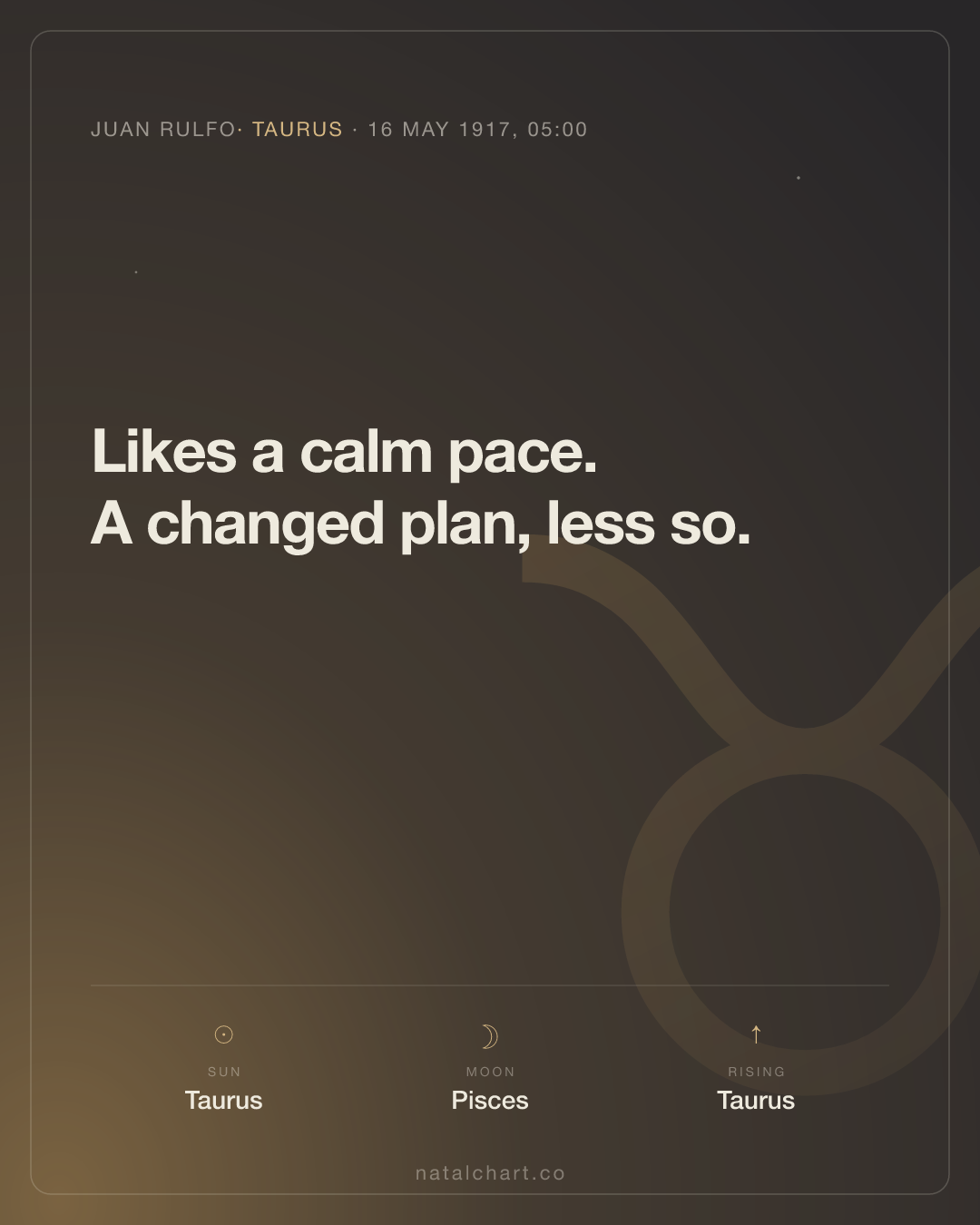
There is a paradox at the heart of Juan Rulfo's chart that mirrors the paradox of his work: the person and the writer appear, at first glance, to want opposite things. Five planets in Taurus — including the Sun, Mercury, Mars, and Jupiter, all in the first house, the house of the self and the immediate presence — describe someone with an almost geological solidity. Taurus is the sign of the tangible, the patient, the quietly stubborn, the person who knows that anything worth making takes time and demands to be built from real materials. The Ascendant, too, is Taurus: the face Rulfo presented to the world was exactly the same as his interior — unhurried, economical, grounded in the physical. He was famously reticent. He gave few interviews. He wrote very little, and nothing idly.
And yet what he wrote was populated by ghosts.
That is where the Moon comes in. In Pisces in the eleventh house — the house of collective belonging, of what connects one person to many — the Moon in Pisces describes an emotional interior that is radically different from the fixed-earth exterior. Pisces is the sign that dissolves boundaries, that hears the voices of the absent, that holds grief without being destroyed by it. The Taurus body and mind build the container; the Pisces Moon fills it with the uncanny. This is the chart that produced Pedro Páramo: a novel as solidly structured as a dry-stone wall, inhabited entirely by the dead.
Mercury and Saturn: the architecture of silence
The tightest aspect in the entire chart is Mercury in exact step with Saturn — a separation of only 0.4 degrees, practically a single point. Mercury governs the mind, language, and how thought becomes expression. Saturn governs structure, discipline, and the refusal to accept shortcuts or decoration. When the two are this close, the mind thinks like a builder: every sentence must bear weight, every word must earn its place, anything that can be cut should be cut.
Rulfo's prose became famous for exactly this quality. His sentences in El Llano en llamas — the 1953 short story collection that first announced him — are among the most stripped and exact in the Spanish language. He reportedly spent years revising, removing, reducing. The Saturn discipline is not dryness; it is a precision that paradoxically makes the silences around the words louder. What is not said in a Rulfo story does as much work as what is said.
This Mercury is also in easy flow with the Moon in Pisces, suggesting that the precision of the language and the ghost-haunted emotional world are not at war with each other — they collaborate. The spare sentence allows the unspoken grief to breathe.
The Moon in Pisces: grief as a form of attention
Rulfo was six when his father was shot during the Cristero War. He was ten when his mother died. He was raised partly by relatives, partly in an orphanage. The Moon in Pisces in the eleventh house does not explain these events — no chart placement does — but it does describe the particular quality of attention that such a childhood can produce: a porousness to loss, a capacity to hold the dead as present, a sense that the boundary between here and gone is thin.
Pedro Páramo, his 1955 novel, is set in a village called Comala that the narrator arrives at only to discover is populated entirely by the dead who speak, remember, and continue their old quarrels. García Márquez famously said he had read it more than a dozen times and could recite it from memory. The Moon in Pisces does not create loss — but it creates the kind of imagination that can make loss into form.
Saturn in Cancer: memory as architecture
Saturn — structure, discipline, time — sits in Cancer, the sign of memory, home, family, and what is inherited and cannot be discarded. In the third house, which governs communication, writing, and the immediate environment, this placement gives the work a particular orientation: the past is not backdrop but material. Rulfo's rural Jalisco — the ravines, the dust, the abandoned villages of the Cristero War's aftermath — is not atmosphere in his fiction. It is the substance of everything.
Saturn in Cancer in the third house also pulls against the moon with a harmonious angle — structure and feeling working together rather than against each other. The grief is architectural; the memory has walls and floors. This is what keeps Pedro Páramo from becoming formless, what keeps the dead from being merely melodramatic: the feeling is exact, the structure holds.
Venus in Gemini: photography and the twin record
Venus in the second house — the house of what one values, what one works with, what sustains — is in Gemini, the sign of duality, documentation, and the two-sided record. Rulfo was also a distinguished photographer, spending years documenting rural Mexico. Venus in Gemini in the house of values suggests that the camera and the pen were not separate activities but twin forms of the same attention: looking closely, capturing what is about to disappear, honoring what official culture tends to overlook.
His photographs of indigenous communities, of eroded landscapes, of faces marked by work and weather, carry the same qualities as his prose: economy, precision, and a profound respect for the subject that refuses the picturesque.
The Midheaven in Aquarius: a vocation that outlives its maker
The Midheaven — the career and vocation point, the highest point in the chart — is in Aquarius, the sign of the collective, the future, and the capacity to change what comes after. Rulfo wrote almost nothing after Pedro Páramo. There were fragments, scripts, a few essays. But the Aquarius Midheaven suggests that the measure of the work was never going to be volume or productivity — it was going to be influence, the way an idea released into the right moment shapes what others then do.
The acknowledgment came slowly, as Aquarian things sometimes do: the Cervantes Prize in 1983, and, far more measurably, the transformation of Latin American literature. García Márquez, Onetti, Carlos Fuentes — all named him. The magical realism that swept the world in the 1960s and 1970s runs a direct line through Pedro Páramo. Uranus, the traditional ruler of Aquarius, sits in the tenth house, the house of public standing. A disrupting planet in the house of legacy: the work rewrites the rules.
Sun square Uranus: the deliberate break
The Sun in Taurus pulls against Uranus in Aquarius at 1.4 degrees — a tension between the desire for stability and solidity on one side, and the impulse toward rupture and reinvention on the other. In a writer, this shows up as a person who by temperament might prefer the traditional and the rooted, but whose deepest creative moves are always radical breaks with existing form.
Pedro Páramo did not just tell a story about the dead — it dismantled narrative linearity, collapsed time, and placed the reader inside a mind that cannot distinguish past from present. This was not experimentalism for its own sake; it was Taurus pragmatism applied to a radical problem. The form had to break because the story could not be told inside a form that assumed the living were more real than the dead.
Chiron in Pisces: the wound that becomes the work
Chiron — an asteroid associated with an early wound that over time transforms into the capacity to reach others — sits in Pisces in the eleventh house, alongside the Moon. The Pisces placement and the eleventh house both point toward collective experience: the grief is not only personal, it connects to something shared, to a community of loss. Rulfo's Jalisco was a region devastated by the Cristero War and its aftermath, depopulated by death and emigration. His fiction gave voice to that collective silence.
The North Node — the direction of growth and purpose — is in Capricorn, the sign of enduring structures, of what is built to last. For someone with such a small body of work, the growth edge was never about quantity. It was about making something that would stand.
A portrait in full
Juan Rulfo's chart describes a person who was outwardly Taurus to the core — patient, physical, economical with words and gestures — and inwardly tuned to frequencies most people cannot hear: the voices of the absent, the grief of a landscape, the persistence of the dead. The five Taurus planets gave him the discipline to build the vessel tight enough to hold that material without it spilling into sentiment. The Pisces Moon gave him the permeability to hear what needed to be said.
Saturn and Mercury working together — that 0.4-degree precision — produced prose of extraordinary compression: two small books that together reshaped world literature. The Aquarius Midheaven ensured the work was not for his moment but for the moment after. And the Sun in tension with Uranus made sure that when he finally broke the form open, he broke it completely.
He received the Cervantes Prize in 1983, three years before he died. The recognition was overdue, the way it often is when someone has built something that the present cannot yet fully measure. What Rulfo left is not a large body of work. It is a key.
The chart
How to read it →Frequently asked questions
What is Juan Rulfo's zodiac sign?
Juan Rulfo's Sun sign is Taurus — the Sun was in Taurus at birth (1917).
What is Juan Rulfo's moon sign?
Juan Rulfo has the Moon in Pisces. The Moon sign describes the emotional and instinctive layer of the chart.
What is Juan Rulfo's rising sign?
Juan Rulfo's rising sign (ascendant) is Taurus — the sign on the eastern horizon at the moment of birth.
When and where was Juan Rulfo born?
Juan Rulfo was born in 1917 in Sayula, Mexico.