Luchino Visconti — natal chart
What does Luchino Visconti’s natal chart reveal?
Luchino Visconti (1906-1976) was an Italian film and theatre director, a founder of neorealism with 'Ossessione' and 'La Terra Trema'. Born into nobility, he later directed sumptuous historical epics such as 'The Leopard' and 'Death in Venice', becoming one of postwar Italy's most influential auteurs.
 Share
Share
Birth
1906-11-02 · 19:30 · Milan, Italy Reliability: AA · vetted record
A Double Who Sees Everything
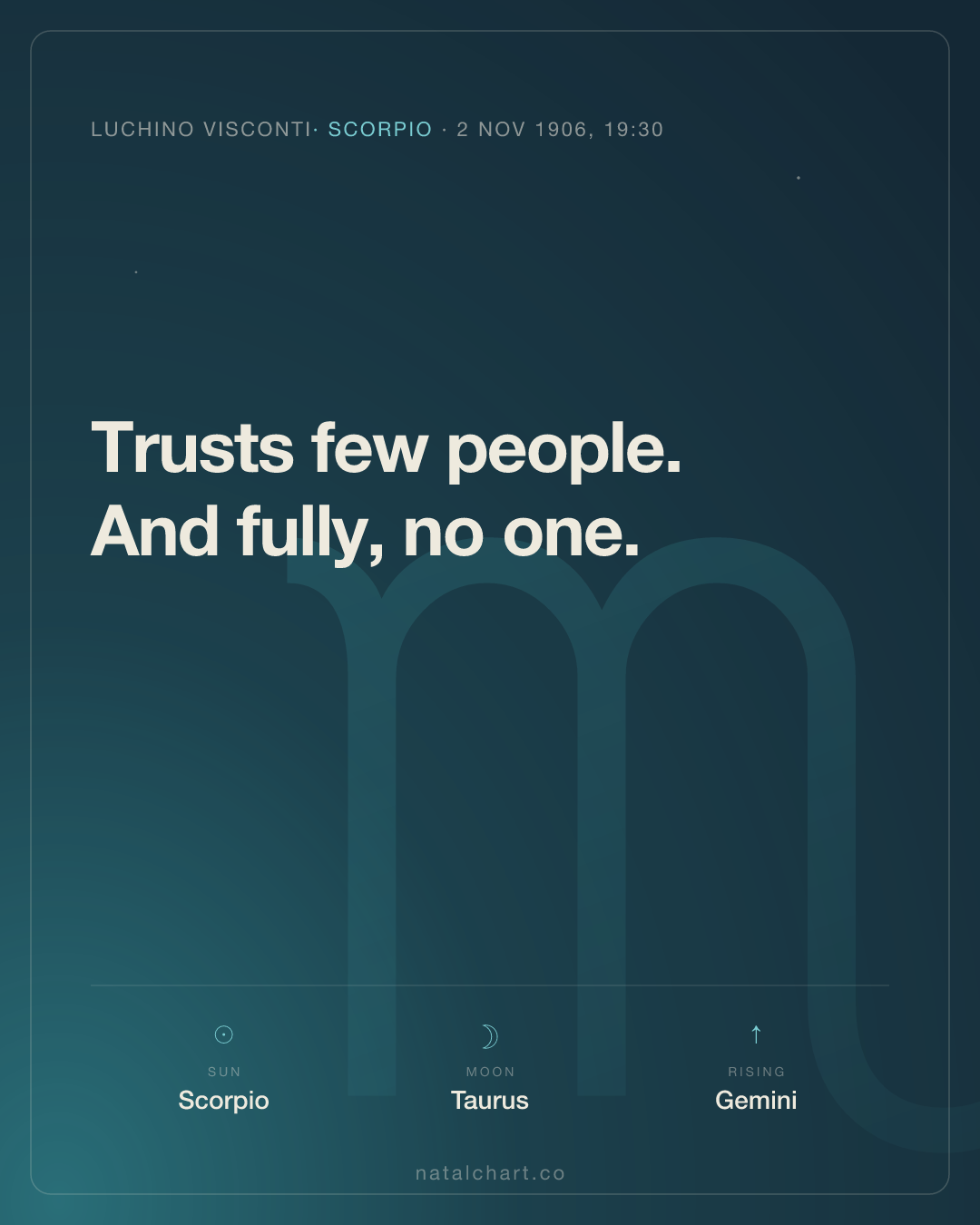
Luchino Visconti arrived in the world with Gemini on the Ascendant (the face he met the world with), and Pluto — the planet of depth, hidden forces, and radical transformation — sitting right there alongside it in the first house. Pluto-Gemini on the Ascendant is a study in paradox: a surface that speaks, observes, and adapts, while underneath runs a current of inexorable will. Visconti was the great Italian director of surfaces — exquisite costumes, decaying palazzos, operatic gestures — and simultaneously the unsparing analyst of everything those surfaces concealed. He could not stop seeing through things even as he polished them to a magnificent sheen.
And he was a man of genuine contradictions. Born into the Milanese aristocracy, a count with an ancient name, he became a Communist. He began his career documenting Sicilian fishermen in La Terra Trema with rigorous neorealist discipline, then spent the rest of it in lavish baroque spectacle. Both impulses are completely legible in this chart.
Sun in Scorpio: The Craftsman in the Dark
His Sun sits in Scorpio, in the sixth house — the house of daily work, craft, and service. Scorpio governs depth, intensity, and the refusal to stay on the surface of anything; the sixth house is unglamorous and precise, concerned with the actual making of things rather than their public reception. This placement belongs to someone who is most alive in the work itself: in the cutting room, in the rehearsal, in the private argument with a cinematographer over a single shot. Visconti was notoriously demanding, relentless in his pursuit of a particular truth in each scene. The Sun trines Saturn — in easy, flowing alignment — with an orb of just one degree: what he built, he built to last. Ossessione, Rocco and His Brothers, The Leopard, Death in Venice — the work does not fade.
The Sun also trines both Jupiter and Neptune with equally tight orbs, forming a grand trine in water signs across the sixth, second, and tenth houses. This is a signature of sustained creative abundance: the ability to pour enormous emotional and material resources into work and to produce something that moves people at the level of feeling, not just intellect. The Leopard, in particular — that elegiac portrait of an aristocracy passing from the world — is the exact film this configuration would write.
Moon in Taurus: The Hidden Sensualist
The Moon in Taurus in the twelfth house tells a quiet but essential story. Taurus governs beauty, physical pleasure, and the tangible world; the twelfth house is private, withdrawn, the place where things are felt before they are spoken. Visconti's emotional life was deeply interior. The extraordinary attention to material detail in his films — the exact weave of a fabric, the light falling across a specific hour of the afternoon, the composition of a dinner table — was not decorative. It was how he felt the world. Sensuousness was his private language, translated into cinema.
The twelfth-house Moon also suggests a capacity for deep solitude and for keeping the most intimate feelings carefully out of sight. He was a public figure of enormous force and a very private person. That combination, in someone born into a family that expected both grandeur and discretion, makes complete sense.
Mercury and Venus in Sagittarius: Vision Before Craft
Mercury and Venus both land in Sagittarius in the seventh house — the house of encounter, dialogue, and the Other. Sagittarius thinks in wide arcs, is drawn to philosophy and grand narrative, and is allergic to the merely adequate. For a film director, this is the placement of someone who begins with the largest possible question — about history, about class, about the decay of beauty — and then finds the story that can carry it.
Mercury sextiles Mars with a one-degree orb: the communication and the will to act are in productive dialogue, closely linked. Words do not just describe; they mobilise. Visconti was a theatre director as much as a film director, and his stagings were renowned for their conceptual clarity and their dramatic force. He argued for his interpretations and won.
Venus in Sagittarius amplifies the grandeur: beauty, for him, was not intimate and miniature but expansive and historical. The costumes, the sets, the casting of particular faces — all of it was in the service of a vision larger than any individual scene.
Jupiter and Neptune: The Grand Gesture
Jupiter and Neptune sit together in Cancer in the second house, in a conjunction of just one and a half degrees. Cancer is the sign of memory, family, and emotional roots; the second house governs material resources, production value, and what one considers worth investing in. Jupiter conjunct Neptune here is lavish, almost extravagantly so — it places the highest value on the beautiful and the emotionally resonant, and it trusts feeling over calculation.
In practical terms: Visconti's productions were legendary for their expense and their opulence. Stories circulated about furniture bought for period-accurate rooms that never appeared on camera. The production of Senso, of Ludwig, of The Innocent — each was an act of material excess in the service of emotional truth. Jupiter-Neptune in Cancer does not ask whether it can afford to make something beautiful; it asks only whether it is beautiful enough.
This conjunction also trines Saturn: the extravagance had structure. Visconti was not reckless — he was methodical about excess, purposeful about waste. The grand gesture was always in service of a specific, defensible idea.
Mars in Libra: The Elegant Fighter
Mars in Libra in the fifth house — the house of creative expression — is a particularly telling placement. Libra is the sign of balance, proportion, and refined judgment, and it does not sit entirely comfortably with the raw drive of Mars. The result is not weakness but refinement: a director whose creative combativeness expressed itself through aesthetic argument, through the insistence on getting the exact tone right, through the refusal to accept a scene that was merely good when it could be precisely right. The fifth house governs the creative act itself, the artistic signature.
Mars squares Uranus: creative will and the impulse toward the unconventional pull against each other. Visconti moved from neorealism — radical, austere, working-class — to aristocratic historical epic, a journey that in retrospect looks like a tension between two irreconcilable poles held in productive friction throughout a forty-year career.
Midheaven and Saturn: The Long Discipline
The Midheaven — the public and career point of the chart — falls in Aquarius, and it is ruled by Saturn in Pisces in the tenth house. Saturn in the tenth is, in the traditional reading, the signature of serious, hard-won, long-lasting public achievement. It does not come quickly and it does not depart quickly. Visconti's reputation as a master of his form was built over decades; it was not the reputation of a prodigy or a fashion, but of a sustained body of work.
Aquarius on the Midheaven adds something important: the public identity carried an element of deliberate provocation, of positioning oneself against the current order. A Communist aristocrat making films about the death of the aristocracy is a perfectly Aquarian public stance — committed to the collective, suspicious of its own class, using the tools of one world to diagnose another.
Saturn sextiles Uranus: the discipline and the disruption were not at war in his public life. They were in dialogue.
Chiron and the North Node: The Wound of Ideas, the Calling of the Stage
Chiron (the point that marks an old wound that becomes a gift over time) sits in Aquarius in the ninth house — the house of ideas, philosophy, and the broad intellectual frame. The wound here is around ideas that are too large, too impersonal, too utopian for the world as it is; the recurring experience of a vision that cannot be fully realised in the material conditions available. Visconti spent his career in exactly that tension: films made on the grandest intellectual scale that were always, in some measure, constrained by what was producible, speakable, permissible.
The North Node sits in Leo — the calling was toward performance, toward the full expression of a creative self in front of an audience, toward standing in the light rather than observing from the wings. For someone born into a world of inherited privilege and intellectual achievement, the deeper work was learning to be seen as a maker rather than as a name.
The Aspects That Shaped the Work
The tightest aspects in this chart form an interlocking web. Sun trine Saturn (one degree): the identity and the discipline move together, and together they produce lasting form. Jupiter conjunct Neptune (one and a half degrees): the capacity for beautiful excess, for the film that costs more than it should because it must. Sun trine Jupiter (one and two-thirds degrees): optimism about the scope of what is possible, a refusal to think small. Jupiter trine Saturn (two and two-thirds degrees): the ability to sustain large, expensive, ambitious projects over long periods of time without either losing the vision or running out of the will to finish.
Mars square Uranus (three and a third degrees) adds the productive friction: the tension between the traditional and the rupturing, between preservation and destruction, which gives the best films their particular charge.
A Portrait in Full
Luchino Visconti's chart is the map of a man who contained a genuine and irresolvable contradiction — aristocrat and Communist, sensualist and analyst, maker of beautiful surfaces and their most relentless critic — and who turned that contradiction into one of the most distinctive bodies of work in European cinema.
The Sun-Saturn trine grounded the work across a forty-year career. The Jupiter-Neptune conjunction in Cancer filled it with beauty and emotional excess. The Scorpio Sun kept it honest about what those beautiful surfaces were actually covering. The Gemini Ascendant kept him watching, always watching — curious, double, never wholly committed to any single version of the truth.
Chiron in the ninth suggests the ongoing wound was the gap between the vision and what could actually be made. The films he completed are, in that light, not triumphs over that gap but negotiations with it — and those negotiations produced The Leopard, Death in Venice, Rocco and His Brothers. The gap was generative.
The chart
How to read it →Frequently asked questions
What is Luchino Visconti's zodiac sign?
Luchino Visconti's Sun sign is Scorpio — the Sun was in Scorpio at birth (1906).
What is Luchino Visconti's moon sign?
Luchino Visconti has the Moon in Taurus. The Moon sign describes the emotional and instinctive layer of the chart.
What is Luchino Visconti's rising sign?
Luchino Visconti's rising sign (ascendant) is Gemini — the sign on the eastern horizon at the moment of birth.
When and where was Luchino Visconti born?
Luchino Visconti was born in 1906 in Milan, Italy.