Lucio Dalla — natal chart
What does Lucio Dalla’s natal chart reveal?
Lucio Dalla was an Italian singer-songwriter, musician and composer, born on 4 March 1943 in Bologna. Beginning as a jazz clarinettist, he became one of Italy's most inventive and beloved songwriters. His album Come è profondo il mare (1977) marked his maturity as a lyricist, followed by Lucio Dalla (1979), which contained the enduring hits Anna e Marco and L'anno che verrà. His song Caruso (1986) became a worldwide standard recorded by many artists. He also wrote Itaca and the much-loved 4 marzo 1943. A constant innovator who blended pop, jazz and folk, he performed and recorded for over five decades. He died in 2012 while on tour, mourned as one of the central figures of Italian songwriting.
 Share
Share
Birth
1943-03-04 · 08:15 · Bologna, Italy Reliability: AA · vetted record
The Man Who Heard Bologna Thinking
Lucio Dalla began by playing jazz clarinet in clubs, which is how you learn to listen. You listen to the room, to the space between notes, to what the other musicians are about to do before they do it. That habit of attention never left him. By the time he became one of Italy's most beloved songwriters, he was still essentially a jazz musician: someone who improvised around the truth of a moment, who found the note that named what a whole country was feeling but had not yet put into words.
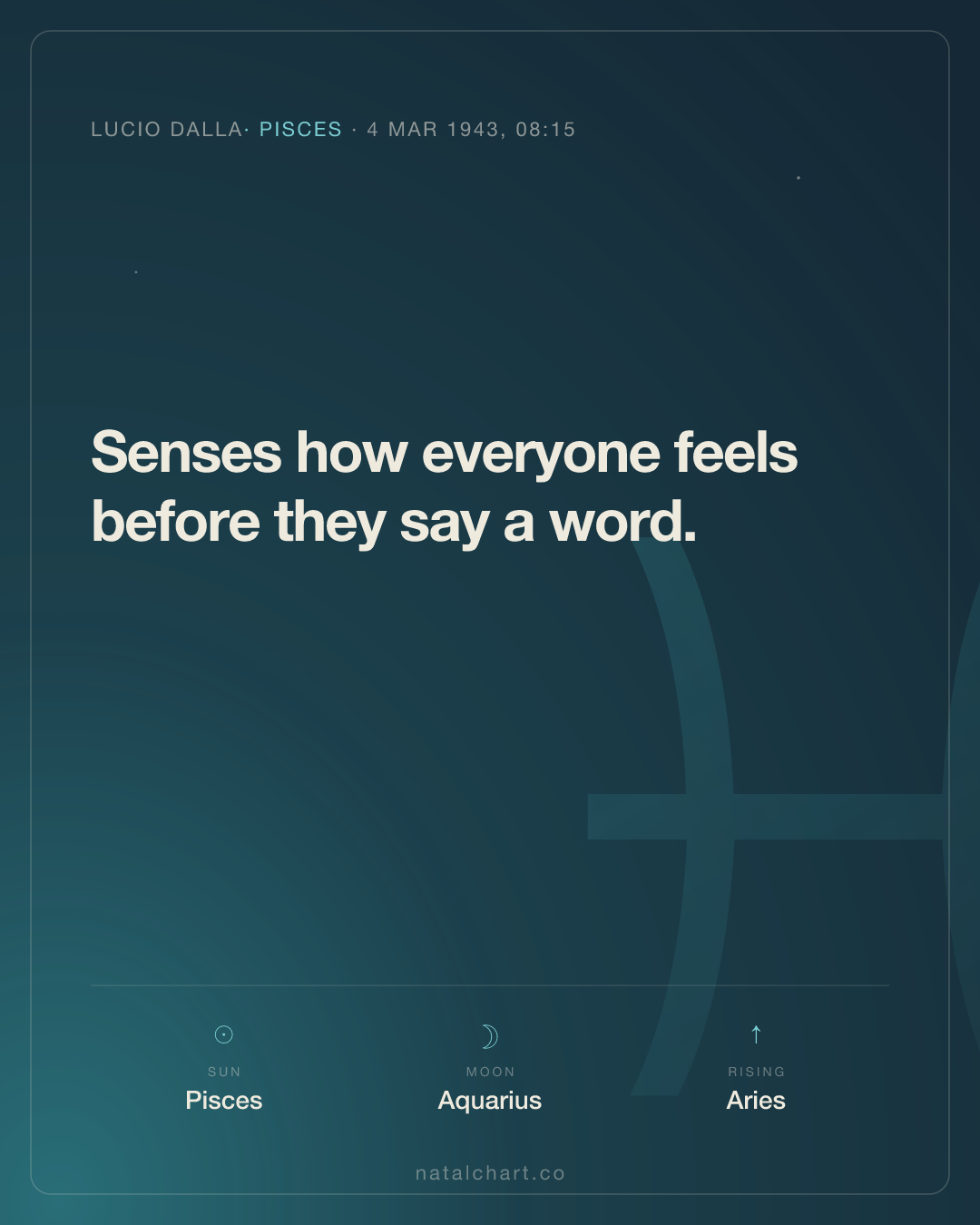
The chart behind this life is striking: a Pisces Sun buried in the twelfth house — the most interior, least visible place in the zodiac — paired with an Aries Ascendant (the face one meets the world with) that is direct, immediate, and impossible to ignore. The private man and the public performer were very different versions of the same person.
Pisces Sun in the twelfth house: the artist who lives in the invisible
The Sun was in Pisces, in the twelfth house — the section of the chart associated with solitude, with what happens beneath the surface, with the imagination that works in the dark. Pisces is the sign of permeability: it takes in the emotional weather of everyone nearby and turns it into something expressible. The twelfth house adds another layer of interiority; it is the house of the private life, of spiritual search, of what is not spoken in the daylight.
Levi wrote in a letter that the hardest thing about Auschwitz was the destruction of the private self — the erasure of the inner life that makes a person human. Dalla's twelfth-house Sun was the inverse: an inner life so rich, so full of images and voices, that it needed a public form to contain it. The album Come è profondo il mare (1977) — whose title translates as How Deep Is the Sea — was the first full expression of this: songs that moved like water through the gaps between the things people say to each other.
Aries Ascendant: the man you actually met
The Ascendant — the sign rising at the moment of birth, the face one presents to the world before the interior has been reached — was Aries. Aries is the sign of immediate presence: energetic, warm, physically direct, impossible to ignore in a room. Everyone who met Dalla described this quality. He was small, distinctive-looking, boundlessly energetic, and he filled whatever space he occupied.
Venus, the planet of beauty and artistic values, sat right on the Aries Ascendant — in the first house, conjunct the rising sign. This means the warmth, the charm, the irresistible quality of his public persona was not performed: it was structural. The way he moved through the world was aesthetically generous. And in flowing relationship with Pluto (the planet of depth and magnetism), this Venus-Ascendant gave him a presence that people remembered for decades after meeting him once.
Moon and Mercury in Aquarius, eleventh house: the songwriter who thinks in we
The Moon — the emotional interior, how someone processes feeling — was in Aquarius, in the eleventh house. Aquarius is the sign of the collective, the group, the future; the eleventh house is the house of society, of community, of the audience. A Moon here does not feel things only personally; it feels them collectively. The pain of a generation is also its own pain. The hope of a year is also its hope.
This placement explains L'anno che verrà (1979) more clearly than almost any biographical note could. The song imagines the arrival of a new year as the return of something better — vague enough to contain everyone's private wish, specific enough to feel personal. It became, and remains, an anthem: something millions of Italians hear at midnight on December 31st and feel, each time, as though it was written for them specifically. A Moon in the eleventh house in Aquarius is the poet of the commons.
Mercury — the mind, the writer's intelligence — was also in Aquarius in the eleventh house, reinforcing this orientation entirely. Dalla thought in social images, in collective scenarios, in the voices of ordinary people caught in historical moments. Anna e Marco (1979), from the same album, is a love story told entirely in the particulars of two specific young people's lives — and yet every Italian who heard it recognized their own story inside it.
Mars in Capricorn, tenth house: the professional
Mars — the planet of drive, discipline, and how someone works toward a goal — was in Capricorn, in the tenth house. The tenth house is the public career; Capricorn is the sign of long-term construction, of patience, of the work that takes decades to appreciate fully. Capricorn Mars does not hurry. It builds.
The Midheaven — the career point, the public vocation — was also in Capricorn, directly reinforced by Mars sitting there. Dalla's career lasted more than five decades, through enormous changes in Italian popular music, without ever settling into a single formula. He kept making new things: the jazz experiments, the pop albums, the theatrical collaborations with Roberto Roversi, the worldwide reach of Caruso (1986), which became a standard recorded by opera singers and pop artists on every continent.
Capricorn Mars delivers on very long timelines. Caruso — written after a visit to the room in Sorrento where the great tenor had died — is now so embedded in the repertoire that many listeners encounter it first as a classic, not knowing who wrote it or when.
Jupiter in Cancer, fourth house: the roots that feed everything
Jupiter — the planet of abundance, generosity, and the quality that one gives to the world — was in Cancer, in the fourth house. The fourth house is the home, the origin, the private foundation from which everything else grows. Cancer is the sign of memory, of attachment to place, of the tenderness that comes from knowing where you are from.
Bologna is in everything Dalla wrote. Not as a postcard or a local-color detail, but as a way of being in the world: ironic but warm, politically engaged but humanist, serious about pleasure. 4 marzo 1943, the song whose title is his own birthday, is a meditation on origin, on the circumstances of a birth, on the accident of being in a particular place at a particular time. Jupiter in the fourth house in Cancer is the artist who draws from the well of home, and the well does not run dry.
Saturn and Uranus in Gemini, third house: the structure and the rupture of language
Saturn — discipline, form, the long craft — and Uranus — innovation, the rupture of convention — were both in Gemini, in the third house. Gemini is the sign of language, of communication, of the mind that moves between registers. The third house governs how one speaks and writes.
This pairing in Gemini produced a lyricist who was technically meticulous (Saturn in Gemini) and formally experimental (Uranus in Gemini) at the same time. Dalla's lyrics do not read like folk songs or like confessional poetry; they read like compressed short fiction — character sketches, narrative scenes, specific gestures that carry enormous weight. The collaboration with the poet Roberto Roversi in the mid-1970s, which produced some of his most ambitious work, was the Uranus-in-Gemini moment: a deliberate break with commercial convention to make something formally new.
Saturn and Uranus in flowing relationship with Neptune (in Libra, seventh house) added another dimension: the craft and the experimentation were always, finally, in service of connection — of reaching the other person across the song.
Chiron in Leo, fifth house: the wound that became a gift
Chiron — an asteroid that in astrological tradition marks the old wound that, once accepted, becomes the deepest source of creative strength — was in Leo, in the fifth house. Leo is the sign of self-expression and performance; the fifth house governs creativity, love, and what one makes for its own sake.
Dalla's early years as a performer were marked by rejection: he was not conventionally good-looking, his voice was unusual, and the early records did not find their audience. The wound of being overlooked or dismissed as a performer was real. What he did with it was to go deeper into the craft — to become so good at the writing and the arrangement that the performance became secondary to the song itself. Chiron in Leo in the fifth house: the gift that grew from the place of earliest hurt.
North Node in Leo: toward the fully expressed self
The North Node — in astrological tradition, the direction of growth across a lifetime — was in Leo. The movement of Dalla's career was from collaborative anonymity (Pisces Sun in the twelfth, Moon in Aquarius) toward fully claimed authorship, toward a signature that was unmistakably his own. The album Lucio Dalla (1979) — titled with his own name, as a statement — marked this arrival. It is the most Leo act possible: to put your name on the thing and own it completely.
The voice that is still heard
Lucio Dalla died in 2012, at sixty-nine, on tour — still performing, still moving. The twelfth-house Pisces Sun that had always lived most fully in the invisible left behind an entirely visible legacy: songs that Italians know by heart, that carry the weight of specific years and specific feelings, that are still played at midnight and still make people feel, somewhere, that something better might be coming.
The jazz clarinettist who learned to listen never stopped. He just found larger instruments.
The chart
How to read it →Frequently asked questions
What is Lucio Dalla's zodiac sign?
Lucio Dalla's Sun sign is Pisces — the Sun was in Pisces at birth (1943).
What is Lucio Dalla's moon sign?
Lucio Dalla has the Moon in Aquarius. The Moon sign describes the emotional and instinctive layer of the chart.
What is Lucio Dalla's rising sign?
Lucio Dalla's rising sign (ascendant) is Aries — the sign on the eastern horizon at the moment of birth.
When and where was Lucio Dalla born?
Lucio Dalla was born in 1943 in Bologna, Italy.