Zico — natal chart
What does Zico’s natal chart reveal?
Arthur Antunes Coimbra, known as Zico, born on 3 March 1953 in Rio de Janeiro, Brazil, is a Brazilian former footballer and football manager. An attacking midfielder celebrated for his free-kick technique, vision and goalscoring, he was nicknamed "the White Pelé". He spent the core of his career at Clube de Regatas do Flamengo, where he debuted professionally in 1971 and led the club to the Copa Libertadores and the Intercontinental Cup in 1981, defeating Liverpool 3-0 in Tokyo. He won three Brazilian national championships with Flamengo (1980, 1982, 1983) and remains the club's all-time top scorer. With the Brazil national team he played at the 1978, 1982 and 1986 World Cups. He later played for Udinese in Italy and for Kashima Antlers in Japan, where he helped launch the J.League. After retiring he managed several clubs and the Japan national team, and briefly served as Brazil's Secretary of Sport.
 Share
Share
Birth
1953-03-03 · 07:00 · Rio de Janeiro, Brazil Reliability: A · reliable data
The core: the dreamer who counted every goal
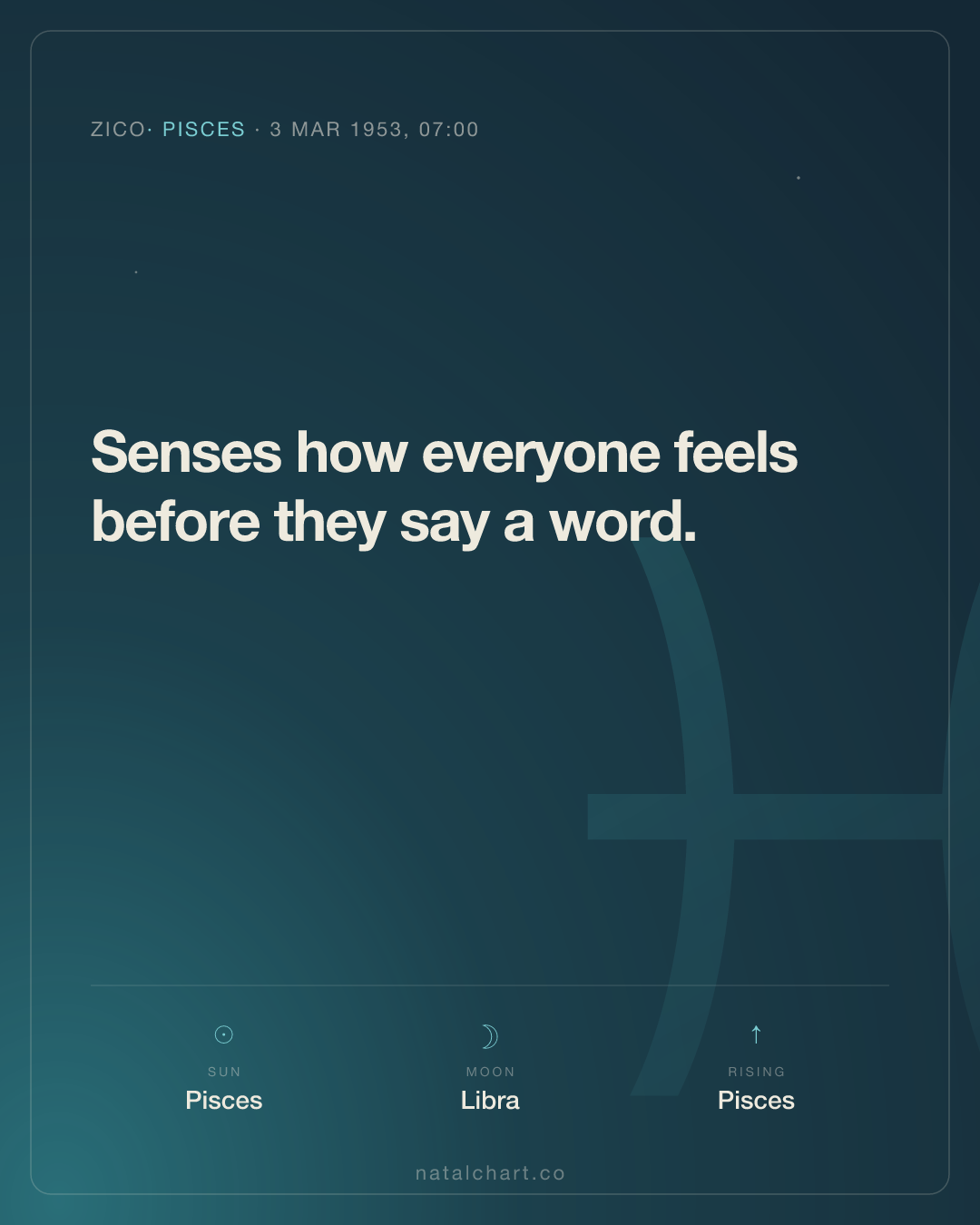
Zico moved across the pitch with something that felt inevitable — not forceful, but inexorable, like a tide. The Sun in Pisces rising on the Ascendant (both in the same sign, both on the horizon at the moment of birth) gives an identity that is porous, intuitive, capable of reading invisible currents in a game. Pisces as both Sun and Ascendant means that what Zico projected to the world was exactly what he was: a player who seemed to operate on a frequency others couldn't quite locate. The nickname "the White Pelé" captured something real — not imitation but a similar quality of making the difficult look effortless, the calculated look spontaneous.
And yet this same chart is full of Aries: Mercury, Venus, and Mars all land in the sign of the pioneer, in the second house (the house of concrete resources, what one builds and keeps). Aries cuts, accelerates, leads from the front. The tension between Pisces and Aries is the tension between vision and execution — between sensing where the game is going and being the one who gets there first. Zico was both: the free-kick taker who had seen the trajectory of the ball before the run-up, and the man who scored 508 goals for Flamengo across his career.
The mind and the attack: Aries fires first
Mercury in Aries in the second house is a mind that decides fast and commits. There is no long deliberation, no infinite weighing of options — there is the read, and then the pass. In the 1981 Intercontinental Cup final against Liverpool, Flamengo won 3–0 in Tokyo, and it was that combination of tactical clarity and physical commitment that dismantled one of the best club sides in the world. Mercury in Aries does not second-guess; it acts on the first correct reading.
Venus and Mars are also in Aries in the second house, adding desire and drive to the same territory. Mars in Aries is among the most natural placements in the zodiac — Mars governs action and Aries is its home. But Mars in a tense relationship (square, meaning in friction) with Uranus in Cancer in the fifth house (3 degrees apart) introduces unpredictability: the flashes of individual brilliance, the sudden swerves in direction. The fifth house governs creative expression and spectacle. That Mars-Uranus friction was part of what made Zico electric to watch — never entirely predictable, always on the verge of something surprising.
The emotional life: depth in private
The Moon in Libra in the eighth house is the interior register, hidden from the public-facing Pisces-Aries identity. Libra needs balance, harmony, the weighing of relationships; the eighth house is the sector of depth, transformation, and what happens in the spaces no camera enters. Saturn and Neptune are also in Libra in the eighth — a generation marker, but one that in Zico's case personalises into an emotional life shaped by discipline and idealism in equal measure.
The Moon in tension with Venus (opposition, meaning pulling against each other, across the chart at 1.1 degrees) describes a recurring friction between the drive toward connection and the demands placed on relationships by a life of competition and travel. Zico played in Brazil, Italy with Udinese, Japan with Kashima Antlers — transitions that uprooted repeatedly, that tested the Libra Moon's need for continuity. Saturn joined to Neptune in the same house adds a layer of quiet seriousness beneath any apparent ease: the emotional maturity that comes from knowing that things built last longer than things felt in an instant.
Values and vision: Jupiter opens the horizon
Jupiter in Taurus in the third house suggests a mind that accumulates knowledge steadily, practically, with an eye for what can be used. In easy collaboration with Uranus in Cancer (sextile, 1.5 degrees apart), this is the placement that led Zico to Japan: the willingness to go somewhere entirely new, to help build something from the ground up, to bet on a culture and a league that did not yet exist as a serious footballing project. Kashima Antlers and the J.League's launch in 1993 — Zico arrived when the whole experiment was in question, and his presence gave it credibility.
That Jupiter-Uranus pattern repeats a theme across the chart: the conjunction of established value (Taurus, Capricorn) with the disruptive and unexpected (Uranus, Aries). Zico was conservative in his technique and radical in where he chose to apply it.
Venus and the weight of beauty
Venus in Aries is passionate, direct, competitive even in what it loves. The opposition to Neptune (the opposing pull, 1.1 degrees — the single tightest aspect in this chart) is a powerful and complicated configuration. Neptune dissolves boundaries, turns the concrete into the ideal, makes what is present feel somehow unreachable. Venus opposite Neptune in the axis between second and eighth houses describes a constant tension between what is tangible and what is longed for — between the goal scored and the game that could have been even better.
The 1982 World Cup in Spain is the place where this tension became biographical. Brazil's 1982 squad is widely considered one of the finest teams never to win the tournament — Zico, Sócrates, Falcão, Cerezo, a generation of technical brilliance eliminated by Italy in a 3–2 defeat that remains one of football's most discussed what-ifs. Venus opposite Neptune describes that experience with uncomfortable accuracy: beauty at its peak, and then its sudden dissolution. Venus in easy flow with Pluto (trine, 3 degrees) adds something else — the capacity to transform loss into lasting meaning, to keep the love of the game intact after the wound.
The career point: a Sagittarian horizon
The Midheaven (the public and career point at the top of the chart) in Sagittarius says that what Zico was remembered for publicly was expansion — taking what he knew across borders, into new cultures, new contexts. The Sagittarian Midheaven is the ambassador, the one who carries something valuable across distance. His career traced exactly that arc: Flamengo as the base, then Italy, then Japan, then management of the Japanese national team, then a brief period as Brazil's Secretary of Sport. Each transition was not retreat but extension.
The Pisces Sun trine Uranus in Cancer (2.1 degrees) reinforces this: an ease with transitions, with crossing from one context to another without losing the thread. Zico in Japan was not a curiosity or an experiment; he was a builder. Kashima Antlers became one of the most successful clubs in the J.League partly because of the culture of seriousness he brought.
The tightest tensions: discipline in the depths
Saturn in conjunction with Neptune in Libra in the eighth house (3.2 degrees apart) is one of the defining patterns here. Saturn is discipline, limit, the long count; Neptune is the dissolution of limits, the ability to transcend the frame. Together in Libra — the sign of balance and relationship — they describe someone who understood that the greatest beauty in football requires rigorous constraint. The free kick taken from 25 metres is not free at all: it is the product of years of calibrated repetition. Zico's technical gift was never separable from the work that produced it.
The sextile between Neptune and Pluto (1.9 degrees) is generational — shared by everyone born in this period — but in this chart it falls across the sixth and eighth houses, linking the daily work ethic to the deeper transformations happening below the surface. Pluto in Leo in the sixth house places the transformative drive directly in the territory of craft, training, the unglamorous daily labour of becoming excellent.
Chiron and the North Node: the long game
Chiron (the chart's indicator of a formative wound that eventually becomes a specific kind of understanding) sits in Capricorn in the eleventh house. The eleventh house is the sector of collective belonging, of teams, of what one contributes to something larger than oneself. Capricorn brings with it a seriousness about legacy, about whether what is built will last. A wound in this territory often shows as doubt about one's place in a larger structure — whether the contribution is enough, whether the team will hold.
The 1982 World Cup, the 1986 World Cup — Zico played three tournaments without winning the one trophy that would have made the record unambiguous. That is the Chiron wound in the eleventh: the team, the collective, the group achievement that slipped away. What grew from it was something more diffuse and arguably more durable: a generation of players and fans for whom Zico represents not a trophy but a standard of how the game should be played. The North Node in Aquarius points toward this — toward the contribution that outlasts any individual result, toward the collective memory that carries a name forward not through statistics but through the quality of what was demonstrated.
A portrait in full
Zico's chart is not the chart of someone who wanted to be famous. It is the chart of someone who wanted to be excellent — and who discovered, perhaps gradually, that excellence at that scale carries its own weight in the world's memory. The Pisces sensitivity and the Aries precision never quite resolved their tension; they held it productively, across decades and continents. The goals scored for Flamengo, the defeat in Spain, the patient work in Japan — each one is legible in the chart, not as prediction but as pattern.
The most telling moment may be the one least remembered: arriving in Japan before the J.League existed as a proven concept, betting on a culture that had barely touched the professional game, and staying long enough to help it take root. That is the Sagittarian Midheaven meeting the Aquarian North Node — the ambassador who leaves something permanent behind, not because he planned a legacy, but because he could not help building wherever he went.
The chart
How to read it →Frequently asked questions
What is Zico's zodiac sign?
Zico's Sun sign is Pisces — the Sun was in Pisces at birth (1953).
What is Zico's moon sign?
Zico has the Moon in Libra. The Moon sign describes the emotional and instinctive layer of the chart.
What is Zico's rising sign?
Zico's rising sign (ascendant) is Pisces — the sign on the eastern horizon at the moment of birth.
When and where was Zico born?
Zico was born in 1953 in Rio de Janeiro, Brazil.