Bernardo Bertolucci — natal chart
What does Bernardo Bertolucci’s natal chart reveal?
Bernardo Bertolucci, born in Parma on 16 March 1941, was an Italian film director and screenwriter. Son of the poet Attilio Bertolucci, he debuted very young and made his name with "Before the Revolution" (1964). He created works marked by history and politics such as "The Conformist" (1970), "Last Tango in Paris" (1972) and the epic "1900" (1976). With "The Last Emperor" (1987) he won nine Academy Awards, including Best Picture and Best Director. Later works include "The Sheltering Sky" (1990) and "The Dreamers" (2003). He died in Rome in 2018.
 Share
Share
Birth
1941-03-16 · 19:25 · Parma, Emilia-Romagna, Italy Reliability: A · reliable data Birth time (19:25) credited to Steinbrecher. In March 1941 Italy observed continuous daylight saving time (UTC+2).
The Director Who Dissolved
Bernardo Bertolucci was born with the Sun, Mercury, and Venus all in Pisces, in the seventh house — the sector of the chart associated with relationships, with the significant other, with the encounter that changes you. Pisces does not hold hard boundaries: it feels into things, absorbs atmosphere, finds the emotional logic in what others experience as chaos. The seventh house placement of three Pisces planets suggests someone whose sense of self was perpetually formed and reformed in the act of engaging with another person — another consciousness, another worldview, another era in history.
His films bear this out. Last Tango in Paris (1972) is almost entirely a study of two strangers forming and destroying each other in a bare apartment. 1900 (1976) is the story of two men — a peasant and a landowner, born on the same day — whose lives mirror and oppose each other across half a century of Italian history. The Last Emperor (1987) follows a single consciousness as it is shaped and reshaped by forces entirely outside its control. In each case, the subject is the permeability of the self.
The Ascendant: The Working Eye
The Ascendant — the face someone presents to the world — was in Virgo, and Neptune was right there with it, in the first house. This is a remarkable configuration for a filmmaker. Virgo is the sign of craft, of precise observation, of the eye that notices the detail everyone else steps past. Neptune, the planet associated with image, with dissolving borders, with the camera's capacity to make the unreal feel real, sat directly on that Ascendant. The result was a director who approached his material with a craftsman's rigor — meticulous framing, careful composition, documented research — while allowing the finished image to carry an atmospheric charge that resisted straightforward interpretation.
The Sun in Pisces stood directly across from that Neptune, in an almost exact opposition — less than a degree of separation. When a planet and its opposite are this close, they pull against each other with unusual force. The Pisces Sun wanted immersion, identification, the dissolution of the line between the director and the material. The Virgo Neptune wanted observation, precision, the maintained distance of the craftsman. That tension was not a problem to be solved. It was the engine of the work.
The Emotional Interior
The Moon in Scorpio, in the third house, speaks to a private interior of considerable depth. Scorpio does not show its hand: it observes, it waits, it probes beneath the surface of what is presented. The third house is associated with communication, with the relationship between internal experience and external expression — with the gap between what one knows and what one can say.
The Moon stood in exact opposition to Saturn — less than a degree of separation — and in close opposition to Jupiter as well. Saturn opposite the Moon introduces a quality of seriousness into the emotional life, a sense that feeling must earn its expression, that lightness is a small betrayal. Jupiter on the other side of that axis opened the emotional range: grandiosity, excess, the willingness to push a scene further than caution would allow. Last Tango and 1900 both carry this signature — the Scorpio Moon's intensity, the Saturnian gravitas, the Jupiterian refusal to stop before the thing is fully exposed.
Bertolucci's father was the poet Attilio Bertolucci. Growing up in a literary household, in Parma, with a poet for a father — the Moon in Scorpio in the third house is the emotional imprint of that formation: language as serious business, words as things that carry weight, expression as a moral act.
Venus and the Beautiful Obligation
Venus in Pisces in the seventh house added a further dimension to the relational picture. Venus governs what one finds beautiful, what one values, how one loves. In Pisces, Venus tends toward the total: the love that does not distinguish clearly between the beloved and oneself, the aesthetic that finds beauty in dissolution as much as in form. Venus in the seventh house placed all of that in the arena of encounter — in the other person, in the collaboration, in the charged space between two people or between a director and a subject.
Venus worked in easy coordination with Mars in Capricorn — a practical, disciplined energy that counterbalanced the Pisces tendency toward boundlessness. The craft had to serve the vision. The schedule had to be kept. Mars in Capricorn in the fifth house — the house of creative expression — grounded the Pisces idealism in the concrete demands of production. Bertolucci spent years securing the financing for 1900, negotiated across multiple countries and studios. The Capricorn Mars gave him the endurance to do it.
Jupiter, Saturn, and Uranus: The Taurus Ninth
Jupiter, Saturn, and Uranus were all in Taurus, in the ninth house — a concentration of planetary weight in the sector associated with philosophy, with long journeys, with the attempt to understand the large patterns of history and culture. Taurus in the ninth house tends toward a worldview built on material reality: not abstract systems, but what can be seen to actually happen to actual bodies over actual time.
1900 is the literal expression of this configuration: five hours of film about the material conditions of peasant life in the Po Valley, from the turn of the century to the end of the Second World War. History rendered in grain and mud and blood, not in ideological abstraction. Jupiter and Saturn in conjunction in Taurus in the ninth: the ambition to tell the full story (Jupiter), the discipline to do it with integrity (Saturn), the Taurus insistence that the story must be grounded in the physical world.
Uranus in the same cluster introduced disruption into that worldview: the capacity to see history as rupture, not only as continuity. The cuts in 1900 are often abrupt; the tonal shifts in The Conformist (1970) move between intimacy and horror without warning. The Taurus ninth house wanted to build the grand narrative; the Uranus component within it kept breaking the frame.
The Midheaven: Vocation
The Midheaven — the chart's career and public-reputation point — was in Gemini. Gemini governs language, the double, the exchange of ideas, the relationship between one form and another. A Gemini Midheaven in a filmmaker's chart suggests a vocation built on translation: between literature and image (Bertolucci adapted Moravia for The Conformist, Bowles for The Sheltering Sky), between politics and cinema, between the personal and the historical. The film is always, for him, a dialogue — between two registers, two eras, two versions of the same life.
Before the Revolution (1964), made when he was twenty-two, is already a Gemini Midheaven film: a young man pulled between the life he is supposed to want and the politics he cannot abandon, unable to fully inhabit either, living in the gap between them.
Chiron and the North Node
Chiron — an old wound that gradually becomes a place of wisdom — was in Cancer, in the eleventh house. Cancer's wounds tend to involve belonging, home, the need for a place that feels safe enough to return to. The eleventh house is associated with the broader community, with collective projects, with the question of what one owes to others. Bertolucci's political commitments — his Marxism, his engagement with collective history — can be read as the creative response to a Chiron in Cancer in the eleventh: the wound of belonging became the impulse to make work that belonged to everyone, that told the stories of people who did not usually get to see their own history on screen.
The North Node in Libra — the direction in which the life found its fullest expression — pointed toward collaboration, toward partnership, toward the ability to hold two opposing views in the same frame without crushing one to elevate the other. The Last Emperor required the collaboration of Chinese authorities, a multinational cast, and crews from multiple countries. The Libra North Node was the orientation that made it possible: not the imposition of a single vision, but the genuine willingness to let the encounter change the work.
A Single Portrait
Bernardo Bertolucci was a director whose chart describes, with unusual completeness, both his gifts and his method. The Pisces planets in the seventh house gave him the capacity to enter entirely into his subjects — to feel a historical period or a character's psychology from inside rather than observe it from outside. The Virgo Ascendant with Neptune gave him the craftsman's discipline to shape that immersion into something that could be seen. The Scorpio Moon with Saturn gave him the gravitas to work with material that demanded gravity. The Taurus ninth house gave him the belief that history mattered enough to spend years on.
The Sun opposite Neptune — nearly exact — was the tension that animated everything: the Pisces director who wanted to dissolve into the film, held in check by the Virgo craftsman who knew that the film had to be finished and had to be true. That tension produced nine Academy Awards and a body of work that stretched from a poet's son in Parma to the Forbidden City in Beijing. It was not resolution he was after. It was the form that held the tension without collapsing it — and that, in the end, is what every one of his great films is about.
The chart
How to read it →Frequently asked questions
What is Bernardo Bertolucci's zodiac sign?
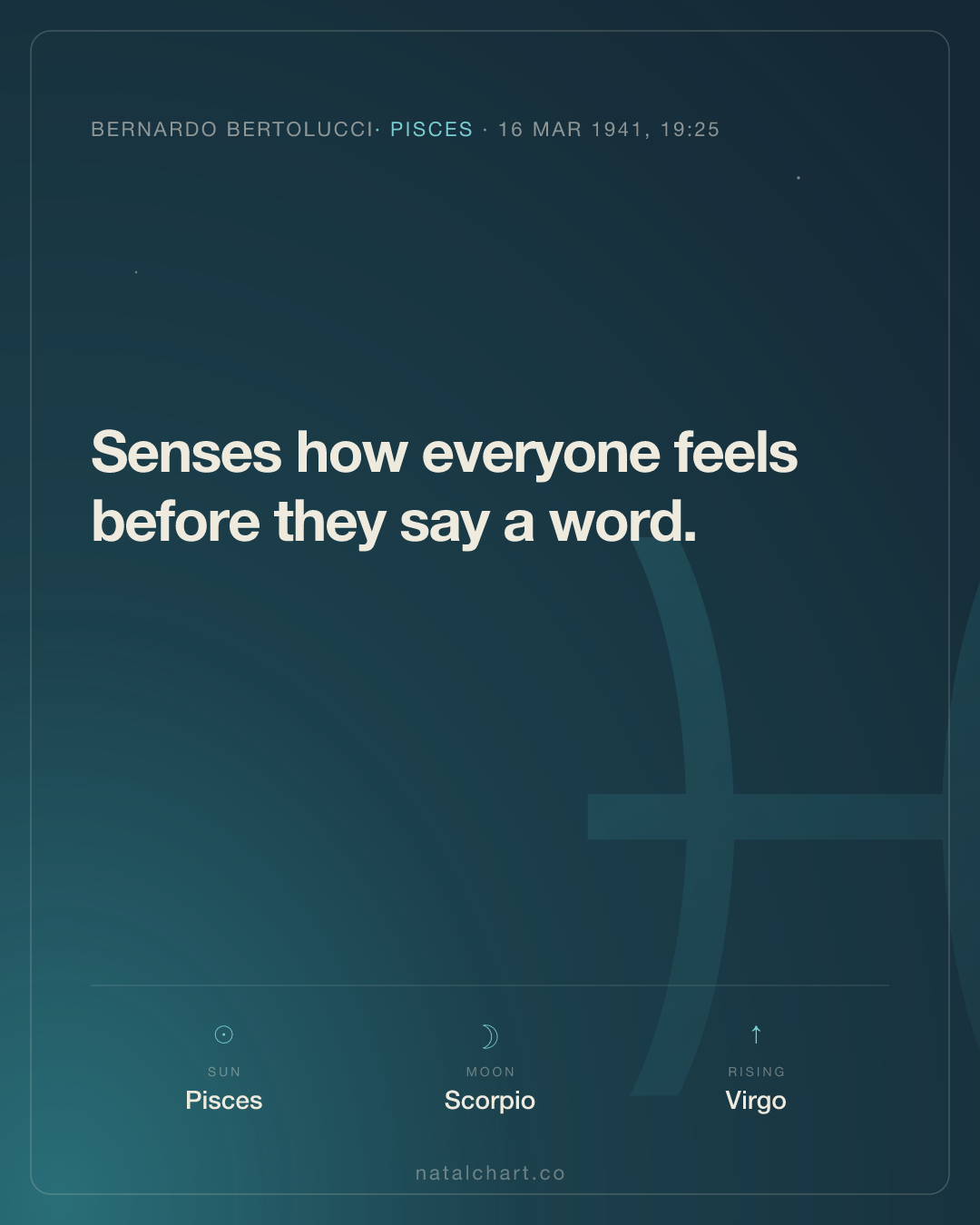
Bernardo Bertolucci's Sun sign is Pisces — the Sun was in Pisces at birth (1941).
What is Bernardo Bertolucci's moon sign?
Bernardo Bertolucci has the Moon in Scorpio. The Moon sign describes the emotional and instinctive layer of the chart.
What is Bernardo Bertolucci's rising sign?
Bernardo Bertolucci's rising sign (ascendant) is Virgo — the sign on the eastern horizon at the moment of birth.
When and where was Bernardo Bertolucci born?
Bernardo Bertolucci was born in 1941 in Parma, Emilia-Romagna, Italy.