Carlos Drummond de Andrade — natal chart
What does Carlos Drummond de Andrade’s natal chart reveal?
Carlos Drummond de Andrade (1902-1987) was a Brazilian poet, writer and journalist, widely regarded as one of the most influential figures of twentieth-century Brazilian literature. Born in Itabira, in the state of Minas Gerais, he trained as a pharmacist before dedicating himself to writing and to a long career as a civil servant in the Ministry of Education. He published his first collection, 'Alguma Poesia', in 1930, a landmark of the Brazilian Modernist movement. Subsequent volumes such as 'Brejo das Almas' (1934), 'Sentimento do Mundo' (1940), 'A Rosa do Povo' (1945) and 'Claro Enigma' (1951) consolidated his reputation. His poem 'No Meio do Caminho' provoked intense debate for its repetitive, colloquial style. He also worked as a chronicler and translator, rendering authors such as Balzac and Proust into Portuguese. His work combines irony, social concern and reflection on everyday life.
 Share
Share
Birth
1902-10-31 · 06:00 · Itabira, Brazil Reliability: A · reliable data
The core
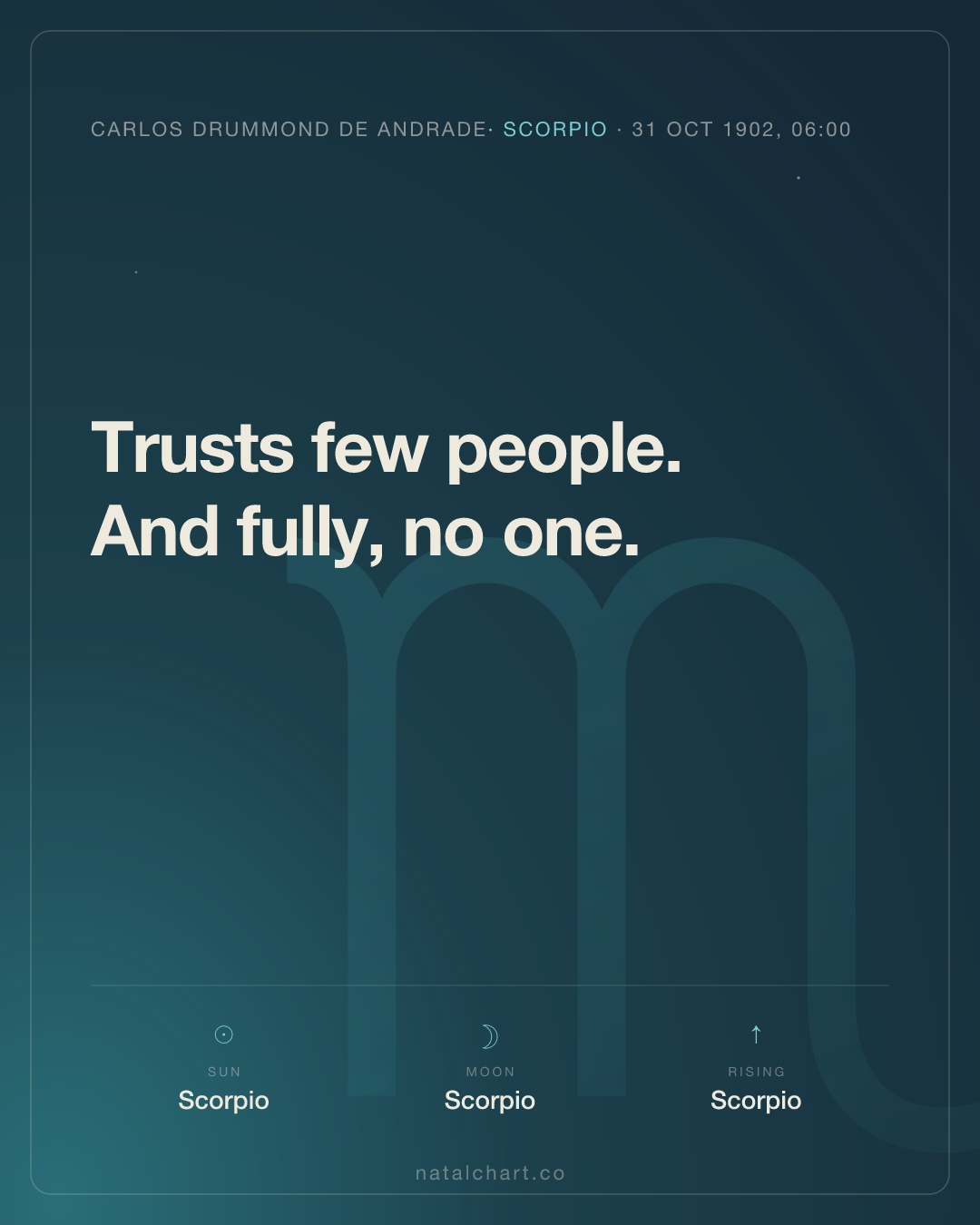
Carlos Drummond de Andrade was born on the morning of October 31, 1902, in Itabira, Minas Gerais — and the chart that opened that day is one of the most concentrated pieces of astrological shorthand for a poet: the Sun and Moon together in Scorpio, both on the Ascendant, in the first house. The Ascendant is the face a person meets the world with, the first impression they make. When the Sun and Moon sit there, so close they are almost a single point (less than half a degree apart), there is no separation between the private self and the public face, between how one feels and how one appears. What Drummond was inside is what he showed. The irony, the wounded directness, the refusal of ornament — these were not a performance. They were him.
Scorpio on the Ascendant adds a quality of penetrating awareness: the ability to see what is actually happening beneath the surface of things, and to name it without flinching. Brazilian literature of the twentieth century has few figures more associated with the stripped, unglamorous truth than Drummond. His 1928 poem "No Meio do Caminho" — with its bare repetition of a stone in the road — provoked outrage and debate precisely because it looked so ordinary. That Scorpio eye found what was genuinely strange in the plain.
The emotional interior
With both the Sun and Moon in Scorpio, Drummond's inner life and his outer identity were made of the same material: intensity, persistence, and a complicated relationship with loss. The Moon describes emotional responses, instincts, the interior weather a person lives in. In Scorpio, the Moon tends to hold feelings deeply rather than dispersing them — grief stays, attachment stays, a slight stays. The Moon sits in tension with Jupiter in Aquarius (about 1.2 degrees), and this pull between the emotionally concentrated Scorpio Moon and the broad, detached, universalizing Jupiter in Aquarius is one of the central tensions in Drummond's poetry. He was capable of writing with fierce intimacy about a specific stone on a specific road in Minas Gerais, and also of writing "A Rosa do Povo" (1945), a collection animated by social concern and collective suffering during the Second World War. The intimacy and the universal pull were always both present, always in friction.
Mercury and the instrument of poetry
Mercury — the planet governing how a person thinks, speaks, and writes — is in Libra, in the twelfth house. The twelfth house is the most interior sector of a chart: it holds what is worked through in private, in solitude, in silence. Libra gives Mercury a concern for balance, for weighing, for finding the phrase that holds two things in just proportion. Together: a poet whose instrument was forged in private, whose craft was the art of weighing one word against another until the balance felt right.
Mercury forms a trine with Pluto in Gemini — the most exact aspect in the entire chart, less than a tenth of a degree apart. A trine means two planets work together with an unusual degree of ease. Mercury (language) working effortlessly with Pluto (transformation, what is buried, what has weight) gave Drummond his signature move: finding in ordinary language — a stone, a hand, a drawer, a gaucho — the thing that carries everything. His chronicles in the Jornal do Brasil for decades were exercises in this: the apparently trivial daily observation that contains something essential.
Mercury also forms a sextile with Uranus in Sagittarius (0.4°), almost as tight: this brought the quality of sudden formal rupture, the willingness to break with what poetry was supposed to look like. The colloquial language, the broken syntax, the anti-heroic subject matter — these were not accidents of temperament. They were Uranus working through Mercury.
Venus and what he loved
Venus in Libra, also in the twelfth house, near Mercury: what Drummond loved — aesthetically and personally — lived in the domain of the private, the not-quite-stated, the withheld. He was famously private about his personal life. The twelfth house does not perform; it experiences inwardly. Libra in Venus gives a sensitivity to form, to proportion, to what is elegant without being excessive. His essays and chronicles have exactly this quality: elegant, precisely weighted, never sentimental in a showy way.
The North Node — the direction of growth in this lifetime — is in Libra, reinforcing this movement toward the balanced, the considered, the civilized weighing of contraries. His entire body of work can be read as the working-out of that North Node: how to hold Itabira and Rio de Janeiro together, the rural and the modern, the ironist and the humanist, without forcing a false reconciliation.
Mars and the working life
Mars in Virgo, in the eleventh house: the drive toward craft, precision, and the community of one's peers. Virgo gives Mars its discipline and its exacting standards; the eleventh house connects that drive to the collective — to groups, to social concerns, to what one owes to the broader world. It fits that Drummond spent decades as a civil servant in the Ministry of Education alongside his literary career, not as a contradiction but as a form of the same attention: methodical service to something larger than the individual self.
Mars forms a sextile with Neptune in Cancer (0.7°), one of the tightest aspects in the chart. Neptune governs what is collective, diffuse, the shared imagination of a place and a time. Cancer is the sign of homeland, family, the particular flavors of a specific childhood. Mars (the worker, the craftsman) working in easy flow with Neptune in Cancer: the craftsmanship that could make individual effort resonate at the level of collective feeling. His poem "Confidência do Itabirano" — the guilt and tenderness of the man from the iron city, whose ore runs in the blood — is exactly this configuration made language.
Jupiter, Saturn, and the frame
Jupiter in Aquarius, fourth house: a domestic world organized around expansive intellectual principles, around ideas rather than possessions. The fourth house is home and origins; Aquarius is the sign of the universal, the forward-looking, the collectivist. Drummond's Itabira origins were not merely a private matter — they became the mythological substrate of an entire country's self-understanding. Minas Gerais, with its baroque tradition and its iron-ore austerity, entered Brazilian literature partly through him.
Saturn in Capricorn, third house: Capricorn is Saturn's home sign, which gives it full authority to impose its demands. In the third house — communication, writing, the daily work of language — this Saturn speaks to a discipline that is almost structural, built into the way the mind approaches its material. Drummond did not write quickly or carelessly. The spare, precise quality of his poems, the way they do a great deal with almost nothing, is Saturn in Capricorn doing what it does best: cutting until only what is necessary remains.
The outer planets and their generation
Uranus in Sagittarius (second house) in tension with Pluto in Gemini (eighth house), less than half a degree apart: this is a generational aspect, shared with many born in that period, but in Drummond's chart it sits in the money and values axis (second house) opposite the house of transformation and what is hidden (eighth house). The configuration of his generation — born at the turn of the century, shaped by two world wars and the upheaval of Brazilian modernization — is fully present in his work. The rupture between the old rural Brazil and the industrialized, urbanized republic runs through his poetry as surely as the rupture between classical and modern literary form.
Neptune in Cancer, ninth house: the imagination (Neptune) housed in the domain of philosophy, long journeys, and one's broader conception of the world (ninth house), expressed through Cancer's attachment to the particular and the remembered. His relationship with Itabira was never nostalgic in a simple way — it was philosophical, almost geological, as if the place had deposited something in him that could never be fully dissolved.
The Midheaven and public vocation
The Midheaven — the astrological point that marks what a person becomes known for, the public face of the career — is in Leo. Leo on the Midheaven is the signature of public visibility, of work that has a quality of brightness and individual authority. For a poet who spent much of his working life as a civil servant, this placement is striking: Drummond's fame rests entirely on the luminosity of the individual voice, the unmistakable style that no one else had and that cannot be attributed to a school or a movement. His Leo Midheaven is his byline — the recognition that arrived not through institutional position but through the irreducible singularity of the work.
Chiron and the wound that became the gift
Chiron — the old wound that over time becomes a source of wisdom for others — is in Capricorn, in the third house. Chiron in Capricorn in the third house: the wound of not being understood, of working hard at communication and finding the official language inadequate, of the gap between what is felt and what the forms of discourse allow one to say. Drummond's entire formal innovation — the colloquial, the broken, the repetitive, the anti-poetic — is legible as the response to this wound. He found that the existing language of Brazilian poetry could not hold what he needed to say, and so he changed the language. Chiron's gift came through the making of a new instrument.
Lilith in Sagittarius, second house: there is something in his relationship with accumulated material and cultural inheritance that has a quality of refusal — he did not accept the received hierarchies of what was worth valuing. The iron ore of Itabira, the gaucho, the bureaucrat, the kitchen, the hand in the dark — these were not elevated subjects in the tradition he inherited. He made them so.
A final portrait
Carlos Drummond de Andrade carried the weight of Scorpio — on the Ascendant, in the Sun, in the Moon — without dramatizing it. That is perhaps the most Scorpio thing of all: the intensity is real, but it is held quietly, expressed through craft rather than gesture. The most exact aspect in his chart (Mercury trine Pluto, nearly perfect) gave him the instrument for it: a language that could descend into the ordinary and find there the thing with weight. The stone in the middle of the road was not a symbol he invented. It was the truth of what he saw. That is what a Scorpio Ascendant with a twelfth-house Mercury in Libra produces: the poet who notices what others prefer not to name, and who finds, in the discipline of naming it precisely, something that looks almost like peace.
The chart
How to read it →Frequently asked questions
What is Carlos Drummond de Andrade's zodiac sign?
Carlos Drummond de Andrade's Sun sign is Scorpio — the Sun was in Scorpio at birth (1902).
What is Carlos Drummond de Andrade's moon sign?
Carlos Drummond de Andrade has the Moon in Scorpio. The Moon sign describes the emotional and instinctive layer of the chart.
What is Carlos Drummond de Andrade's rising sign?
Carlos Drummond de Andrade's rising sign (ascendant) is Scorpio — the sign on the eastern horizon at the moment of birth.
When and where was Carlos Drummond de Andrade born?
Carlos Drummond de Andrade was born in 1902 in Itabira, Brazil.