Ernesto Sabato — natal chart
What does Ernesto Sabato’s natal chart reveal?
Argentine writer born in 1911 in Rojas. Author of the novels 'The Tunnel' (1948), 'On Heroes and Tombs' (1961) and 'Abaddón the Exterminator' (1974). Chaired the CONADEP, which produced the 'Nunca más' report (1984).
 Share
Share
Birth
1911-07-03 · 07:00 · Rojas, Argentina Reliability: AA · vetted record
The Mind That Could Not Choose Between Worlds
There is a particular kind of intellectual anguish that comes from being equally at home in two completely opposed ways of knowing the world. Ernesto Sabato spent decades living inside that anguish before he made it literature. Born on 3 July 1911 in Rojas, with the Sun in Cancer joined closely to Mercury in the same sign and the same first house, thinking and feeling were never separate operations for him — every idea carried emotional weight, every emotion demanded examination. Cancer is the sign of interiority, of the depth that builds walls to protect itself; and with both the Sun and Mercury rising together in that sign, Sabato's whole orientation was inward before it was outward.
The Ascendant — the face a person meets the world with — is also Cancer. The Cancer triple emphasis (Sun, Mercury, Neptune all in the first house) means that what people encountered when they met Sabato was not a public persona maintained at arm's length but the full, unfiltered atmosphere of his inner world. That can be magnetic or overwhelming, sometimes both at once.
The Moon's Restlessness
The Moon — the emotional interior, how someone registers experience privately — sits in Libra in the fourth house, and it pulls directly against the Cancer Sun at a tight 0.9-degree angle. The fourth house is the domain of origins, the foundation, the private self at home; Libra seeks balance, symmetry, the considered judgment that weighs both sides. The tension between a Cancer Sun driven toward immersion and a Libra Moon that needs to weigh and balance was not incidental to Sabato's psychology: it was the engine of it.
He trained as a physicist at the La Plata National University and worked at the Curie Laboratory in Paris in the late 1930s before abandoning science permanently for literature. That rupture — between the rigorous rationalism of physics and the unbearable subjectivity he found he could not suppress — is exactly the lived story of a Sun-Mercury in Cancer pulling against a Moon in Libra trying to find the middle ground. He wrote in his essays that science had felt like a betrayal of something essential; what he meant, in chart terms, is that Cancer does not thrive under conditions where feeling must be bracketed.
The Cluster That Defined Everything
Three placements cluster in the first house in Cancer — Sun, Mercury, Neptune — and the way they interact is worth reading together. Neptune here dissolves the boundary between self and atmosphere; it makes the first house porous, receptive, prone to absorbing the suffering of others as if it were one's own. For a novelist, that is an extraordinary gift. On Heroes and Tombs (1961) draws on Argentine history and Buenos Aires street life, but what makes the novel unforgettable is its atmospheric density, the way collective grief becomes private sensation. That is Neptune in the first house working at full capacity.
The Sun joined tightly to Mercury meant Sabato thought in the first person and wrote in the first person even when the voice belonged to a character. The distinction between witness and subject blurred in his prose, which was the point. Mercury here also rules the twelfth house, where Pluto sits in Gemini — suggesting that the writing process involved excavating what was buried and giving words to what normally stays unspeakable.
What Mars and Neptune Pull Against Each Other
Mars — the planet of drive and directed energy — is in Aries in the tenth house, the public face of professional life. Mars in Aries is the most direct expression of that planet's energy: fast, decisive, focused, unafraid of confrontation. And it sits in near-perfect tension with Neptune at only 0.9 degrees of separation — the second tightest aspect in the whole chart. When the planet of action pulls this hard against the planet of dissolution, the result is often a person who cannot simply act without the action meaning something larger — a person who must connect the immediate deed to a moral framework before it feels real.
Sabato's public life bore this out in a way few writers' lives do. As chair of CONADEP — the National Commission on the Disappearance of Persons, formed after Argentina's return to democracy — he oversaw the compilation of the Nunca Más report in 1984, the definitive record of the military dictatorship's crimes. That was Mars in Aries in the tenth house: public, direct, confrontational engagement with power, with real institutional authority. But it was also, unmistakably, Neptune: bearing witness to suffering that was not his own, absorbing it, and giving it a form that could not be looked away from.
Venus and the Architecture of Value
Venus in Leo in the second house — the house of resources and what one builds material life from — is warm, generous with attention, drawn to beauty as a form of truth. In Leo, Venus wants to admire grandly and to be seen doing so. Sabato's aesthetic sense was not incidental to his work; he wrote about painting and visual art with genuine seriousness, and the literary tradition he helped shape in Argentina was one that treated the novel as a form of art-making, not merely of narration.
Venus in easy flow with Pluto and in easy flow with Mars brings together a sense of beauty that carries intensity and the ability to translate that intensity into public form. His prose is not comfortable to read. It earns its beauty through darkness.
Jupiter, Saturn, and the Long Architecture
Jupiter in Scorpio in the fifth house — the house of creative expression — is the placement that explains why Sabato's novels go as deep as they do. Scorpio takes nothing at surface value; it probes until it finds what is hidden underneath. Jupiter here expands that probing into a creative compulsion: the work must investigate, must open what is sealed, must follow the tunnel to wherever it leads. The novel The Tunnel (1948) is almost diagrammatically this placement — a confined first-person narrator who cannot stop excavating his own motives until the excavation destroys everything around him.
Saturno in Taurus in the eleventh house — the house of collective belonging and the wider social world — is the structural counterweight. Saturn in Taurus is patient and slow to commit to a community, but once committed, it holds. Sabato was never a fashionable literary figure; his relationship with Argentine literary and political culture was complicated, sometimes antagonistic. But the Nunca Más report — addressed not to a literary elite but to the Argentine people as a whole — represents that Saturn finally finding its proper register: durable, concrete, built to last.
Chiron and the Wound of Knowing Too Much
Chiron — the point in the chart where an old wound becomes a capacity for helping others — is in Pisces in the ninth house, the house of knowledge systems, belief, and the long reach of the philosophical mind. Pisces is the sign of dissolution and compassion; Chiron here carries a wound that is specifically intellectual: the inability to hold a belief system together, the experience of one framework of understanding collapsing under the weight of what it cannot explain.
Sabato left physics not simply because he preferred writing but because he had looked into the implications of scientific rationalism in the mid-twentieth century — including its role in the development of weapons of mass destruction — and found it could not carry the full weight of what it meant to be human. That specific collapse — the knowledge system that fails — is Chiron in Pisces in the ninth house. The gift it became was a prose that refused the comfort of any single explanatory framework, that held open the wound instead of sealing it.
The North Node and the Direction of Growth
The North Node — the point that marks the direction of real growth, the terrain that demands effort but pays the larger dividend — is in Taurus in the eleventh house. Taurus builds slowly, materially, toward what endures. The eleventh house is the space of collective responsibility, of what one contributes beyond the personal. For a man who spent decades oscillating between the solitary tunnel of the novel and the political reality outside it, the North Node in Taurus in the eleventh house reads as an instruction: the most lasting thing you will build is not the private cathedral of the self but the thing that holds for a community.
Nunca Más has sold hundreds of thousands of copies, been translated into dozens of languages, and remains the legal and moral foundation of Argentina's accounting with its own history of state terror. It is, by any measure, the most durable thing Sabato made. It is also the thing furthest from a novel.
The Midheaven and Public Vocation
The Midheaven — the career and public reputation point — falls in Taurus, the same sign as the North Node. The double Taurus emphasis on both the vocational axis and the growth direction reinforces a single message: what lasts is what is built carefully, what can be touched and verified, what does not dissolve when pressed. For a man who began in the abstract world of theoretical physics and ended writing reports for truth and reconciliation commissions, that grounding impulse is the through-line of the whole life.
Mars in Aries in the tenth house, directly above that Taurus Midheaven, means the public acts were never cautious or hedged. They were direct confrontations with whatever was being avoided: the silence around Argentina's disappeared, the comfortable myths of cultural life, the easy separation between art and responsibility.
What Holds
Sabato's chart is organized around a central conflict between interiority and public responsibility, between the dissolving depths of Cancer-Neptune and the direct confrontational force of Mars in Aries in the tenth house. He spent the first half of his life finding the form — the novel — that could hold both at once. He spent the second half discovering that form was not enough, that the historical emergency of his country required a different instrument.
The tightest aspect in the chart is the Sun joined to Mercury at 0.7 degrees: he was, before anything else, a man who thought out loud, who could not separate the act of writing from the act of being. That is what made the novels alive and what made Nunca Más something more than a legal document. His testimony was always, in the end, personal.
The chart
How to read it →Frequently asked questions
What is Ernesto Sabato's zodiac sign?
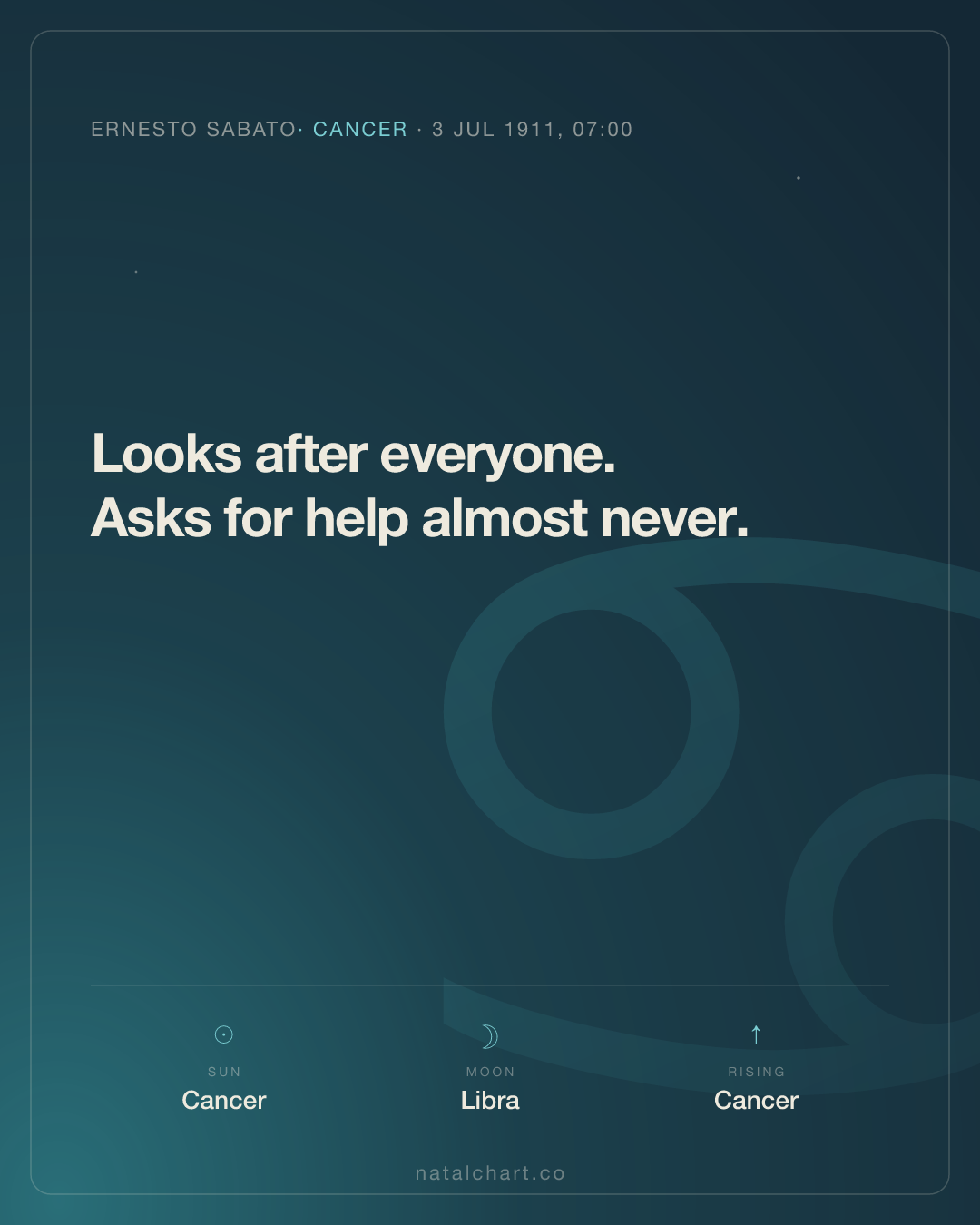
Ernesto Sabato's Sun sign is Cancer — the Sun was in Cancer at birth (1911).
What is Ernesto Sabato's moon sign?
Ernesto Sabato has the Moon in Libra. The Moon sign describes the emotional and instinctive layer of the chart.
What is Ernesto Sabato's rising sign?
Ernesto Sabato's rising sign (ascendant) is Cancer — the sign on the eastern horizon at the moment of birth.
When and where was Ernesto Sabato born?
Ernesto Sabato was born in 1911 in Rojas, Argentina.