Lucio Battisti — natal chart
What does Lucio Battisti’s natal chart reveal?
Lucio Battisti (1943-1998) was an Italian singer-songwriter and composer, one of the most influential figures in Italian popular music. Often partnered with lyricist Mogol, he produced classic songs such as 'Il mio canto libero' and 'Emozioni' that reshaped Italian pop and remain hugely beloved.
 Share
Share
Birth
1943-03-05 · 13:30 · Poggio Bustone, Italy Reliability: AA · vetted record
A double immersion in the imaginal
Lucio Battisti heard the world differently from most people. Sun and Moon both placed in Pisces, and both gathered in the ninth house — the area of the chart that governs meaning, philosophy, and the search for something larger than ordinary life — gave him an almost continuous inner film reel. The ninth house is the zone of quests and horizons; having both luminaries there meant that the quest was not occasional but structural, baked into who he was at every level. He didn't just write songs. He moved through music the way a diver moves through water: total immersion, total pressure, a world where the usual rules of surface life don't apply.
The double Pisces also explains a quality that listeners have always sensed: the feeling that a Battisti song doesn't describe an emotion so much as become it. Pisces dissolves the membrane between inner and outer. What he felt went directly into the melody, without the translation loss that stops most artists from closing that gap.
The face he met the world with
His Ascendant — the outward face, the way he landed on other people when they first encountered him — was Cancer. Cancer rising people tend to come across as both receptive and self-protective, genuinely warm but careful about what they let in. There is an instinctive attunement to mood, to the emotional weather in a room, that makes them feel familiar to strangers almost immediately. With Jupiter, the planet of expansion and generosity, placed right at the Ascendant, that warmth was amplified into something the public could feel through a record player. Jupiter in Cancer on the first house cusp is a rare placement for a musician: it radiates welcome, abundance, the sense that there is room for you in this sound.
Lilith — a point in the chart connected to what is untamed and non-negotiable in a person's nature — also sat in Cancer on the Ascendant. This sharpens the picture: underneath the hospitality was something that could not be tamed or managed by outside expectation. Battisti's famous withdrawal from public life in the 1970s, his refusal to give interviews or appear on television, the mystique he cultivated — these are very Cancer-rising things to do. The shell closes when the exposure becomes too much.
Emotion as raw material
The Moon governs the emotional interior, the private self, what actually moves a person when the lights are off. Battisti's Moon in Pisces in the ninth house sat barely one degree from a sharp tension with Uranus — Uranus being the planet of rupture, instability, and the unexpected. That Moon-Uranus tension (a 0.7° orb, extraordinarily close) is the engine of emotional restlessness that runs through his most celebrated songs. Emozioni is not a calm song. Il mio canto libero is not a settled song. The feelings in them arrive in surges, turn suddenly, leave before they are finished — exactly what a Moon in tight friction with Uranus produces.
This placement also explains something about his relationship with intimacy: the need to feel deeply, the equal need for freedom from being pinned down emotionally. The two pulls run simultaneously and don't resolve. They don't need to. In Battisti's case, they became the artistic substance itself.
How he thought and communicated
Mercury — the planet governing thought and language — was in Aquarius, in the eighth house. Aquarius here means the mind tends toward the structural and the conceptual: patterns, systems, the logic underneath the surface of things. The eighth house is associated with what is hidden, shared, transformative — it is not a zone of easy transparency. Battisti notoriously let Mogol handle the words while he handled the music; the Mercury in Aquarius in the eighth house suggests his native language was harmonic structure and arrangement rather than lyric, and that what he had to communicate about was not suited to casual conversation. The partnership with Mogol was not a convenience — it was a functional complement: Mogol gave linguistic form to what Battisti carried internally.
What drove him toward beauty and what he valued
Venus — the planet that governs what a person finds beautiful and what they move toward in love and art — was in Aries, in the tenth house (the house of public vocation and reputation). Venus in Aries moves fast, chooses boldly, does not wait for permission. In the tenth house it places the pursuit of beauty and original expression directly in the arena of public work. This is the chart's way of saying that his art was his love language — not a side project but the primary channel through which he pursued and expressed what he valued most.
Venus in Aries in an easy flow with Pluto (the planet of deep transformation) adds depth and intensity to what might otherwise be an impulsive placement. The beauty he sought was not light or decorative; it had to carry weight, transformation, some residue that stayed with the listener long after the song ended. Il mio canto libero, La canzone del sole, Insieme — these are not background music. They change the room.
Discipline and the collaborative engine
Mars — the planet of drive, action, and how a person applies effort — sat in Capricorn in the seventh house. Capricorn is one of Mars's strongest positions: the drive is patient, strategic, able to sustain effort over time without burning out. The seventh house is the house of partnership, negotiation, and the significant other. Mars here means that the sharpest creative energy ran through the act of collaboration. The Battisti-Mogol partnership (which produced the overwhelming majority of the classic catalogue) was not accidental or merely practical — it was structurally indicated. His drive found its expression through the friction and complement of another person.
Mars in Capricorn also sat in easy flow with both Uranus and Neptune — the outer planets of innovation and imagination. This is a significant configuration: the disciplined, patient drive (Mars in Capricorn) had direct access to the radical and the imaginal. He could work with extraordinary rigour and still consistently arrive at music that felt like it came from somewhere no one had been before.
Jupiter, Saturn, and the long arc
Jupiter in Cancer on the Ascendant we have already seen: the warmth, the welcome, the public abundance. Saturn — the planet of structure, constraint, and long-term consequence — was in Gemini in the twelfth house. The twelfth house is the chart's most private zone, connected to what operates below the surface of consciousness: fears, creative reserves, what is kept out of sight. Saturn here is not easy. It often produces a quiet, persistent sense of limitation or inadequacy that the person seldom names openly — a private anxiety about whether the structure holds.
Saturn in Gemini in the twelfth also placed the structural constraints specifically in the area of communication and language — exactly the area where Battisti ceded ground to Mogol. This is not coincidence. The arrangement was psychologically economical: he worked with what flowed freely (music, arrangement, melody) and partnered with someone who was strong precisely where his own Saturn made things harder.
The outer planets and the generational signature
Uranus and Neptune were both in Gemini, also in the twelfth house, and their trine to each other was the tightest aspect in the whole chart — a 0.3° orb, essentially exact. Uranus and Neptune are slow-moving planets that entire generations share; what is individual here is their house placement in the twelfth, and the extraordinary precision of their alignment. The twelfth house placement of the Uranus-Neptune trine suggests that the radical imagination (Neptune's dissolving power amplified by Uranus's electricity) worked largely underground, below the conscious creative process — which is to say: Battisti did not always know where the melodies came from. They arrived. That quality of involuntary, almost inexplicable creative flow is precisely what listeners mean when they describe his music as haunting.
Pluto — the planet of transformation, intensity, and what cannot be avoided — was in Leo in the second house, the house associated with material resources, voice, and self-worth. Chiron (an asteroid linked to old wounds that become gifts) also in Leo in the second house, reinforced this zone. The North Node — the point associated with the direction of growth across a life — was in Leo. Three significant placements in Leo in the second house all converge on the same theme: the voice as the site of both the deepest wound and the deepest gift. Battisti reportedly struggled with stage fright and a sometimes difficult relationship with his own public stature — yet the voice, the sound, was precisely what he gave the world and what endured.
Vocation: first and brave
The Midheaven — the public and career point of the chart, the zone that describes how a person's work is eventually recognized — was in Aries. Aries is the first sign, the pioneer, the one who arrives before the others and breaks new ground. An Aries Midheaven in a musician's chart is almost definitionally a chart of the person who reshapes the genre. Battisti did not inherit Italian pop as he found it. He transformed it: the arrangements, the production sensibility, the emotional directness, the fusion of rock and Italian melodic tradition. The Venus in Aries in the tenth house reinforces this — his aesthetic instinct was the career, and that instinct was always pointed toward the new.
The wound that became the gift
Chiron in Leo in the second house, sitting near the North Node and Pluto in the same zone, points to a lifelong negotiation with the question of worth — whether the voice, the creative output, the public presence, was enough. Leo wounds often have to do with visibility: the fear that being truly seen will expose some inadequacy, or that the admiration is for a performance rather than a person. Battisti's withdrawal from the public eye, the years without interviews, the turn in the late 1970s toward increasingly experimental and polarizing work (abandoning Mogol, embracing synthesizers, alienating a large portion of his original audience) can be read as this wound's way of forcing the issue. He stripped away the public apparatus — the warmth, the access, the familiarity of the early records — and kept only the work. The North Node in Leo ultimately calls toward creative self-expression for its own sake, uncoupled from approval. The later albums, baffling and divisive as they were at the time, were that node's journey in plain sight.
A portrait in full
Lucio Battisti was a man who lived inside music the way other people live inside their own skin: continuously, involuntarily, without an exit. The double Pisces gave him a permeability to feeling that most people can only approximate. The Cancer Ascendant with Jupiter gave him the ability to make strangers feel at home in that feeling. The Aries Midheaven and Venus in Aries drove him to be first, to break ground, to place his aesthetic instinct at the centre of his public life without apology. And the Saturn-in-the-twelfth, the Moon's tension with Uranus, the Chiron in Leo — these kept him restless, kept the work honest, kept him from settling into the comfortable version of himself that fame tends to encourage.
What endures in his music is not nostalgia, though it carries nostalgia with it. What endures is the feeling of having been understood by something larger than a lyric — the sense that the melody itself knew something about you. That is the rarest thing a musician can offer, and it came from the exact tensions in this chart: the longing of Pisces, the restlessness of Moon-Uranus, the bold first move of Aries, and the hidden fire of Leo waiting to be claimed.
The chart
How to read it →Frequently asked questions
What is Lucio Battisti's zodiac sign?
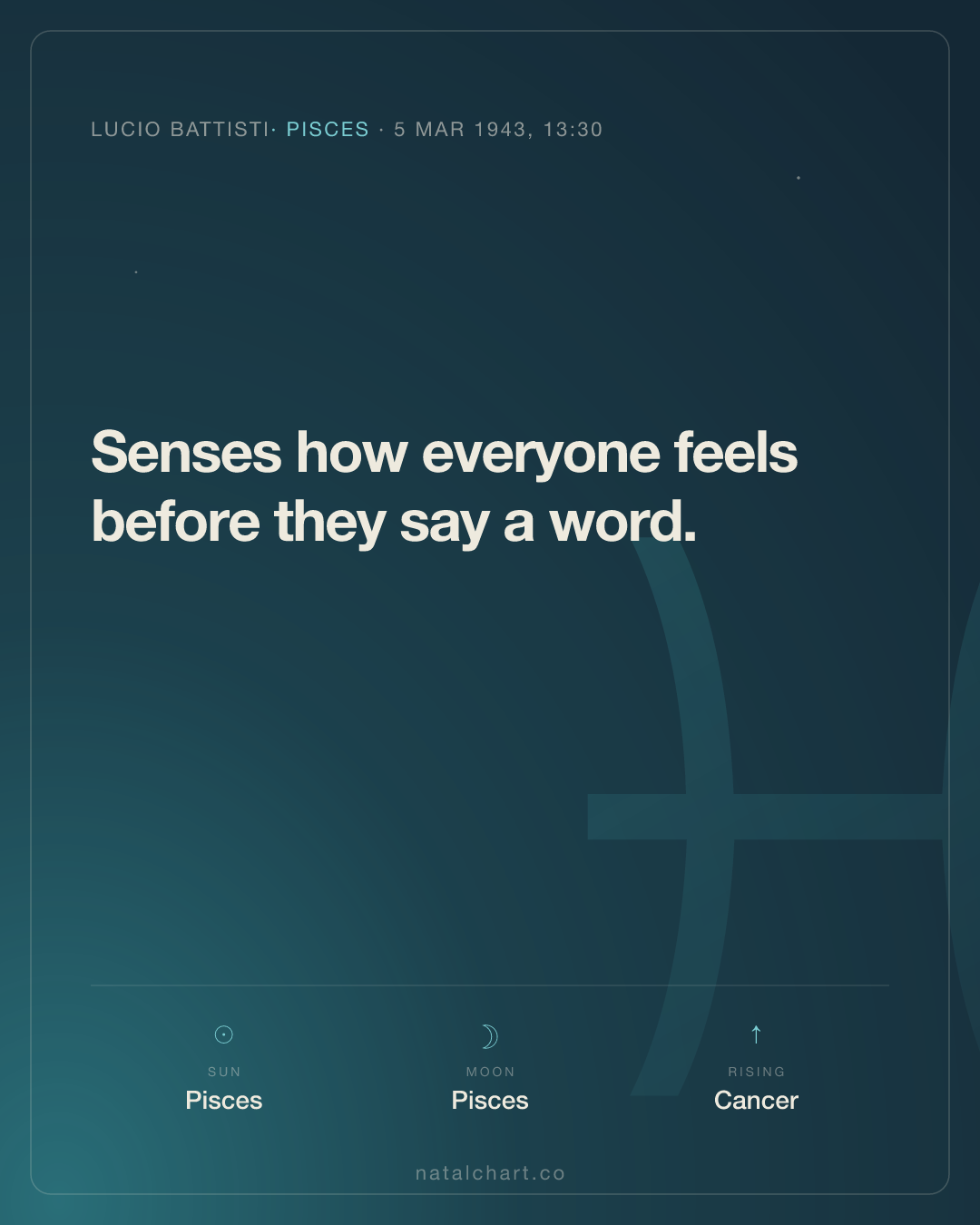
Lucio Battisti's Sun sign is Pisces — the Sun was in Pisces at birth (1943).
What is Lucio Battisti's moon sign?
Lucio Battisti has the Moon in Pisces. The Moon sign describes the emotional and instinctive layer of the chart.
What is Lucio Battisti's rising sign?
Lucio Battisti's rising sign (ascendant) is Cancer — the sign on the eastern horizon at the moment of birth.
When and where was Lucio Battisti born?
Lucio Battisti was born in 1943 in Poggio Bustone, Italy.