Pierre-Auguste Renoir — natal chart
What does Pierre-Auguste Renoir’s natal chart reveal?
Pierre-Auguste Renoir (1841-1919) was a French painter born in Limoges, a leading Impressionist. Celebrated for his vibrant, sensuous depictions of people and Parisian leisure, his works include 'Bal du moulin de la Galette' and 'Luncheon of the Boating Party'.
 Share
Share
Birth
1841-02-25 · 06:00 · Limoges, France Reliability: AA · vetted record
The core: warmth as the organizing principle
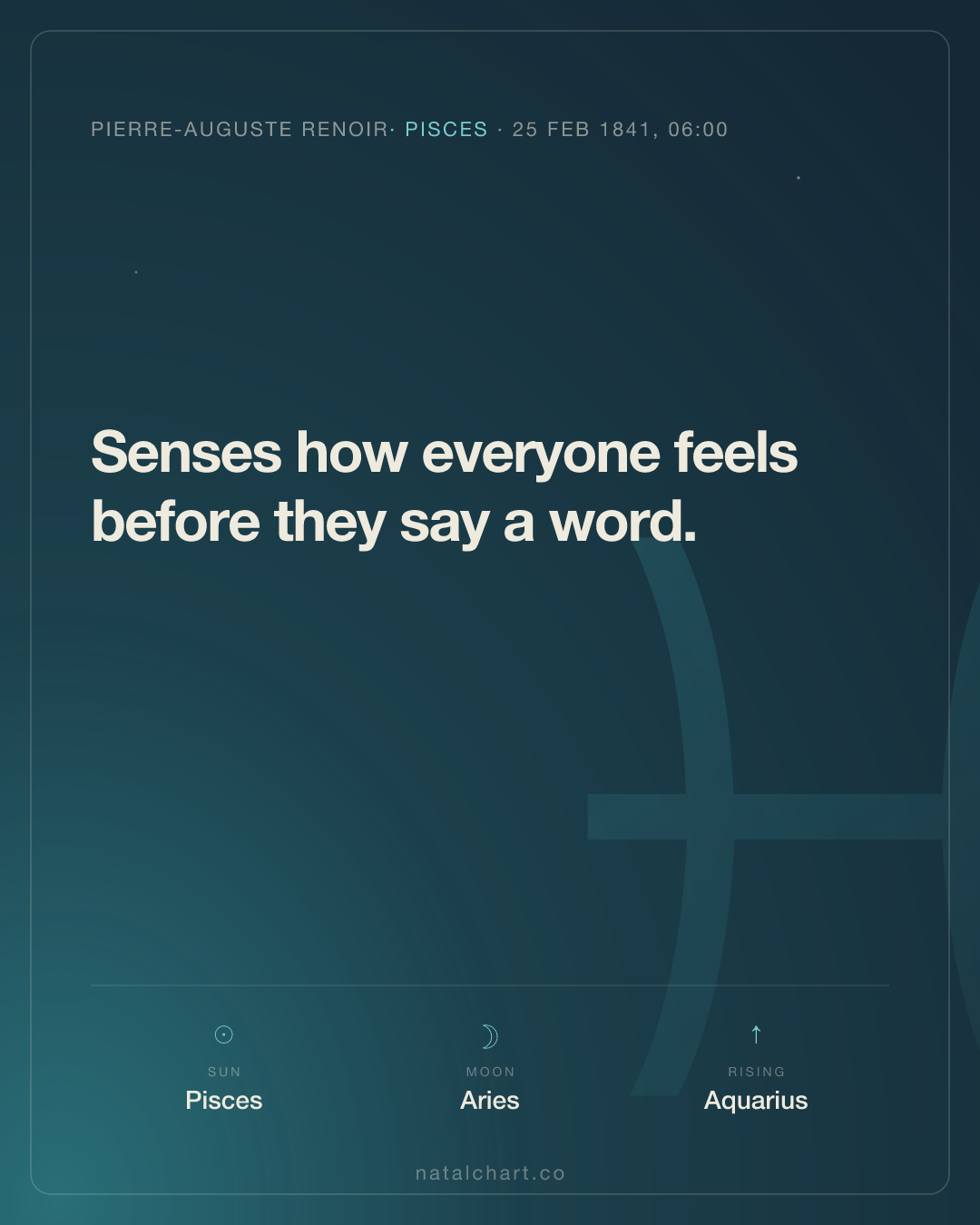
Renoir moved through the world with an Aquarius Ascendant —the face he showed others— that suggested independence, a slightly detached intellectual brightness. But the interior of the chart tells a different story, one far warmer and more tactile than the Ascendant hinted at. Almost everything personal clusters in Pisces and Aries: the Sun, Mercury, and Uranus together in Pisces in the second house; the Moon, Venus, and Pluto tightly gathered in Aries in the third. The loudest note in the whole chart is not cool or cerebral. It is sensory, immediate, alive to pleasure, and driven by an almost physical need to reach out and capture what delights the eye.
The Pisces concentration —especially with Sun and Mercury conjunct Uranus— gives his vision a quality of porousness, of received light rather than constructed form. Renoir did not analyze the world; he absorbed it. His paintings of dappled sunlight on skin and fabric, of crowds in motion at the Moulin de la Galette, of water at Chatou —these are the output of someone for whom the barrier between perceiving and expressing was unusually thin.
The emotional engine: Moon joined to Venus
The Moon and Venus occupy almost exactly the same degree in Aries in the third house, with Pluto drawn in close. That is one of the most significant combinations in this chart. Moon joined to Venus means that what one loves and what one feels are not kept in separate rooms; they are the same room. Renoir's emotional warmth and his aesthetic sensibility were inseparable. He did not paint beauty from a detached appreciation of it; he painted it because beauty was the form his feelings naturally took.
Venus in Aries is bold and immediate; it does not linger before deciding what it finds beautiful. The third house —communication, the local and immediate world— grounds all of this in the everyday. The beauty Renoir chased was never remote or elevated. It was Lise Tréhot in a summer dress. It was the light at La Grenouillère on a Sunday afternoon. It was the texture of a peach.
Pluto drawn close to the Moon-Venus conjunction deepens this: there was an intensity beneath the surface warmth, a pressure behind the prolific output. Renoir produced thousands of canvases over sixty years, and that sheer volume is one marker of how driven that impulse was.
The mind and the eye
Mercury in Pisces, joined to Uranus in the same second house, produces an intelligence that works by association and intuition rather than by step-by-step analysis. Ideas arrived as flashes. The second house is the house of material resources, of what one values — having Mercury and Uranus there means that for Renoir, thinking and perceiving were inseparable from sensory material: color, surface, light, texture. Theory was secondary to touch.
Uranus in Pisces adds an element of the unconventional, of breaking through received form. His method of applying paint —the loose, feathery strokes that dissolve contours rather than define them— is exactly what Mercury-Uranus in Pisces looks like translated into practice. He was not interested in the edge of the thing; he was interested in how the light fell across it.
Drive and the will to build
Mars in Scorpio sits in the tenth house — the career and public position. That placement deserves emphasis. Mars is the planet of directed action; Scorpio gives it precision, depth, and an almost obsessive quality; the tenth house turns it toward professional achievement. This was not an artist who drifted into his vocation or treated it lightly. The productivity of Renoir's career was extraordinary: somewhere between four and six thousand paintings across his working life, documented even through the severe arthritis that, in his final years, made him strap brushes to his wrists rather than stop.
The Sun in Pisces working in easy flow with Mars in Scorpio —the two in harmonious relation— means that creative identity and directed effort pulled in the same direction. The softness of the Pisces vision and the intensity of the Scorpio drive were not in opposition; they reinforced each other. The warmth wanted to express itself and the drive made sure it did, relentlessly.
Vocation: the Sagittarius Midheaven
The Midheaven —the public and career point, the highest position in the chart— falls in Sagittarius. Sagittarius is the sign of expansion, of reaching beyond the local, of a vision that does not stay contained. Renoir's career arc matches: he began painting porcelain in a factory in Limoges, moved to Paris and into the circle of Monet, Sisley, and Bazille, contributed to the first Impressionist exhibitions, and ended his life as one of the most celebrated painters in Europe, his work collected by major institutions on two continents.
Jupiter —the ruling planet of Sagittarius— sits in Sagittarius itself in the eleventh house, trine Pluto. That is a strong signature of expansion through collective connections. The Impressionist movement was not a solitary achievement; it was a network, a circle of people who exhibited together and reinforced each other's convictions. Jupiter in Sagittarius in the eleventh house in easy flow with Pluto describes someone whose vision was amplified by belonging to something larger than the individual studio.
Jupiter and Saturn: the outer frame
Jupiter trine Pluto is the tightest outer-planet aspect in this chart, with an orb of only one degree. The trine means these two worked in easy flow: expansive vision translated into transformative output without needing to fight the chart to do it. The scale of Renoir's ambition was matched, over time, by a commensurate achievement. He didn't just make pleasing small paintings; his major works —the Moulin de la Galette, the Boating Party— are large, complex, socially engaged compositions.
Jupiter also sits in a slight tension with Uranus —pulling against each other by a two-degree orb. Expansion versus disruption: Renoir was genuinely innovative in the 1860s and 1870s, part of the group that broke with the academic tradition, but he also pulled back toward more classical form in his later years, especially in the nudes of his final decades. That tension between the expansive and the disruptive was never fully resolved; it produced a career of more than one phase.
Saturn in Capricorn in the twelfth house brings a private structure, a discipline not always visible from the outside. The twelfth house is a withdrawn position; Saturn there suggests that the organizing force in Renoir's work operated largely beneath the surface of his gregarious, life-loving persona. The warmth was genuine; so was the structure that kept it productive.
Chiron and the North Node: old wound, forward direction
Chiron —the old wound that gradually becomes a gift— sits in Sagittarius in the eleventh house, close to Jupiter. The eleventh house is the house of collective belonging, of the group and what it stands for. A wound here can relate to questions of whether one truly belongs, of whether the movement or the circle actually sees what one is doing. Renoir had a complicated relationship with Impressionism: he exhibited with the group in the early years, then withdrew from their exhibitions to pursue the official Salon, which his colleagues viewed as a betrayal of the collective project. The Jupiter-Chiron proximity suggests that the wound of that belonging question was also the site of his greatest expansion. The choice to seek a broader audience, even at the cost of group solidarity, was part of what made his career reach the scale it did.
The North Node —the direction of growth in this chart— sits in Aquarius, the same sign as the Ascendant. Aquarius points toward collective contribution, toward making something that belongs to a larger cultural body rather than staying in the enclosed world of the workshop. The Impressionist project —taking painting out of the studio and into the light of modern life— was exactly that: an Aquarius answer to a Pisces sensibility.
The late work: what endured
Renoir's final decades, when the arthritis was at its worst, are among the most documented struggles in art history. By his last years he had essentially lost the use of his hands, and yet the paintings he produced from that period —the large-scale bathers, the mythological scenes at Cagnes-sur-Mer— are among the most ambitious of his career in terms of scale and color. The Mars in Scorpio in the tenth house does not stop. It adapts. The brushes strapped to the wrists were not a poignant detail of decline; they were a characteristic response from someone whose drive simply did not contain an off switch.
The emotional warmth of the Moon-Venus conjunction in Aries, the porousness of the Pisces core, the relentless forward pressure of Mars in Scorpio —these stayed consistent across six decades of painting. The style evolved, the subjects shifted, the circumstances became more confined, but the organizing impulse remained: to catch what was alive and beautiful in the immediate world, and hold it still long enough for someone else to feel it too.
A complete portrait
Renoir's chart is the map of someone whose emotional warmth and aesthetic instinct were the same faculty —not two things working together, but one thing operating through painting. The Aquarius Ascendant gave the impression of detachment; everything beneath it was heat, sensory richness, and drive. He worked the tension between the fluid and the intense, the Pisces dissolution and the Aries directness, the visionary and the prolific, across a career of extraordinary length and breadth.
What sets him apart from a merely productive painter is the quality of attention visible in even the simplest canvases. The Moon joined to Venus does not produce competent warmth; it produces delight. And delight, in the end, is what those paintings ask of the people who stand in front of them.
The chart
How to read it →Frequently asked questions
What is Pierre-Auguste Renoir's zodiac sign?
Pierre-Auguste Renoir's Sun sign is Pisces — the Sun was in Pisces at birth (1841).
What is Pierre-Auguste Renoir's moon sign?
Pierre-Auguste Renoir has the Moon in Aries. The Moon sign describes the emotional and instinctive layer of the chart.
What is Pierre-Auguste Renoir's rising sign?
Pierre-Auguste Renoir's rising sign (ascendant) is Aquarius — the sign on the eastern horizon at the moment of birth.
When and where was Pierre-Auguste Renoir born?
Pierre-Auguste Renoir was born in 1841 in Limoges, France.