Sergio Leone — natal chart
What does Sergio Leone’s natal chart reveal?
Sergio Leone (1929-1989) was an Italian film director who pioneered the 'spaghetti western'. His Dollars Trilogy with Clint Eastwood and the epics 'Once Upon a Time in the West' and 'Once Upon a Time in America' became landmarks of cinema, noted for sweeping style and Ennio Morricone's scores.
 Share
Share
Birth
1929-01-03 · 00:30 · Rome, Italy Reliability: AA · vetted record
The man behind the frame
Sergio Leone built his cinema the way a stonemason builds a cathedral — slowly, patiently, with an absolute conviction that the weight of the material would outlast any hurry. His Sun and Mercury both sit in Capricorn in the fourth house, the zone of private foundations, roots, and the long memory of childhood. That placement explains why his greatest films — Once Upon a Time in the West, Once Upon a Time in America — are not really westerns or gangster pictures at all. They are elegies for a lost world, told by a man who kept that world alive in his interior life long after it had disappeared from the exterior one.
The fourth house is also the house of origins — of Rome, of the Italian cinema tradition he absorbed as a boy on the sets where his father worked. That lived-in rootedness is the hidden engine of everything Leone built on screen.
The face he wore
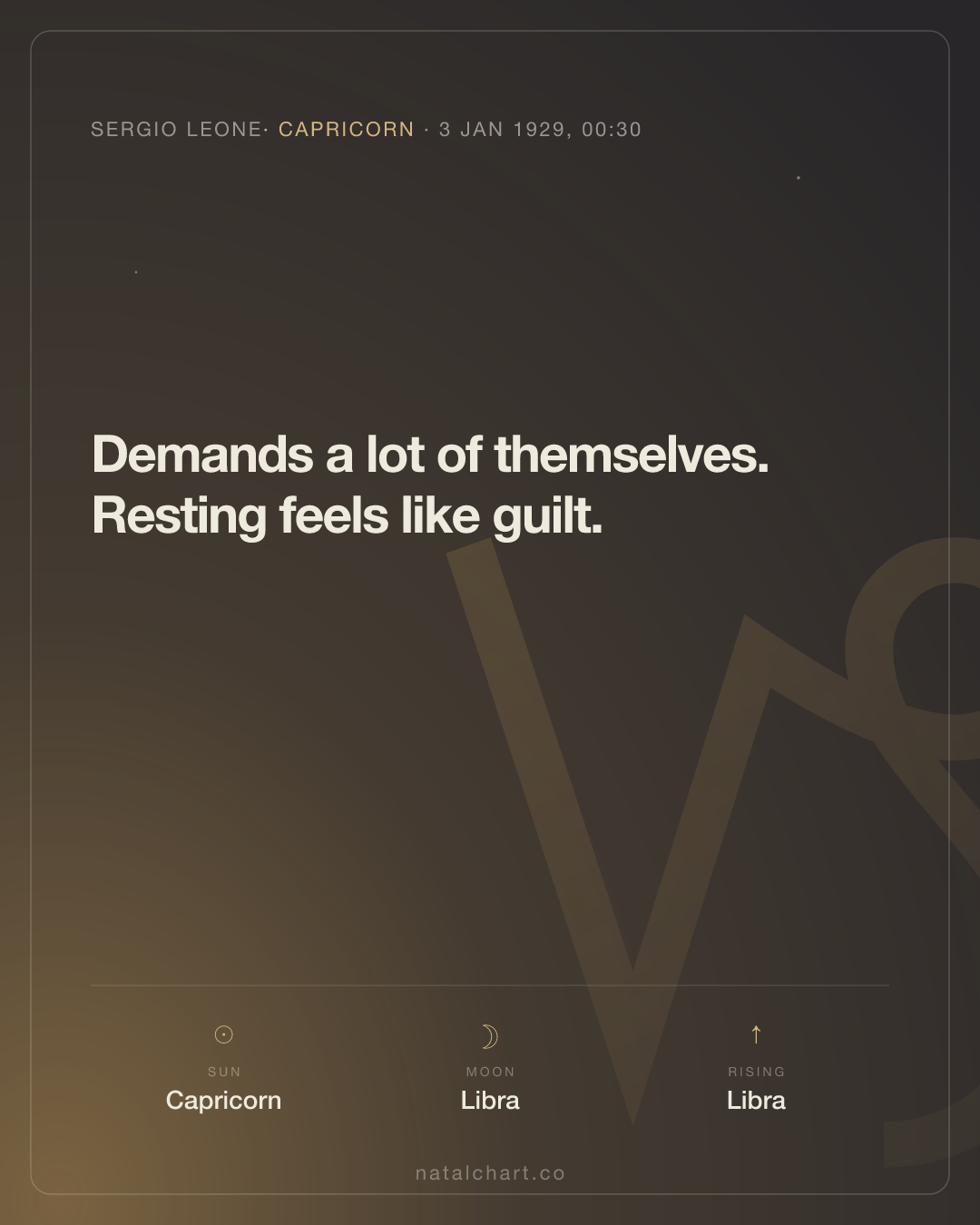
The Ascendant — the face a person instinctively shows the world — is Libra, and the Moon (the emotional interior) is also in Libra, in that same first house. In another person, this would produce a diplomat or a decorator. In Leone it produced something more demanding: an eye so attuned to visual proportion that every shot in The Good, the Bad and the Ugly was composed with the care of a painting, and a need — felt rather than theorised — for the collaboration that beautiful art requires. Libra is not soft; it is exacting. And Leone was famous for exactingness on set, reshooting until a door creak, a face, a shadow fell exactly right.
Yet the Moon in Libra also carries a real tension. This was a man whose emotional life depended on harmony and beauty, but whose deepest drive — the Capricorn Sun — was willing to sacrifice both for the work. The tension between the man who needed grace and the man who needed to finish the cathedral never fully resolved.
What moved him inside
The Moon in Libra in the first house means Leone processed his feelings through other people — through collaboration, through looking and being looked at, through the call and response of an encounter. His emotional intelligence was aesthetic. When something pained him, he did not talk about it; he filmed it. The famous close-ups in his Dollars Trilogy — a squinting eye, a twitching hand near a holster — are not stylistic tics. They are a Libra Moon's way of reading a room, amplified to cinema scale.
The Moon in tension with the Sun (pulling against each other by about two and a half degrees) means the private man and the public craftsman were never fully at peace. Leone the private person wanted roots, continuity, Rome, his family. Leone the director was always inside the next epic, living in another time and another continent. That split was productive and costly in equal measure.
How he loved and what he valued
Venus in Aquarius in the fifth house — the house of creative play and personal expression — explains the paradox that made Leone's cinema so distinctive. He loved the Western genre with the detachment of an outsider. He was not American, had never visited the American West when he made his first great films, and did not especially care. What he loved was the idea of it — the myth, the archetype, the pure form. Venus in Aquarius does not fall in love with the thing itself; it falls in love with the principle behind the thing.
That unusual aesthetic distance is precisely what allowed him to strip the Western of its conventions and rebuild it from the inside out — slower, more operatic, more aware of its own artifice. And Venus flowing easily with Mars (in easy alignment, barely a degree apart) means that aesthetic love was not passive. It drove him. The pull toward beauty and the push toward action worked together in Leone rather than against each other.
Mind and reach
Mercury in Capricorn in the fourth house confirms what the Sun already suggested: Leone thought in structures, in long arcs, in sequences that accumulated weight over time. He was not interested in the quick cut or the witty line. His scripts, famously, were long — sometimes agonisingly so to collaborators — because his mind worked by accretion, laying stone on stone until the edifice stood.
Mars in Gemini in the ninth house is a different register entirely. The ninth house is the zone of philosophy, myth, and foreign horizons — and Gemini makes Mars quick, curious, hungry for reference points from every direction. This is the restless intelligence that drove Leone to absorb Italian neorealism, the Hollywood Westerns of John Ford, Japanese samurai cinema, the Commedia dell'arte tradition, and weld them into something that belonged to none of those traditions and all of them. His research for Once Upon a Time in America was legendary — years of reading, talking, watching, circling. That is Mars in Gemini in the ninth house at work: encyclopaedic curiosity in service of an enormous horizon.
Mars pulls against Saturn (in near-exact opposition), Saturn sitting in Sagittarius in the third house. Saturn in the third house restricts communication — it makes expression a discipline rather than a pleasure. Combined with Mars in Gemini's restless hunger, the result was a permanent creative friction: the man who wanted to absorb everything and the man who could not open his mouth without weighing every word. On screen, that tension resolves into the silence that is Leone's most famous device. His films are about what is not said, what is withheld until the last possible moment.
The scale of vision
Jupiter in Taurus in the eighth house, locked in its closest alignment with Neptune in Virgo in the twelfth house (a mere 0.6 degrees apart), is the single most revealing configuration in the chart. Jupiter in Taurus wants grandeur in the material, sensory world — the biggest screen, the longest shot, the most extravagant use of space. Neptune in the twelfth house is the zone of transcendence, of music that dissolves the boundary between viewer and image. When these two planets work together in easy flow, the result is a filmmaker who can make an audience genuinely forget where they are.
This is the configuration behind Ennio Morricone's scores. Leone did not simply use music as a background element. He edited picture to music before the music was even recorded, worked in absolute partnership with Morricone across nearly thirty years, and the result was a fusion of sound and image so complete that neither can be separated from the other. The whistled theme from The Good, the Bad and the Ugly, the harmonica cry from Once Upon a Time in the West — these are not accompaniments. They are the films.
Vocation and legacy
The Midheaven — the chart's public and career point — falls in Cancer. Cancer is the sign of memory, of the past preserved, of home and family elevated to myth. Every major Leone film is, underneath its genre clothing, a film about what is lost. Once Upon a Time in America is the most explicit — thirty years of friendship and betrayal, compressed into images of men who remembered a world that no longer existed. The Cancer Midheaven made his public identity inseparable from that elegiac impulse. Pluto in Cancer sitting directly at the Midheaven deepens this: his career was built on material that carried real psychological weight, that dealt with power, death, and transformation within the language of memory and belonging.
The wound and the path
Chiron — an asteroid that marks an old, persistent wound that gradually becomes a gift — sits in Taurus in the eighth house, aligned with his North Node (the life direction) also in Taurus. The eighth house deals with shared resources, legacy, what persists after the individual is gone. The wound here is something like: the fear that what one builds will not endure, that the weight of the work will not outweigh the effort of making it. The North Node in Taurus points toward exactly the destination that wound might otherwise block — material permanence, sensory craft perfected over time, a legacy that can be touched and felt.
Leone died in 1989 without completing Leningrad, the film that was to be his most ambitious project. He left behind five completed features. They are permanent.
The eye that stays open
What stays when the analysis is done is the image of a man who carried his whole world inside him — the Rome of his boyhood, the mythological American West he had never seen, the friendship and betrayal of Once Upon a Time in America — and who found, in cinema's specific grammar of light and music and silence and time, a way to make the interior world visible. The Capricorn patience, the Libra eye, the Gemini hunger, the Jupiter-Neptune vision: they did not always sit comfortably together. But they built something that will outlast every discomfort.
The chart
How to read it →Frequently asked questions
What is Sergio Leone's zodiac sign?
Sergio Leone's Sun sign is Capricorn — the Sun was in Capricorn at birth (1929).
What is Sergio Leone's moon sign?
Sergio Leone has the Moon in Libra. The Moon sign describes the emotional and instinctive layer of the chart.
What is Sergio Leone's rising sign?
Sergio Leone's rising sign (ascendant) is Libra — the sign on the eastern horizon at the moment of birth.
When and where was Sergio Leone born?
Sergio Leone was born in 1929 in Rome, Italy.